
Search Header Logo
  1. Resource Library
  2. Science
  3. Earth & Space Science
  4. Mineral Identification
  5. What Is A Mineral?
What is a Mineral?

What is a Mineral?

Assessment

Presentation

Science

7th Grade

Easy

NGSS
MS-PS1-1, MS-ESS1-1, MS-ESS2-1

+14

Standards-aligned

Created by

Stephen Prior

Used 128+ times

FREE Resource

9 Slides • 7 Questions

1

media

Minerals

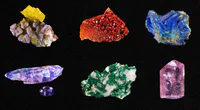
What are they? How are they made? What is defined as a mineral? How are they distributed?

2

media
media
media
media

It’s used in the production of hydrofluoric acid, carbon electrodes, toothpaste, and paint pigment.

​​Fluorite

Used in ceramics and glass; batteries; lubricating greases; rocket propellants; batteries; and medicine.

​​Lithium

Gold is used in jewelry and arts; medicine; medallions and coins; and scientific and electronic instruments.

​​Gold

It’s used primarily in aircraft engines, cutting tools, wear-resistant applications, chemicals, and permanent magnets

Cobalt

​Minerals in Every Day Life

3

A mineral is a naturally occurring solid that forms by inorganic processes, has a crystal structure, and a definite chemical composition.


**All 5 of these things must be true for something to be a mineral.**

The giant crystals here are a mineral called Selenite.

media

What is a mineral?

4

Multiple Choice

Question image

How many things must be true for something to be considered a mineral?

1

2

2

5

3

7

4

8

5

media
media

All minerals are substances that form from natural processes.

Selenite forms naturally from chemical elements as water evaporates.

Naturally Occurring

A mineral is always a solid, which means it has a definite volume and shape. The particles in a solid are tightly packed together.

Selenite is a solid

​​Solid

​The 5 Requirements to be a Mineral

6

media
media
media

Formed from materials that were NOT part of living things.

Selenite forms from sulfate evaporate from water.

Formed Inorganically

The particles inside a mineral line up in a repeating pattern. This repeating pattern forms a crystal.

Selenite has a crystal structure

Crystal Structure

A mineral always contains the same elements in the same amounts.

Selenite always has calcium, oxygen, sulfur, and hydrogen.

Definite Chemical Composition

​​The 5 Requirements to be a Mineral

7

Multiple Choice

Question image

The particles in a mineral line up in a repeating pattern. This pattern is called a(n):

1

Solid

2

Inorganic Chemical

3

Crystal

8

Multiple Choice

Question image

A mineral must be a _________.

1

Solid

2

Liquid

3

Gas

4

Any of the above.

9

10

Poll

Question image

Is salt a mineral?

Yes

No

11

media

Is salt a solid? YES!

Does salt occur naturally?
YES!

Is salt formed by inorganic processes?
YES!

Does salt have a crystal structure?
YES!

Does salt have a definite chemical composition?
YES!

Is salt a mineral?

12

Poll

Question image

Is pepper a mineral?

Yes

No

13

media

Is pepper a solid? YES!

Does pepper occur naturally?
YES!

Is pepper formed by inorganic processes? NO!!!

Does pepper have a crystal structure? NO!!!

Does pepper have a definite chemical composition? NO!!!

Is pepper a mineral?

14

Poll

Question image

Do you think ice is a mineral?

Yes

No

15

media

Is ice a solid? YES!

Does ice occur naturally?
YES!

Is ice formed by inorganic processes?
YES!

Does ice have a crystal structure?
YES!

Does ice have a definite chemical composition?
YES!

Is ice a mineral?

16

Categorize

Options (10)
Question image

Biotite

Question image

Gypsum

Question image

Sulfur

Question image

Graphite

Question image

Wood

Question image

Plastic

Question image

Glass

Question image

Ceramic

Question image

Rubber

Question image

Salt

Question image

Using the 5 things that are necessary to be a mineral, which of these are minerals and which are not?

Mineral
Not a Mineral
media

Minerals

What are they? How are they made? What is defined as a mineral? How are they distributed?

Show answer

Auto Play

Slide 1 / 16

SLIDE
