

weather and climate

Presentation
•
Geography
•
8th Grade
•
Practice Problem
•
Hard

Inyang Uffia
FREE Resource
12 Slides • 0 Questions
1

Weather And Climate
By
Inyang uffia
2

Difference Between Weather And Climate
• Weather reflects short-term conditions of the atmosphere while
climate is the average daily weather for an extended period of time
at a certain location.
3

Weather and climate cont.
4

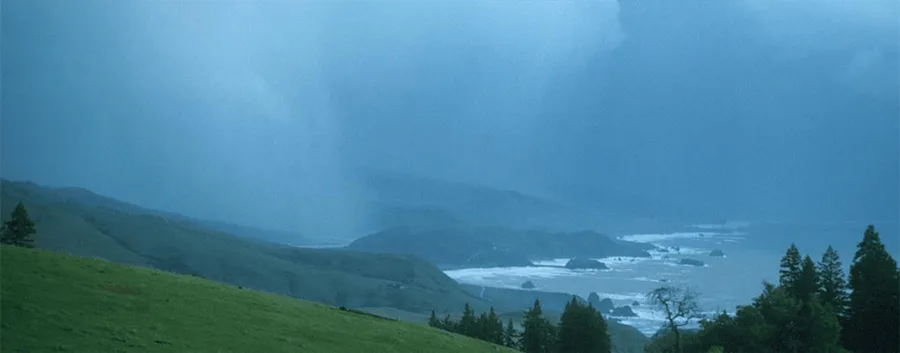
•A storm darkens the sky at the mouth of
the Russian River, north of Bodega Bay,
Calif. Weather can change from minute-
to-minute, hour-to-hour, day-to-day, and
season-to-season. Climate, is the
average of weather over time and space.
5

Weather Instruments
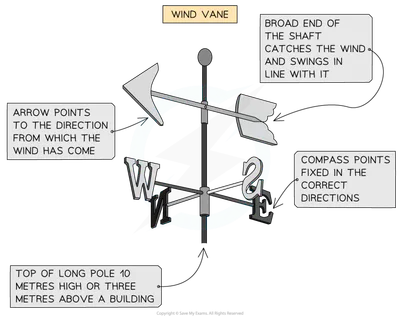
1). Wind direction
•
Wind direction is measured
with a wind vane
•
Direction is the compass
point from where the wind is
blowing - south, north, north-
east etc.
•
The unit of measurement for
wind direction is compass
direction
6
2). Wind speed
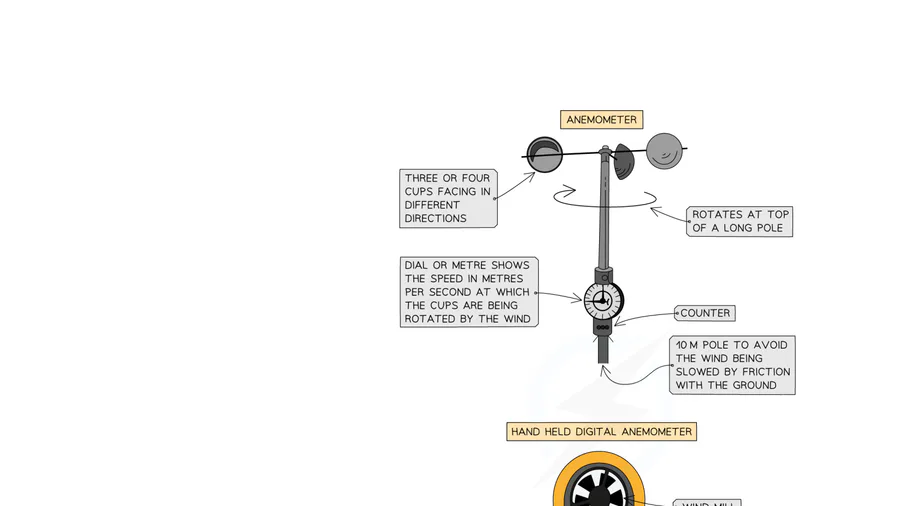
•Wind speed is measured with
an anemometer
•The unit of measurement for wind
speed is m/s or km/hr
•The anemometer consists of 3 or 4
cups fixed on metal arms that rotate
freely on a 10m vertical shaft
•The stronger the wind, the faster
the cups rotate, and more rotations
are recorded on the counter
7
Precipitation
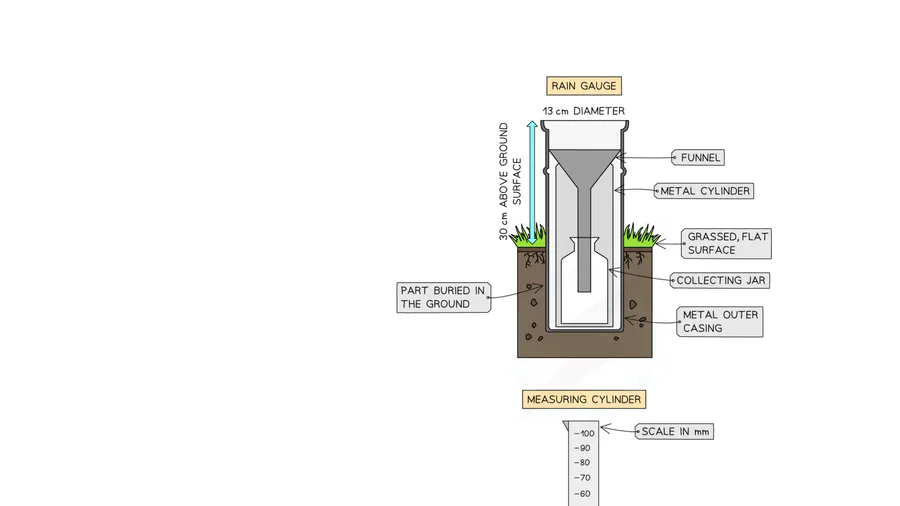
Precipitation is any water that falls to earth - hail,
mist, rain, sleet, or snow
•Unit of measure is millimetres (mm)
•A rain gauge is used to measure precipitation
•At the same time each day, any water that has
collected is poured into the tapered measuring
cylinder
•Measuring cylinder needs to be on a flat
surface
•The water level is then read with the eye at
the same level as the lowest part of
the meniscus of the water
•Measurements are then recorded; too small a
reading and it is recorded as 'trace'
8

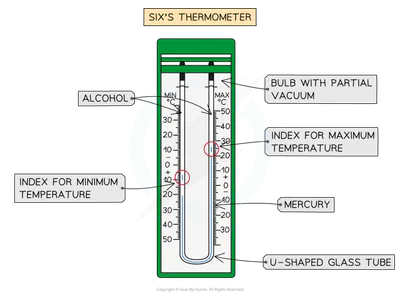
Temperature
•Unit of measurement is Celsius ° C, or
Fahrenheit ° F depending on where you are
in the world
•Temperature is measured using a
thermometer or thermograph
•Shade temperature is measured, as air
temperature is variable due to
direct insolation and cloud cover
•Several types of thermometers can be used,
but the most traditional is a Six's
thermometer, which houses a maximum
and minimum thermometer in a U shape
9

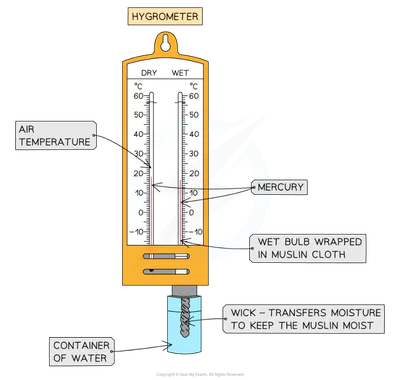
Humidity
Humidity is the amount of water
vapour in a given volume of air
•Wet and dry bulb thermometers are
used to measure relative
humidity and are called
a hygrometer
•Relative humidity is a measure of
how much water vapour the air is
holding in relation to the maximum
amount of water vapour it could
hold at a specific temperature
10

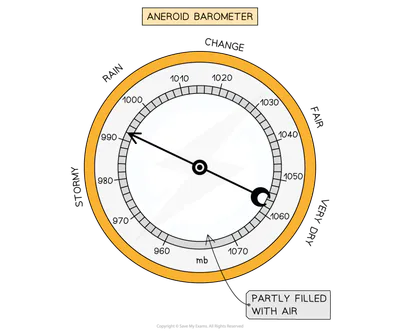
Pressure
•Air has weight and exerts pressure on the Earth's
surface
•Sea level pressure is approximately 1.03 kg/cm²
•Pressure varies with altitude and temperature
•Unit of measurement is millibars (mb)
•Lines of pressure on a map are called isobars
•A barometer measures air pressure of which there
are 3 types:
oMercury barometer
oAneroid barometer
oA barograph
11

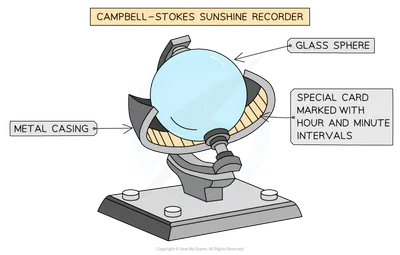
Sunshine hours
The amount of sunshine a place receives
is measured by a Campbell-Stokes sphere
in hours and minutes
•The recorder is a glass sphere partly
surrounded by a metal frame
•Sunlight is concentrated through the
sphere onto a recording card placed
beneath the focal point
•The rays burn a trace on the card
•The length of the trace shows the
sunshine duration at that location
At day's end, the card is replaced
12

Factors Affecting Climate
1. Latitude & Seasons; Imagine Earth like a tilted basketball basking in the sun's spotlight. The closer you are
to the equator (the bulge), the more direct sunlight you get, making it hotter. As you move towards the poles
(the ends), the sun's rays become slanting, spreading out the heat, and making it colder. This is why we have
scorching summers near the equator and chilly winters near the poles.
• 2. Continentality; Oceans act like giant heat sponges. They warm up slowly but hold onto that heat for
longer, like a cozy sweater in winter. Land, on the other hand, heats up quickly but cools down fast, like a t-
shirt on a summer day. So, coastal areas tend to have milder temperatures, while inland areas experience
more extreme heat and cold.
• 3. Altitude; The higher you climb, the cooler it gets! As air rises, it expands and cools down, just like how a
party balloon feels cold when inflated. This is why mountain tops are often snowy, even in summer!
• 4. Prevailing winds : Air Masses on the Move. Think of air masses as giant invisible blankets moving across
the Earth. They carry temperature and moisture, like warm comforters in winter or damp towels in summer.
When air masses meet, they can cause dramatic weather changes, like rain or storms.
• 5. Ocean Currents: Ocean currents are like rivers of warm and cold water flowing through the oceans. The
warm Gulf Stream, for example, brings mild winters to Europe, while the cold Humboldt Current keeps the
west coast of South America cool and dry.
Weather And Climate
By
Inyang uffia
Show answer
Auto Play
Slide 1 / 12
SLIDE
Similar Resources on Wayground

8 questions
Moon
Presentation
•
8th Grade
10 questions
Yo - Go Verbs
Presentation
•
8th Grade
10 questions
Net Forces Practice
Presentation
•
8th Grade
7 questions
fortnite
Presentation
•
8th Grade
13 questions
The Colonization of Africa
Presentation
•
8th Grade
8 questions
Mid-Term Review Social Studies Year 8
Presentation
•
8th Grade
9 questions
AEA Básico 1 - Reading 1
Presentation
•
8th Grade
9 questions
Components of the Universe
Presentation
•
8th Grade
Popular Resources on Wayground
10 questions
How much do you know about our Portrait of an Eagle?

Quiz
•
10th Grade
10 questions
Fast Food Slogans
Quiz
•
6th - 8th Grade
21 questions
Continents and Oceans
Quiz
•
6th Grade
20 questions
Parts of Speech
Quiz
•
5th Grade
16 questions
Subject & Predicate
Quiz
•
5th Grade
25 questions
Multiplication Facts
Quiz
•
5th Grade
12 questions
Map Skills
Quiz
•
3rd Grade
22 questions
Continents and Oceans
Quiz
•
5th Grade