
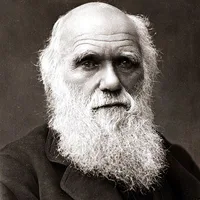
Unit 5-4 Darwin, Natural Selection, & Adaptations

Presentation
•
Science
•
12th Grade
•
Medium
+10
Standards-aligned

Abby Fancsali
Used 10+ times
FREE Resource
23 Slides • 16 Questions
1
DO NOW: Write what you think the example words mean in your lab manual.
Extra Credit: Find three additional words that use this root and write them and their definition in your lab manual (6 Points Max)

2
3


4
Multiple Choice

An organism’s genotype is its
genetic makeup.
feather color
physical appearance.
stem height.
5
Multiple Choice

What happens during meiosis?
Two sex cells combine
Chromosome pairs separate and are distributed into new sex cells.
Each sex cell copies itself to form four new chromosomes.
Chromosome pairs remain together when new sex cells are formed.
6
Multiple Choice

A purebred chicken with white feathers is crossed with a purebred chicken that has black feathers. Each of their offspring has both black and white feathers. Why does this happen?
Both alleles for feather color are codominant.
Both alleles for feather color are corecessive.
The alleles for feather color are neither dominant nor recessive.
Several alleles work together to determine the trait.
7
Describe some of the experiences that brought Darwin to his theory of Evolution
Explain how Natural Selection Results in Populations becoming adapted to their environments
Use Examples to describe different kinds of adaptations found in living organisms

8
History of Evolution
For thousands of years, People believed that life on Earth didn't change
The discovery of fossils helped show that some animals no longer existed, and others seemed to come into being
Fossil: The preserved remains or traces of a dead organism
By looking at fossils, we can see slow and gradual changes in a species over time

9
Lamarck
Jean Baptiste Lamark (1744-1829)
A French naturalist
Naturalist: Someone who studies the Natural world
One of the first to believe that modern species descended from ancestors that had evolved over time
Claimed that organisms gained traits during their lifetimes that they could pass on to their offspring

10
Charles Darwin
An English Naturalist
Traveled around the world on the HMS Beagle and collected samples from multiple continents
On his travels, Darwin noticed repeating patterns in all locations regardless of where they were located


11
What Darwin Observed: Diversity
Darwin noticed and recorded how much variety there was in living things
Different locations had organisms that looked somewhat similar but were vastly different from each other
Has similar body shapes, but different sizes, colors, and body parts
Species: a group of similar organisms that can mate with each other and produce fertile offspring
We know of 1.6 million species on Earth
Are still discovering more every day


12
What Darwin Observed: Fossils
As Darwin traveled he collected fossils
Noticed fossils that looked similar to living species, but had differences
Differences could be as minor as a difference in one or two bones
Differences could be as significant as being much larger in size


13
Multiple Choice

What are fossils?
Molds and Casts of Organisms that live today
drawings of ancient animals and other organisms
footprints or burrows of small animals that live today
the preserved remains or traces of organisms that lived in the past
14
Multiple Choice

A species is a group of similar organisms that
can mate with each other and produce fertile offspring.
can live together on an island.
can migrate to an island from the mainland.
all have exactly the same traits.
15
Dropdown
16
The Galápagos Islands
The Beagle made a stop in the Galápagos islands in the Pacific
A chain of Islands located off the coast of South America
Are close enough that storms can carry animals from the mainland to the islands
Contain one of the largest Varieties of Species in the World

17
Comparing The Galápagos to The Mainland
Darwin Compared organisms on the island to those on the Mainland
Animals on the island resembled those on the mainland but had some differences
Variation: A difference between members of the same species
Darwin theorized that the organisms on the island were related to those on the mainland
The organisms on the island somehow changed to make them different
18


The Galápogas Iguana
Has long, skinny Claws and feet for gripping tree branches
Bright Green Color to blend in with the trees
The South Ameican Iguana
Have short, thick claws and fat feet to reduce friction on slippery rocks
A darker color to blend in with the beach
Iguanas
19
Comparing The Islands to Each Other
Darwin compared organisms on one island to organisms on another island
Found that similar organisms on different islands still showed a great deal of change
One island had tortoises with dome shells, another had tortoises with more flat, saddle-shaped shells
People who lived on the islands could recognize where an organism came from just by looking at it

20
Darwin's Finches
Darwin studied the different birds that lived on all of the islands
When he studied them closely, he noticed they were all finches
They all had different beak shapes that matched the food available on the island
Birds that ate hard seeds had short, thick beaks
Birds that had sharp, pointy beaks atethe cacti's skin
He concluded that the finches all started out the same, but changed as they settled on each island
21
Adaptations
Adaptation: a trait that increases an organism's ability to survive and reproduce
Anything that gives an organism an advantage in getting food, protecting itself, or finding a mate

22
Darwin's Hypothesis
When comparing all his findings, Darwin concluded that organisms change over time
Evolution: The process of change over time
Darwin reasoned that when animals first arrived on the islands, the conditions were different from those on the mainland
When he looked at the fossil record, he found that recent fossils most resembled the organisms on the island while older fossils most resembled those on the Mainland
23
The Theory of Evolution
The Theory of Evolution
Over many generations, Species change to become better adapted to their conditions
Darwin published his findings in his Book On the Origin of Species in 1859
24
Multiple Choice

Differences between members of the same species are called
selections
variations
traits
predators
25
Multiple Select

Which of the following did Darwin observe on his voyages? (Select all correct answers)
Variations in organisms
Fossil Differences
Similar organisms in different locations
An organism changing its phenotype
26
Multiple Choice

An adaptation is a trait that helps an organism survive and
reproduce
evolve
grow
hide
27
Multiple Choice
The colors and feet of the two different iguanas are adaptations to their
Food
Predators
Habitat
Prey
28
Multiple Choice

_____________ is the gradual change in living things over long periods
Evolution
Petrification
Fossilization
Paleontology
29
Multiple Choice
True or false: Darwin made his observations on the Hawaiian Islands
True
False
30
Multiple Choice
Bird beaks having different shapes are an example of a(n)
Fossils
Adaptation
Habitat
Naturalism
31
Multiple Choice
Members of a species can mate with each other and produce...
Gene Pools
Fertile Offspring
Variation
adaptations
32
Natural Selection
Darwin proposed that evolution occurs by Natural Selection
Natural Selection: The process by which individuals that are better adapted to their environment are more likely to survive and reproduce than other members of the same species
Darwin identified several factors that influence the process of natural selection
Genetic Variation
Overproduction
Competition
Selection
33
Natural Selection Factors: Genetic Variation
Members of a species all have different traits that are inherited through genetics
Genetic Variation: Any difference in genes between individuals of the same species

34
Natural Selection Factors: Overproduction
Most species produce far more offspring than can possibly survive

35
Natural Selection Factors: Competition
Since resources are limited, individuals must compete to gain them
Does not necessarily involve physical fights
A fast organism can avoid a predator better than a slow one
Fitness: The number of offspring an individual can have over its lifetime
The better you are at competition, the more you can reproduce

36
Natural Selection Factors: Selection
Some variations make individuals better adapted to their environment
Those are the ones that survive, reproduce and pass on their genes to the next generation
Overtime, Helpful variations build up in a species and unfavorable ones disappear

37
Example of Natural Selection Australian Rabbits
In 1859, Rabbits were first introduced to the continent of Australia and quickly became a pest
In an attempt to control the population, the Australian Government released a myxoma virus into the rabbit population
killed 99.9% of rabbits
Some rabbits survived the virus and reproduced, and their offspring also resisted the disease

38
Multiple Select
Select all aspects of Natural Selection
Variation
Selection
Overproduction
Competition
Restriction
39
Dropdown
DO NOW: Write what you think the example words mean in your lab manual.
Extra Credit: Find three additional words that use this root and write them and their definition in your lab manual (6 Points Max)
Show answer
Auto Play
Slide 1 / 39
SLIDE
Similar Resources on Wayground

32 questions
Nucleosynthesis
Presentation
•
KG
33 questions
AP PSYCHOLOGY UNIT 1 SCIENTIFIC FOUNDATIONS
Presentation
•
12th Grade
34 questions
ES 2.2 LESSON What is Matter?
Presentation
•
12th Grade
32 questions
Detecting Blood Evidence
Presentation
•
12th Grade
34 questions
Module 10 Lesson_1_Work_and_Energy
Presentation
•
12th Grade
32 questions
Forensic Science Lesson 01: Intro to Forensic Science
Presentation
•
12th Grade
35 questions
Integumentary System Slides Review
Presentation
•
12th Grade
33 questions
Interactions of Trophic
Presentation
•
12th Grade
Popular Resources on Wayground
21 questions
Continents and Oceans

Quiz
•
6th Grade
20 questions
Parts of Speech
Quiz
•
5th Grade
16 questions
Subject & Predicate
Quiz
•
5th Grade
25 questions
Multiplication Facts
Quiz
•
5th Grade
12 questions
Map Skills
Quiz
•
3rd Grade
22 questions
Continents and Oceans
Quiz
•
5th Grade
15 questions
Rounding Decimals
Quiz
•
5th Grade
20 questions
Brand Labels
Quiz
•
5th - 12th Grade
Discover more resources for Science
7 questions
Newton's Laws Video Quiz

Interactive video
•
9th - 12th Grade
28 questions
Asexual vs. Sexual Reproduction
Quiz
•
9th - 12th Grade
19 questions
Understand Roles of Organisms in Food Chains
Quiz
•
9th - 12th Grade
10 questions
Understand Cell Functions and Organelles
Quiz
•
9th - 12th Grade
12 questions
Understand Organism Roles in Energy Transfer
Quiz
•
9th - 12th Grade
19 questions
Explore Macromolecules in Living Organisms
Quiz
•
9th - 12th Grade
25 questions
Ecology Review (9th grade biology)
Quiz
•
9th - 12th Grade
49 questions
APES Unit 1 Review
Quiz
•
12th Grade