Unit 8 Review AP Chem
Presentation
•
Chemistry
•
12th Grade
•
Easy
John Oglesby
Used 2+ times
FREE Resource
30 Slides • 40 Questions
1
Rules for Naming Branching Alkanes
1. Find the longest continuous chain (it does NOT have to be straight!)
CH3
|
CH3–CH2–CH–CH2–CH2–CH3
2
3
Rule 3
If there is more than one identical
substituent the number of
substituent is indicated by using
prefixes –di, –tri, –tetra and so on.
4
Rule 4
When two or more different
substituents are bonded to the
carbon chain, they are ordered
alphabetically.
5
Reorder
Sort the steps for naming alkanes.
Find the longest carbon chain
Number the carbon chain so substituents have lowest possible numbers
Identify the types of substituents
6
Multiple Choice
When writing names for organic compounds, commas separate....
numbers
names from numbers
7
Multiple Choice
When writing names for organic compounds, dashes separate....
8
Groups
Cl - chloro
Br - bromo
CH3 - methyl
C2H3C2H2- ethyl
9
Multiple Choice
What is the common name given to this alkyl branch?
Propyl
Methyl
Isopropyl
Ethane
10
Multiple Choice
Name the following alkane?
3-ethyl octane
2-ethyl hexane
3-ethyl heptane
5-ethyl heptane
11
Multiple Choice
Name the following alkane:
2-methyl pentane
1-methyl hexane
1,1-dimethyl pentane
1,2-dimethyl butane
12
Multiple Choice
Name the following alkane:
3-ethyl hexane
3-ethyl 2-methyl pentane
2-methyl 3-ethyl pentane
3-ethyl 4-methyl pentane
13
Multiple Choice
Name the following alkane:
2-methyl 3-methyl butane
1,1,2-trimethyl butane
2,3-dimethyl butane
2,3-dimethyl pentane
14
Multiple Choice
Which is the structures with IUPAC nomenclature
2,2,4-trimethylpentane
15
Multiple Choice
16
Multiple Choice
What is the correct name for the alkyne shown?
butyne
1-butyne
2-butyne
1-methyl-1-propyne
17
Multiple Choice
1-propene
2-propyne
18
19
20
21
22
23
24
The strength of intermolecular forces increases in the order of:
London dispersion forces < dipole-dipole forces < hydrogen bonding < ion-dipole forces.
These forces are responsible for many of the observable properties of liquids and solids, such as surface tension, viscosity, boiling point, and melting point.
25
Ion-dipole forces: These forces occur between an ion and a polar molecule, such as between sodium chloride (an ionic compound) and water (a polar molecule).
The attractive force between the ion and the dipole in the molecule results in a strong intermolecular force.
The strength of intermolecular forces increases in the order of London dispersion forces < dipole-dipole forces < hydrogen bonding < ion-dipole forces.
These forces are responsible for many of the observable properties of liquids and solids, such as surface tension, viscosity, boiling point, and melting point.
26
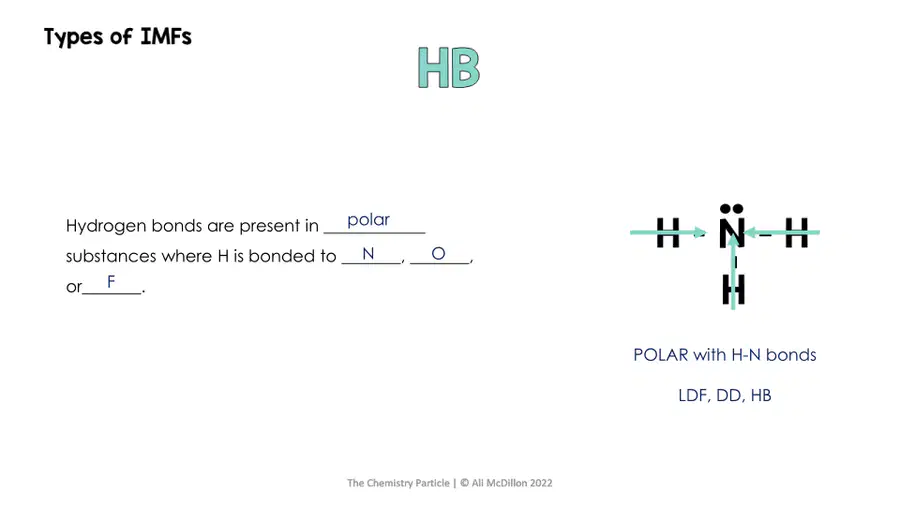
Hydrogen bonding:
This is a specific type of dipole-dipole force that occurs between a hydrogen atom bonded to an electronegative atom, such as nitrogen, oxygen, or fluorine, and a lone pair of electrons on a neighboring molecule.
Hydrogen bonding is responsible for many of the unique properties of water and other polar molecules.
27
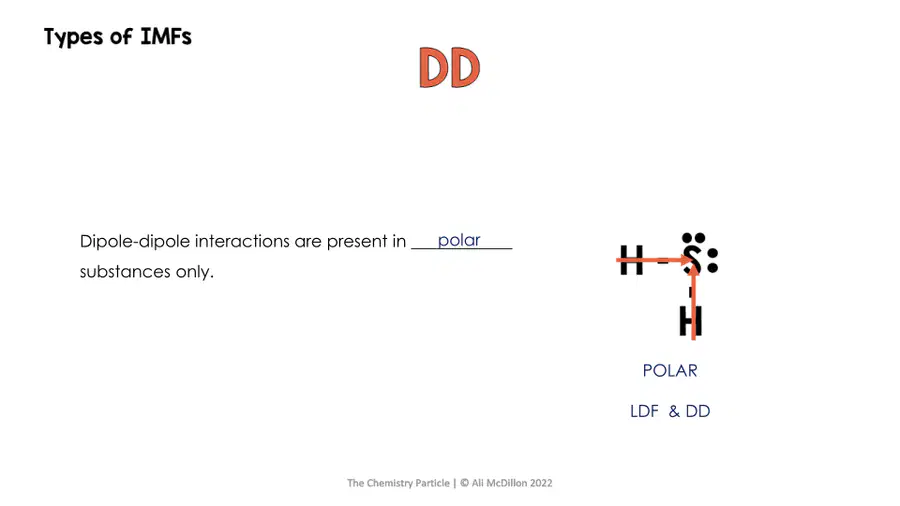
Dipole-dipole forces:
These forces arise between polar molecules that have a permanent dipole moment.
The partially positive end of one molecule is attracted to the partially negative end of another molecule, resulting in an attractive force between the molecules.
28
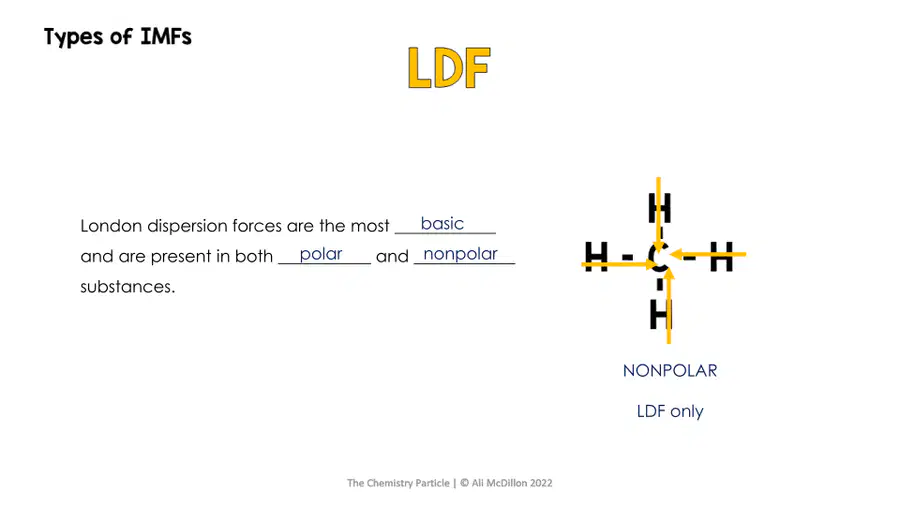
London dispersion forces:
These are the weakest type of intermolecular force, and they occur in all molecules, whether polar or nonpolar.
They arise from the temporary fluctuations in the electron distribution around a molecule, which causes a temporary dipole moment.
These temporary dipoles can induce similar dipoles in neighboring molecules, resulting in a weak attractive force between the molecules.
29
30
31
Match
Match the Following
Hydrogen Bond
London Dispersion Forces
Dipole- Dipole
Present in Polar involving N, O, F
Present in both Polar and Non Polar Molecules
Polar Substances only
Present in Polar involving N, O, F
Present in both Polar and Non Polar Molecules
Polar Substances only
32
33
34
35
Multiple Choice
Rank these in order of strength(highest to lowest):
covalent bond
London forces
hydrogen bond
dipole-dipole attraction
dipole-dipole>covalent bond>hydrogen bond>London
London>dipole-diple>hydrogen bond>covalent bond
covalent bond>hydrogen bond>dipole-dipole>London
hydrogen bond>dipole-dipole>London>covalent bond
36
Multiple Choice
What is the strongest intermolecular forces in the molecule?
Van der Waals Forces
Hydrogen bonds
Dispersion Forces
37
Multiple Choice
What is the strongest intermolecular forces?
Hydrogen bonds
Van der Waals Forces
Dipole-Dipole
38
Multiple Choice
Is the molecule polar or non-polar and what is the strongest intermolecular forces?
Polar- Van der Waals Forces
Non-Polar- Van der Waals Forces
Polar- Dipole-Dipole
Non-Polar- Dipole-Dipole
39
Multiple Choice
within molecules
between molecules
40
Multiple Choice
dipole dipole
H-bond
dispersion
metallic
41
Multiple Choice
dipole dipole
dispersion
H-bond
ionic
42
Multiple Choice
dipole dipole
dispersion
H-bond
ionic
43
Multiple Choice
yes
no
44
Multiple Choice
dipole dipole
H-bond
dispersion
metallic
45
Multiple Choice
yes
no
46
Multiple Choice
dipole dipole
dispersion
H-bond
ionic
47
Multiple Choice
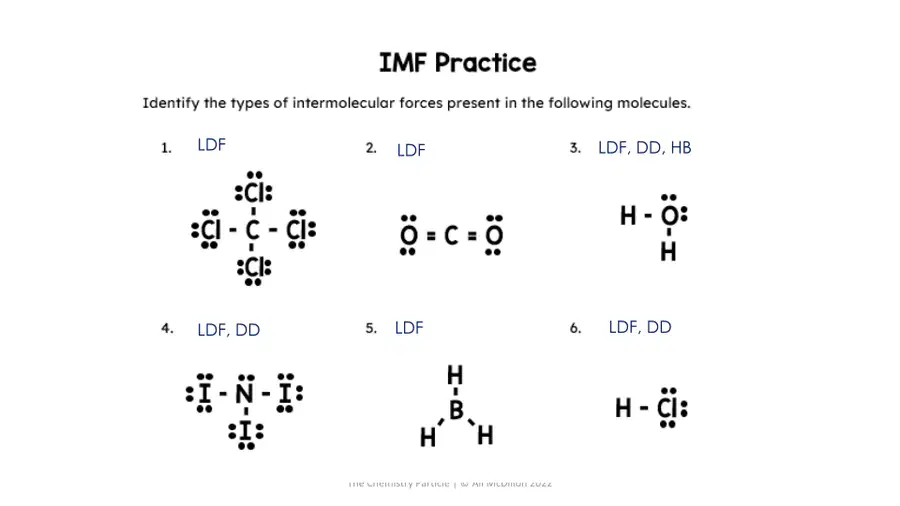
Intermolecular forces for: NH3
Dispersion Force
Dipole dipole
Hydrogen bonding
48
Multiple Choice
CaCl2
PH3
Cl2
N2
49
Multiple Choice
Xe
Kr
Ar
He
50
Multiple Choice
H2
NH3
N2
O2
51
Multiple Choice
CH3CH2OH
CH3OH
CH3CH3
52
Multiple Choice
Which substance would have the weakest intermolecular forces of attraction?
CH4
NaCl
H2O
MgF2
53
Multiple Choice
bond type
density
solubility
molecular polarity
54
Some text here about the topic of discussion.
A full heating curve looks like this
55
Some text here about the topic of discussion.
We need to be able to tell what phases are present, and what is happening, in each segment
56
Remember that temperature can go up ONLY when a single phase is present.
. . .
If more than one phase is present, the phase is changing, and rearranging particles takes up all of the energy
Some text here about the topic of discussion.
First, let's identify phases
Solid
Liquid
Vapor
57
Since substances melt at a lower temperature than they boil, the lower temp plateau is melting (solid + liquid); the higher is vaporization.
Some text here about the topic of discussion.
Recall that the flat segments were the surprising result in our experiment
Solid + liquid (melting)
liquid
+ vapor
(vaporization)
58
Multiple Choice
What phase(s) are present in segment (C)?
Solid only
Solid and liquid
Liquid only
Liquid and vapor
59
Multiple Choice
What phase(s) are present in segment (A)?
Solid only
Solid and liquid
Liquid only
Liquid and vapor
60
Multiple Choice
What phase(s) are present in segment (D)?
Solid and liquid
Liquid only
Liquid and vapor
Vapor only
61
Multiple Choice
What phase(s) are present in segment (B)?
Solid only
Solid and liquid
Liquid only
Liquid and vapor
62
Multiple Choice
What is happening in segment (C)?
melting
liquid heating up
vaporization
vapor heating up
63
Multiple Choice
What is happening in segment (E)?
melting
liquid heating up
vaporization
vapor heating up
64
65
66
67
68
69
Drag and Drop
Energy Change:
Molecular Order:
70
Drag and Drop
Energy Change:
Molecular Order:
Rules for Naming Branching Alkanes
1. Find the longest continuous chain (it does NOT have to be straight!)
CH3
|
CH3–CH2–CH–CH2–CH2–CH3
Show answer
Auto Play
Slide 1 / 70
SLIDE

Similar Resources on Wayground
66 questions
Recursamiento primer semestre
Presentation
•
12th Grade
64 questions
Review of Physical Science Content
Presentation
•
12th Grade
63 questions
Australian Food Systems
Presentation
•
12th Grade
68 questions
CE_101 Review of Lessons
Presentation
•
University
65 questions
CHEMICAL EQUATIONS AND REACTION TYPES
Presentation
•
University
65 questions
Lesson 1: Computer systems and system software
Presentation
•
12th Grade
64 questions
2.3.2 - L3 - Academic Writing
Presentation
•
12th Grade
66 questions
Blood
Presentation
•
12th Grade
Popular Resources on Wayground
20 questions
Math Review
Quiz
•
3rd Grade
15 questions
Fast food
Quiz
•
7th Grade
20 questions
Context Clues
Quiz
•
6th Grade
20 questions
Inferences
Quiz
•
4th Grade
19 questions
Classifying Quadrilaterals
Quiz
•
3rd Grade
20 questions
Figurative Language Review
Quiz
•
6th Grade
20 questions
Equivalent Fractions
Quiz
•
3rd Grade
10 questions
Identify Fractions, Mixed Numbers & Improper Fractions
Quiz
•
3rd - 4th Grade