

Unit 317 Session 4a Underfloor heating systems

Presentation
•
Mathematics
•
1st Grade
•
Easy

Plumbers Cymoedd
Used 5+ times
FREE Resource
15 Slides • 11 Questions
1
The working principles of underfloor central heating system pipework and components
As we have already seen, underfloor heating works by distributing heat in a series of pipes laid under the floor of a room.
To do this, certain components are required to distribute the flow of heat to ensure that the system warms the room.
This is achieved by the use of:
● manifolds
● a thermostatic blending valve
● a circulating pump
● various pipework arrangements to suit the floor and
its coverings
● the application of system controls – time and
temperature – to space heating zones.
2
The use of manifolds
In technical terms, the manifold is designed to minimise the amount of uncontrolled heat energy from the underfloor pipework.
The manifold is at the centre of an underfloor heating system.
It is the distribution point where water from the heat source is distributed to all of the individual room circuits, and as such, should be positioned as centrally in the property as possible.

Typical underfloor heating manifold
3
Room temperature is maintained via thermostatic motorised actuators on the return manifold whilst the correct flow rate through each coil is balanced via the flow meters on the flow manifold.
The thermostatic mixing (blending) valve
The thermostatic mixing or blending valve is designed to mix the flow and return water from the heat source to the required temperature for the underfloor heating circuits.
The circulating pump
The circulating pump is situated between the thermostatic mixing valve and the flow manifold to circulate the blended water through every circuit. Most models are variable speed.

Underfloor heating circulating pump/blending valve module
4
Underfloor heating pipework arrangements
The success of the underfloor heating system depends upon the installation of the underfloor pipework and the floor pattern installed.
There are many variations Underfloor heating pipework arrangements of pipe patterns based upon two main pattern types.
These are:
● the series pattern
● the snail pattern.
5
The series pattern
The series pattern (also known as the meander pattern) is designed to ensure an even temperature across the floor especially in systems incorporating long pipework runs.
It is often used in areas of high heat loss.

6
The snail pattern
The snail pattern (also known as the bifilar pattern) is used where an even uniform temperature is required such as under hardwood floors and vinyl floor tiles.

7
Multiple Choice

Can you name the underfloor heating pipework pattern shown in the picture?
Snail pattern
Series pattern
Snake pattern
Manifold pattern
8
Multiple Choice

Can you name the underfloor heating pipework pattern shown in the picture?
Snail pattern
Series pattern
Snake pattern
Manifold pattern
9
Pipework arrangements (cabling)
There are many variations to these two basic layouts.
The pattern should be set out in accordance with the orientation and the shape of the room.
Window areas may be colder and may require the bulk of the heat in that area.
Other considerations include the type of floor construction and the floor coverings.
The pipework should be laid in one continuous length without joints.
It is recommended that no loop should exceed 100 m.

10
Solid floor
There are many types of underfloor heating installation techniques for a solid floor.
The drawing above shows one of the more common types using a plastic grid where the underfloor heating pipe is simply walked into the premade castellated grooves. Another popular method is the use of plastic clips/staples.

11
12
Research task
13
Open Ended
Research how we install underfloor heating in suspended timber floors, please use images to back up your work.
14
15

As seen in the video, installation under a poured screed floor is the most common method of underfloor heating, however there are methods that allow installation under Suspended timber floors.
16
Suspended timber floor
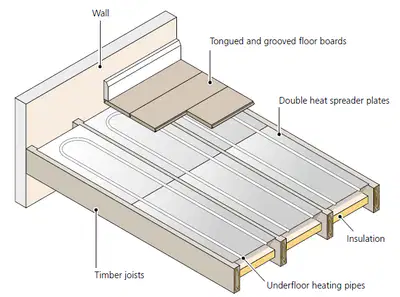
This system is designed for use under timber suspended floors. It uses aluminium double heat spreader plates to transmit heat evenly across the finished floor surface.
This system is suitable for any timber suspended floor with joist widths up to 450 mm.
The heat plates are simply fixed to the joists using small flat headed nails or staples.
A layer of insulation must be placed below the plates to prevent the heat penetrating downwards.
Where the pipework must cross the joists, the joists must be drilled in accordance with the Building Regulations.
17
Multiple Choice
What is the central distribution point where water from the heat source is distributed to individual room circuits in an underfloor heating system?
Thermostatic blending valve
Circulating pump
Manifold
Pipework arrangements
18
Multiple Choice
The purpose of the thermostatic mixing (blending) valve in an underfloor heating system is to:
Mix the flow and return water for the heat source
Control the room temperature
Circulate water through every circuit
Balance the flow rate
19
Multiple Choice
The success of an underfloor heating system depends on:
The type of floor construction
The floor pattern installed
The circulating pump model
All of the above
20
Multiple Choice
Which pattern type is designed to ensure an even temperature across the floor, especially in systems with long pipework runs?
Series pattern
Snail pattern
Serial pattern
Bifilar pattern
21
Multiple Choice
The snail pattern is often used under which types of floor coverings?
Hardwood floors
Ceramic tiles
Carpeted floors
Suspended floors
22
Multiple Choice
What is the recommended maximum length for an underfloor heating loop?
50 m
75 m
100 m
150 m
23
Multiple Choice
For timber suspended floors, what is used to transmit heat evenly across the finished floor surface?
Plastic clips
Castellated grooves
Aluminium double heat spreader plates
Plastic grid
24
Multiple Choice
What must be placed below the heat spreader plates in a timber suspended floor to prevent heat penetration downwards?
Insulation
Vapor barrier
Joists
Radiant barrier
25
Using the drawing given (Also on the next slide)
Draw a suitable underfloor layout, remember you cannot cross pipework runs.
The manifold is to be installed in the 1m² 'St' area near the centre of the bungalow.
Once you have designed the pipework layout, produce an estimate for the system including the manifold and all required components.
Assume the pipework feeding the manifold is already present.
26

The working principles of underfloor central heating system pipework and components
As we have already seen, underfloor heating works by distributing heat in a series of pipes laid under the floor of a room.
To do this, certain components are required to distribute the flow of heat to ensure that the system warms the room.
This is achieved by the use of:
● manifolds
● a thermostatic blending valve
● a circulating pump
● various pipework arrangements to suit the floor and
its coverings
● the application of system controls – time and
temperature – to space heating zones.
Show answer
Auto Play
Slide 1 / 26
SLIDE
Similar Resources on Wayground

21 questions
Interpret Data
Presentation
•
1st Grade
22 questions
Similar Figures, find scale factor and solve for missing sides
Presentation
•
KG
16 questions
Compare 2-Digit Numbers
Presentation
•
1st Grade
21 questions
Oro A1 Entrance Test
Presentation
•
KG
21 questions
Go Math Chapter 10
Presentation
•
1st Grade
19 questions
Money Review
Presentation
•
KG
19 questions
Counting Money and Change
Presentation
•
KG
19 questions
Learning to Count Money
Presentation
•
KG
Popular Resources on Wayground
21 questions
Continents and Oceans

Quiz
•
6th Grade
20 questions
Parts of Speech
Quiz
•
5th Grade
16 questions
Subject & Predicate
Quiz
•
5th Grade
25 questions
Multiplication Facts
Quiz
•
5th Grade
12 questions
Map Skills
Quiz
•
3rd Grade
22 questions
Continents and Oceans
Quiz
•
5th Grade
15 questions
Rounding Decimals
Quiz
•
5th Grade
20 questions
Brand Labels
Quiz
•
5th - 12th Grade
Discover more resources for Mathematics
15 questions
Addition and Subtraction
Quiz
•
1st Grade
20 questions
Addition and Subtraction facts
Quiz
•
1st - 3rd Grade
20 questions
Place Value
Quiz
•
KG - 3rd Grade
10 questions
Fact Families
Quiz
•
1st Grade
15 questions
Place Value tens and ones
Quiz
•
1st Grade
20 questions
Telling Time to the Hour and Half hour
Quiz
•
1st Grade
15 questions
Addition and Subtraction Facts
Quiz
•
1st - 2nd Grade
10 questions
Exploring Forces in 5th Grade Science

Interactive video
•
1st - 5th Grade