
5-6: Evidence of Evolution

Presentation
•
Science
•
12th Grade
•
Medium
+6
Standards-aligned

Abby Fancsali
Used 9+ times
FREE Resource
27 Slides • 18 Questions
1
DO NOW: Write what you think the example words mean in your lab manual.
Extra Credit: Find three additional words that use this root and write them and their definition in your lab manual (6 Points Max)

2
3

4
Multiple Choice

True or false: Darwin made his observations on the Galapagos Islands
True
False
5
Multiple Choice

Members of a species can mate with each other and produce...
Gene Pools
Fertile Offspring
Variation
Adaptations
6
Multiple Select
Select all aspects of Natural Selection
Variation
Selection
Overproduction
Competition
Restriction
7
Multiple Choice

Bird beaks having different shapes is an example of a(n)
Fossils
Adaptation
Habitat
Naturalism
8

List and provide examples of the main kinds of Evidence that support the Theory of Evolution
Describe how Fossils form
Differentiate between different kinds of fossils
Discuss what Fossils tell us about organisms and environments of the past and support the theory of evolution
9
Evolution as A Scientific Theory
Evolution is considered to be a scientific theory
Recall: A theory is a collection of well-tested and consistent hypotheses
There are multiple different ways the theory of evolution is supported
8 broad categories
10
Observations of Natural Selection in Action
We can observe how a species changes over time, and see natural selection as it occurs
Recall: our Australian Rabbits evolved to resist a natural virus
Bacteria provide the fastest way to see selection pressures
Antibiotic Resistance can be "selected for" in a population and become the most frequent trait


11
Artificial Selection
Artificial Selection: The selective breeding of organisms with desirable traits to obtain desirable traits
Humans put selective pressure on a population rather than nature
This can result in drastic changes
Examples:
Agricultural Breeds
Dogs


12
Darwin's Pigeons
When he returned to England, Darwin looked to support his theory by studying domesticated animals
Darwin bred pigeons to have fan-shaped tails
Only would breed individuals with the shape he wanted
Some additional characteristics would still be passed on, like the number of feathers
Over time, all the pigeons born from his breeding had more feathers than those he let breed normally

13
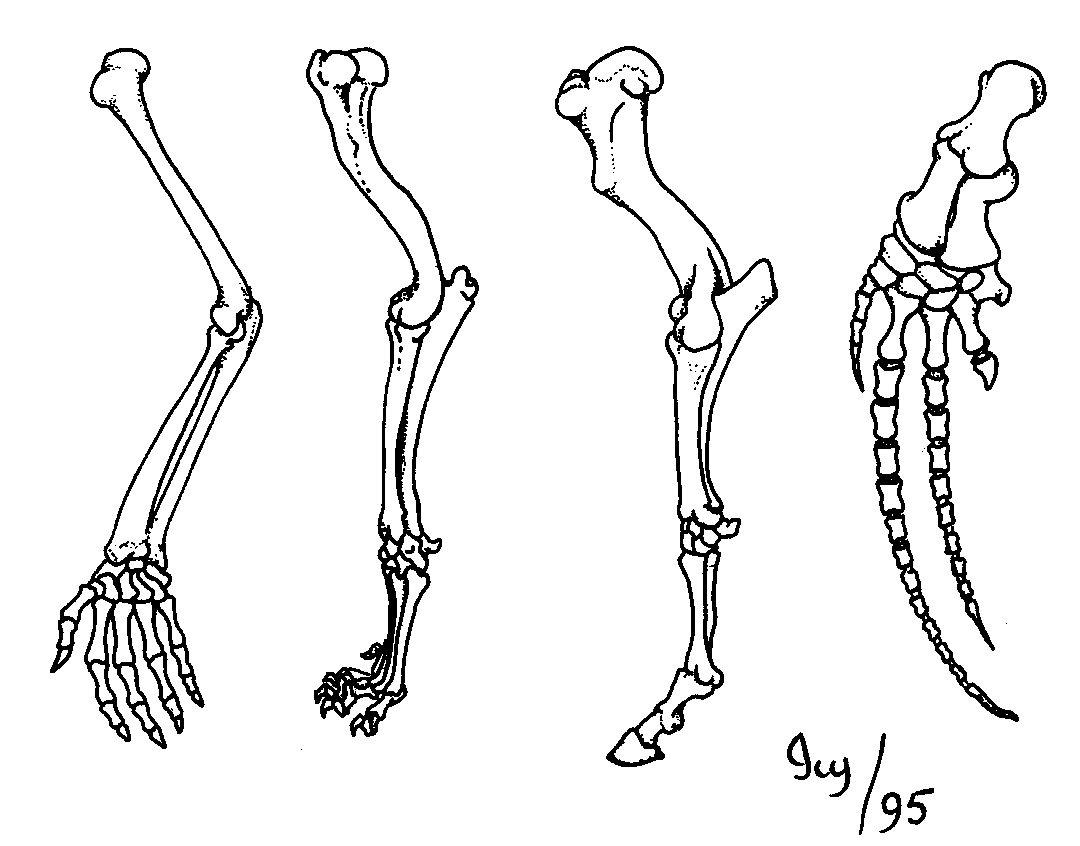
Similarities in Body Structure
When we Observe the body structures of different organisms we see a lot of repeating patterns
Example: Arms in mammals follow a one-bone, two-bone, many bones, finger pattern
If all these organisms had originated independently, the bone structures would be more specialized to the function of the limb
It instead seems the structure was inherited from a common ancestor

14
Homologous Structures
Homologous structures: Similar structures that related species have inherited from a common ancestor
Fossils are the main way of identifying homologous structures
Looking at extinct species can help show where a trait first appeared

15
Vestigial Organs
Vestigial Organs: Organs in an organism that are not functional, but remain from a previous ancestor
Examples
Snakes have very tiny incomplete leg bones
Many species that live in dark caves still have eyes, even though they cannot see
Humans have a coccyx (tail bone) that remains from ancestors with tails


16
DNA & Molecular Evidence
Closely related species have similar DNA Nucleotides
The more closely related, the more nucleotides in common
Noncoding regions are also common, which indicates that they would come from a shared ancestor
Noncoding regions are not selected for, and it is unlikely so many species would randomly develop the exact same ones without a common ancestor
17
Multiple Choice

Which of the species listed is the most distantly related to the horse?
Donkey
Rabbit
Snake
Turtle
18
Multiple Choice
Scientists infer that species with similar body structures and development patterns had a common
Environment
Predator
Ancestor
Gene
19
Multiple Choice
Only organisms with a desired characteristic are bred by people in
Artificial Selection
Natural Selection
England
South America
The Galapagos
20
Patterns of Development
Related Species go through many of the same developmental stages
All animals start as a single cell organism
The Earliest stages of development look very similar for most organisms
Have a tail
Have gill slits near the throat
These indicate that we all started from the same common ancestor and are related

21
Hierarchical Organization of Living Things
When we look at different organisms, we can put them into groups
Example: Vertebrates have a backbone
We can then further divide groups into smaller groups that share specific adaptations
The more closely related species are, the more traits they have in common

22
Biogeography
Biogeography: The study of how species are distributed on Earth
Biogeography tends to be consistent with evolution
Organisms evolved in a certain place and left descendants in places where they were
Not all locations with the same habitat types have the same organisms

23
Multiple Choice
Scientists infer evolutionary relationships by comparing the early development of different
dinosaurs
backbones
proteins
organisms
24
Multiple Choice
25
Multiple Choice

26
Multiple Choice

Which of the following can be determined by observing the embryos shown in the diagram
27
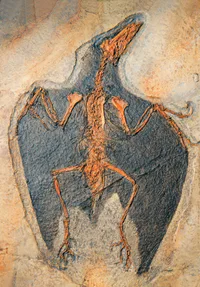
What are Fossils?
Fossil: the preserved remains or traces of living things
Includes things like:
Bones
Teeth
Imprints


28
How do Fossils Form?
Most Fossils form when living things die and are buried by sediment
Are found in or near still water where sediment builds up
After an organism dies, the soft tissue decays quickly or gets eaten
Usually only hard tissues remains
Over time, sediment covers the organism in layers and hardens into rock

29
What are the different kinds of Fossils?
Different kinds of of fossils include
Molds and Casts
Petrified Fossils
Carbon Films
Trace Fossils
Preserved Remains

30
Molds & Casts
The most common types of fossils
Preserve the fine details of the organisms (Textures, shapes)
Mold: a hollow area in sediment in the shape of an organism
Forms when the organism is buried in sediment
Just an imprint
Cast: A solid copy of the shape of an organism where sediment fills in spaces
Shows all the fine details

31
Petrified Fossils
Petrified: turned to stone
In petrified fossils, minerals replace all or part of an organism
water seeps into the cells, carrying minerals
Eventually water evaporates and the minerals are left behind, taking the form of the organism
Are usually plants or bones

32
Carbon Films
An extremely thin layer of carbon is left behind of an organism
While other sediment is removed, the carbon leaves a flat image behind
Preserves the most delicate details of organisms
Shows the outer details of an organism


33
Trace Fossils
Show activities of an organism
Foot prints
Nests
Scat
Can reveal what an organism did and ate


34
Preserved Remains
Preserve the entire organism
Freezing in ice
Trapped in amber
Amber: Hardened tree sap
Tar Pits


35
Answering The Jurassic Park Question
It isn't possible to retrieve DNA from remains in Amber
While some tissue remains, the DNA degrades over time
Frozen Fossils do preserve some DNA, but it is extremely difficult to extract
DNA degrades as the fossil thaws
Wooly Mammoth DNA has been preserved
2021: Scientists believe they may have successfully retrieved DNA from a frozen dinosaur
tests remain inconclusive as to whether it is true Dinosaur DNA


36
Multiple Choice
A __________ fossil can form when sediment buries the hard tissues of an organism.
mold/cast
Trace
Carbon Film
Petrified
37
Multiple Choice
A __________ fossil forms when minerals replace parts of an organism
mold/cast
Trace
Carbon Film
Petrified
38
Multiple Choice
Which of the following can you learn from a carbon film fossil?
How an organism behaved
What an organism ate
Fine Details of an organisms body
The bone structure of an organism
39
Multiple Choice
Which of the following substances is not able to preserve entire organisms?
Tar
Water
Amber
Ice
40
What do Fossils show?
Paleontologists: Scientists who study fossils
Paleontologists gather information into the Fossil Record
Provides evidence about the history of life and past environments on Earth
Helps show how organisms have changed over time

41
Fossils and Past Environments
The types of fossils found in an area can tell what the area was like in the past
Can tell if a location was under water or on land
Can distinguish between fresh and salt water
Can show the previous climates of area
Antartica has coal deposits, which only form in warm climate
42
Change and the Fossil Record
Looking through the fossil record, changes in species can be seen
Organisms become more complicated in subsequent generations
Older rocks have simpler organisms, while newer rock has more complex organisms
Extinct: a type of organism no longer exists and will no longer reproduce on Earth
This can occur due to different factors like environmental changes
Fossils help scientists construct models of what extinct organisms could have looked like
43
Multiple Choice
44
Multiple Choice
This is the sort of scientist who studies fossils/
Geologist
Evolutionist
Paleontologist
Fossilist
45
Multiple Choice
_____________ is the gradual change in living things over long periods
Evolution
Petrification
Fossilization
Paleontology
DO NOW: Write what you think the example words mean in your lab manual.
Extra Credit: Find three additional words that use this root and write them and their definition in your lab manual (6 Points Max)
Show answer
Auto Play
Slide 1 / 45
SLIDE
Similar Resources on Wayground

43 questions
Atoms Lesson
Presentation
•
KG
38 questions
Primates Intro
Presentation
•
12th Grade
40 questions
Newton's Third Law
Presentation
•
11th Grade
40 questions
Work and Power
Presentation
•
KG
40 questions
CCU6.B Ionic Formulas
Presentation
•
12th Grade
42 questions
Origin of the Universe
Presentation
•
11th Grade
40 questions
Fossil Fuels
Presentation
•
11th Grade
37 questions
Connective Tissues
Presentation
•
11th - 12th Grade
Popular Resources on Wayground
10 questions
How much do you know about our Portrait of an Eagle?

Quiz
•
10th Grade
10 questions
Fast Food Slogans
Quiz
•
6th - 8th Grade
21 questions
Continents and Oceans
Quiz
•
6th Grade
20 questions
Parts of Speech
Quiz
•
5th Grade
16 questions
Subject & Predicate
Quiz
•
5th Grade
25 questions
Multiplication Facts
Quiz
•
5th Grade
12 questions
Map Skills
Quiz
•
3rd Grade
22 questions
Continents and Oceans
Quiz
•
5th Grade
Discover more resources for Science
22 questions
Periodic Table Review
Quiz
•
9th - 12th Grade
7 questions
Newton's Laws Video Quiz

Interactive video
•
9th - 12th Grade
17 questions
Unit 3A: Cells Vocab
Quiz
•
9th - 12th Grade
89 questions
Unit 1 (Ch 2 & 3) Test Review - Water/Ocean Currents
Quiz
•
9th - 12th Grade
58 questions
Biomolecule Test Corrections
Quiz
•
9th - 12th Grade
20 questions
Unit 2: Cell Energy Review
Quiz
•
9th - 12th Grade
17 questions
Explore Newton's Laws of Motion
Quiz
•
8th - 12th Grade
35 questions
Directional Terms, Body Cavities, Body Planes
Quiz
•
11th - 12th Grade