

Use of Participles and The Active and Passive Voice

Presentation
•
English
•
6th - 8th Grade
•
Practice Problem
•
Hard
+10
Standards-aligned

Ankyrin Quizizz
FREE Resource
11 Slides • 9 Questions
1

Use of Participles and The Active and Passive Voice
2
What are Participles?
A Participle is a form of a verb that can do the job of an adjective and also helps form certain verb tenses.
Present Participle: Formed by adding '-ing' to the base verb. Used to describe ongoing actions or conditions.
Examples: running, swimming, laughing
Past Participle: Typically ends in -ed, -d, -t, -en, or -n for regular and irregular verbs. Used to describe completed actions or states.
Examples: walked, burnt, chosen, seen

3
The Participle as Adjectives
As an adjective, the Participle can be used in the following manner:
The sinking ship.
The burning house.
The decorated hall.
The copied idea.


4
Multiple Choice

Fill in the blank in the following sentence, by choosing the participle from the options :
The __________ saucer was seen near our house yesterday.
fly
flying
flew
flown
5
Fill in the Blanks

Fill in the blank with the right participle to complete the sentence.
The students found the lesson
6
The Participle is different from the Gerund
Never get confused between the Participle and the Gerund.
Participles function as adjectives, modifying nouns or pronouns. They can describe the characteristics or states of nouns and can be found in various verb tenses.
Gerunds function as nouns. They can act as subjects, objects, or the complement of a sentence, essentially fulfilling any role that a noun can perform.
7
Drag and Drop
A
8
Reorder

Reorder the following jumbled words to create a sentence with a participle.
The
broken
window
looks
bad
9
Let us Summarize
Participles are formed from verbs by adding suffixes such as 'ing', 'ed', 'd', or 'en'.
These participles primarily function as adjectives to modify nouns or pronouns in sentences.

10
The Active Voice
In the English language, there are two voices- The Active voice and the Passive voice. Let us explore the Active Voice:
In the Active Voice, the noun or the pronoun is the doer of the action.
Example:
The leopard killed the deer yesterday.
The woodcutter cuts trees.

11
The Passive Voice
In the Passive Voice, subject takes the place of the object, and the object takes the place of the subject:
Example:
Active voice
The woodcutter cuts trees every day.Passive voice
Trees are cut by the woodcutter every day.
(The tree which is the direct object in the Active voice, takes the place of the subject in the Passive voice).

12
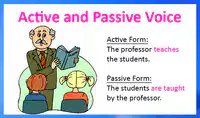
The rules of Active Voice and Passive Voice
Here are the different structures of both, the Active Voice and the Passive Voice types:
Active Voice: Subject + Verb+ Object
The subject is the performer of the action.
Passive Voice : Object (from active voice) + Form of "to be" + Past Participle of Verb + (optionally) "by" + Subject (from active voice)
In the Passive voice format, the subject receives the action.
13
Differences between Active Voice and Passive Voice
Active Voice | Passive Voice |
|---|---|
The subject of the sentence is the doer of the action. | The subject is 'acted upon' by the action. |
The verb can be used straightaway; it does not require an auxiliary verb. | The verb requires an auxiliary verb. |
In the active voice, the subject takes responsibility for the action | In the passive voice, the object of the active voice takes the position of the subject. |
14
15
Multiple Choice
Choose the correct word from the options that transforms the active voice sentence to its passive voice:
The dog ate the bone.
The bone was eaten by the dog.
The bone ate the dog.
The dog is eating the bone.
The dog was eaten by the bone.
16
Fill in the Blanks
Fill in the blank in the sentence below, by writing the correct form of the verb in brackets :
A delicious cake was (bake)
17
Drag and Drop
My uncle
18
Multiple Choice

Select the correct option for the passive voice form of the sentence below:
The aliens healed the earth.
The earth was healed by the aliens.
The earth was healing by the aliens.
The earth healed the aliens.
The aliens healed the aliens.
19
Match
Classify each of the following sentences as either "Active Voice" or "Passive Voice":
The teacher assigns homework every Friday.
Homework is assigned by the teacher every Friday.
A mysterious figure opened the ancient tomb.
The ancient tomb was opened by a mysterious figure.
Active Voice
Passive Voice
Active Voice
Passive Voice
Active Voice
Passive Voice
Active Voice
Passive Voice
20
Let us Summarize
In the Active Voice, the structure is Subject + Verb + Object.
In the Passive Voice, the structure is Object + Form of 'to be' + Past Participle of Verb + (by + Subject).
Use of Participles and The Active and Passive Voice
Show answer
Auto Play
Slide 1 / 20
SLIDE
Similar Resources on Wayground

13 questions
Making Inferences & Predictions
Presentation
•
6th - 8th Grade
12 questions
Editing and Revising
Presentation
•
6th - 8th Grade
14 questions
Greek and Latin Roots
Presentation
•
5th - 8th Grade
15 questions
Concrete and Abstract Nouns
Presentation
•
6th - 8th Grade
14 questions
Agreement of Subject and Verb
Presentation
•
6th - 8th Grade
15 questions
Objective Summary
Presentation
•
7th Grade
13 questions
Greek & Latin Roots: aqu/hydr/aer
Presentation
•
6th - 8th Grade
16 questions
ELPAC Reading Practice #3: Student Essay
Presentation
•
6th - 8th Grade
Popular Resources on Wayground
6 questions
PRIDE Always and Everywhere
Presentation
•
12th Grade
20 questions
Lab Safety Quiz

Quiz
•
6th Grade
26 questions
KOR Review Kahoot Questions
Quiz
•
8th Grade
21 questions
Continents and Oceans
Quiz
•
6th Grade
12 questions
Unit Zero lesson 2 cafeteria
Presentation
•
9th - 12th Grade
20 questions
Parts of Speech
Quiz
•
5th Grade
10 questions
Riddles Riddles fun Riddles
Quiz
•
6th - 12th Grade
16 questions
Subject & Predicate
Quiz
•
5th Grade
Discover more resources for English
20 questions
Context Clues
Quiz
•
6th Grade
20 questions
Types of sentences
Quiz
•
6th Grade
8 questions
Main Idea & Key Details
Quiz
•
3rd - 6th Grade
20 questions
Figurative Language Review
Quiz
•
6th Grade
20 questions
Figurative Language Review
Quiz
•
8th Grade
12 questions
Plot Elements
Quiz
•
6th Grade
20 questions
Homophones and Homonyms
Quiz
•
6th Grade
25 questions
Making Inferences
Quiz
•
6th - 8th Grade