


Science Review
Presentation
•
Science
•
7th Grade
•
Easy
AMBER CAVAZOS
Used 6+ times
FREE Resource
9 Slides • 51 Questions
1
2
Internal Stimuli- inside feeling or need.
Examples:
-Getting a drink when you feel thirsty
-If you are exercising, then you breathe faster to feed more oxygen to your muscles.
-If you consume too much liquid (stimulus), then you have to urinate frequently (response).
-If you are hungry (stimulus), then you eat (response).
Internal Stimuli
3
External Stimuli-changes in the organism's environment.
Examples:
-An animal is cold, so it moves into the sunlight
-You touch something hot (stimulus), so you move your hand away (response).
-You eat spoiled food (stimulus), so you get sick (response).
-If in a stressful situation (stimulus), then you will fight for survival or flee for survival (response).
4
Multiple Choice
Changes in the organism's environment.
Internal Stimuli
External Stimuli
5
Multiple Choice
Inside feeling or need.
Internal Stimuli
External Stimuli
6
Multiple Choice
Which of the following is an external stimulus?
Bacterial infection
Hunger
Temperature of environment
Thirst
7
Multiple Choice
Which of the following is an internal stimulus?
Presence of food
Being hungry (lack of nutrients)
Predator nearby
Hot temperature
8
Multiple Choice
9
Multiple Choice
Green plants use sunlight to make their own food in the form of glucose. This process, known as photosynthesis, is an example of which of the following energy conversions?
Radiant energy to chemical energy
Sound energy to radiant energy
Chemical energy to mechanical energy
Mechanical energy to thermal energy
10
Multiple Choice
When a plant performs photosynthesis, the radiant energy from the Sun is -
transported into the soil through the roots
used up in the process
released into the atmosphere
transformed into chemical energy
11
Multiple Choice
This example for
Internal stimuli
Light stimuli
Tough stimuli
Temperature stimuli
12
Multiple Choice
13
Multiple Choice
Phototropism is a response to ________.
light
gravity
touch
water
14
Multiple Choice
Hydrotropism is a response to ________.
light
gravity
touch
water
15
Multiple Choice
Gravitropism is a response to ________.
light
gravity
touch
water
16
Multiple Choice
Thigmotropism is a response to ________.
light
gravity
touch
water
17
Multiple Choice
To what order does a two pairs of wings, rigid and leathery and mouth for sucking belong to?
Diptera
Lepidoptera
Heteroptera
Coleoptera
18
Multiple Choice
You found a cone that was large with needles in groups of 2 or more, what did you find?
Juniper
Pine
Spruce
Fir
19
Multiple Choice
Which organelle is responsible making food (Glucose) using sunlight?
Cell Membrane
Nucleus
Chloroplast
Mitochondria
20
21
22
Multiple Choice
A ___ change causes the substance to change to a new substance with different properties.
Physical
Chemical
23
Multiple Choice
A ____ change only changes the look of the substance but NOT the chemical make-up.
Physical
Chemical
24
During a physical change, substances are NOT altered chemically.
They change from one state of matter to another.
Or, they separate or combine without breaking or making bonds.
Mixtures can be separated based on the physical properties of their components.
Making and separating mixtures are examples of a physical change.
What is a physical change?
25
The substance can change between the states of matter. For example, changing from a liquid to a solid or gas.
Change in state of matter
The size the substance is altered to make it bigger or smaller. The shape can also be altered. For example, cutting wood, ripping paper, squeezing a sponge.
Change in size or shape
Any change made can be easily undone allowing the substance to return to its original form. For example, an ice cube that melts can be refrozen.
Change is reversible
26
During a chemical change, a substance combines in a chemical reaction to form one or more new substances with different chemical and physical properties.
A chemical reaction is a process by which the atoms of one or more substances are rearranged to form different substances
The rate of the chemical reaction is affected by temperature, pressure, the concentration of the reactants, and the state of matter.
What is a chemical change?
27
Reactions may either produce or absorb heat.
If heat is absorbed this is an endothermic reaction.
If heat is released this is an exothermic reaction.
Change in energy
A reaction may produce a solid substance called a precipitate or release gas.
If gas is produced it can be seen as bubbles or effervescence (fizzing).
Production of a new substance
During a reaction, light is sometimes produced.
It can be released in a flash or slowly. For example the chemicals in a glow stick.
Production of light
28
Fill in the Blanks
Type answer...
29
Fill in the Blanks
30
Multiple Choice
What is an example of a chemical change that happens inside your body?
Carbohydrates being broken down by acids in your stomach.
Food being broken down into small pieces by your teeth.
Your food shape changes as it is chewed
Water is absorbed back into body inside your large intestine.
31
Multiple Choice
A change in the state of matter ...
Chemical Change
Physical Change
32
Multiple Choice
What is considered a chemical change during digestion?
Moving food through the esophagus by peristalsis.
Churning food in the stomach.
Absorption of water in the large intestines.
Enzymes in the mouth and stomach breaking down fats proteins and carbohydrates.
33
Multiple Choice
The candle wick is burning and the wax is melting. What changes are happening?
Only Physical
Only Chemical
Both Physical and Chemical
34
Multiple Choice
All of the following are a part of cell theory EXCEPT...
Cells come from pre existing cells
All living things are made of cells
All cells adapt over time
Cells are the basic unit of life
35
Fill in the Blanks
Type answer...
36
Multiple Choice
This structure is most like the ___________ system because it controls the cell.
digestive
nervous
circulatory
integumentary
37
Multiple Choice
In Asexual reproduction, organisms cannot adapt because they are _______.
different (genetically diverse)
multicellular (made of many cells)
uniform (lack genetic diversity)
diverse (all the same)
38
Multiple Choice
Which statement is NOT part of the cell theory?
All living things are made of cells
Cells are the basic unit of life
All cells contain the same organelles
All new cells come from preexisting cells
39
Multiple Choice
Which BEST describes the function of the nucleus of a cell?
The “powerhouse”; produces energy
The “gatekeeper” ; lets materials in and out
The “control center”; controls activities and stores genetic material
The “support structure” ; rigid, strong, stiff outer layer
40
Match
Match the following parts of the Cell Theory
Cells are the ______ of life
All cells come from...
All organisms are made of
basic unit
pre-existing (other) cells
cells
basic unit
pre-existing (other) cells
cells
41
Multiple Choice
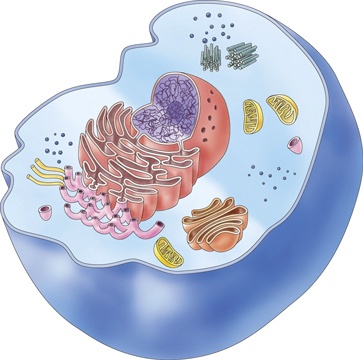
What kind of cell is in the diagram?
Animal Cell
Plant Cell
Bacterial Cell
Virus
Prokaryotic Cell
42
Multiple Choice
43
Multiple Choice
44
Multiple Choice
Controls what enters or exits the cell. Provide a protective barrier for the cell.
Nucleus
Cell Membrane
Cytoplasm
Mitochondria
Chloroplast
45
Multiple Choice
Convert the radiant energy of the sun to chemical energy of glucose (photosynthesis)
Nucleus
Cell Membrane
Cytoplasm
Mitochondria
Chloroplast
46
Multiple Choice
Chloroplasts are found only in plant cells and some protists. What is the function of chloroplasts?
to store water
to make glucose using the Sun's energy
to make proteins
to excrete waste materials
47
Multiple Choice
All cells have a cell (plasma) membrane. Plant cells have an additional organelle outside of the cell membrane that provides the cell with additional structure and support. What is that organelle?
nuclear membrane
ribosome
vacuole
cell wall
48
Multiple Choice
Photosynthesis is a ____________ change because a new substance is created.
chemical
physical
both
49
Multiple Choice
This system brings in oxygen and removes carbon dioxide
respiratory
circulatory
digestive
endocrine
50
Multiple Choice
Which answer shows only PHYSICAL CHANGES in digestion?
stomach acid breaks down proteins & teeth chew food into smaller pieces
teeth chew food into smaller pieces & saliva enzymes break down starches for digestion
teeth chew food into smaller pieces & the esophagus moves the food down to the stomach
the enzymes in saliva break down starches & acids in the stomach break down proteins
51
Multiple Choice
The sand dunes in the in the Gulf Coast Prairies and Marshes ecoregion most likely formed by —
the deposition of sand carried by swift wind blowing along the coast.
land that slightly uplifted when tectonic plates moved under the beach sand.
a primitive river that flowed toward the ocean and carved out the sand dunes.
strong waves dumping chunks of the ocean floor onto the beach.
52
Multiple Choice
Little erosion due to nutrient rich soil and lots of vegetation.
Trees are the main plant life, lumber industry
Piney Woods
Edward's Plateau
53
Multiple Choice
In the Woodlands, erosion by runoff is minimal due to ______.
dense forests hold soil in place
sediments are released into runoff
fires have been going on for many years
All the above
54
Multiple Choice
55
Multiple Choice
56
Multiple Choice
DNA is found in
the nucleus
the golgi body
the ribosome
the cell wall
57
Multiple Choice
Which of the following situations contributes to the sustainability of an ecosystem
A. Increase in biodiversity
B. Decrease in biodiversity
C. Extinction of a population from the ecosystem
D. Removal of many populations of organisms
58
Multiple Choice
Complete this statement. The more diverse an ecosystem is ----
A. the more threatened its populations are
B. the more similar the species will be
C. the more stable it is
D. the few varieties of species are present
59
Multiple Choice
60
Multiple Choice
Show answer
Auto Play
Slide 1 / 60
SLIDE

Similar Resources on Wayground
56 questions
Importance of the Oceans 7.11B
Presentation
•
7th Grade
54 questions
Unit 4 Mexican National - Texas Studies
Presentation
•
7th Grade
55 questions
Q3 - Sci 7 - Wk 4 - Waves Around You
Presentation
•
7th Grade
53 questions
asam basa garam KLS ABC SMP 60 SBY
Presentation
•
7th Grade
56 questions
Rocks, Rocks and MORE Rocks Packet
Presentation
•
7th Grade
56 questions
PARTS OF MICROSCOPE
Presentation
•
7th Grade
54 questions
Complex Invertebrates
Presentation
•
7th Grade
55 questions
Classification of Matter
Presentation
•
6th - 7th Grade
Popular Resources on Wayground
20 questions
STAAR Review Quiz #3
Quiz
•
8th Grade
20 questions
Equivalent Fractions
Quiz
•
3rd Grade
6 questions
Marshmallow Farm Quiz
Quiz
•
2nd - 5th Grade
20 questions
Main Idea and Details
Quiz
•
5th Grade
20 questions
Context Clues
Quiz
•
6th Grade
20 questions
Inferences
Quiz
•
4th Grade
19 questions
Classifying Quadrilaterals
Quiz
•
3rd Grade
12 questions
What makes Nebraska's government unique?
Quiz
•
4th - 5th Grade
Discover more resources for Science
19 questions
Introduction to Properties of Waves
Presentation
•
6th - 8th Grade
16 questions
Interactions within Ecosystems
Presentation
•
6th - 8th Grade
45 questions
Food Webs
Quiz
•
6th - 8th Grade
16 questions
Photosynthesis and Cellular Respiration Review
Quiz
•
7th Grade
20 questions
Abiotic & Biotic Factors
Quiz
•
7th Grade
20 questions
Asexual/Sexual Reproduction
Quiz
•
7th Grade
20 questions
Energy Transformations
Quiz
•
6th - 8th Grade
20 questions
Food Webs + Energy Pyramids
Quiz
•
7th Grade