Search Header Logo
  1. Resource Library
  2. Math
  3. Geometry
  4. Angles
  5. Lines And Angles
Lines and Angles

Lines and Angles

Assessment

Presentation

Mathematics

9th - 12th Grade

Medium

CCSS
HSG.CO.A.1, 4.G.A.1, 7.G.B.5

+5

Standards-aligned

Created by

Susan Budde

Used 2+ times

FREE Resource

8 Slides • 46 Questions

1

media
media
media

Lines, Line Segments, and Rays

Words &

Definitions

Lines are straight and
extend infinitely in
both directions,
without beginning or
end.

Line Segments are
part of lines with
two endpoints,
indicating a specific
length.

Rays start at a point
and extend
infinitely in one
direction.

2

media
media
media

Parallel Lines, Perpendicular Lines, and
Intersecting Lines

Parallel Lines never meet,
no matter how far they
extend, because they are
always the same distance
apart.

Perpendicular Lines
intersect at a 90-degree
angle.

Intersecting Lines meet or
cross each other at some
point, but not necessarily at
a 90-degree angle.

3

Multiple Choice

Question image

Use the figure to name a line containing the

point X.

1

line X

2

line c

3

line Z

4

line YZ

4

Multiple Choice

Question image

Use the figure to name a plane containing the

point Z.

1

plane XY

2

plane c

3

plane XQY

4

plane P

5

Multiple Choice

Question image

How many points do you need to make a line?

1

1

2

at least 2

3

3

4

4

6

Multiple Choice

Question image

A line that contains point M.

1

Line q

2

Line p

3

Line r

4

Line NH

7

Multiple Choice

Question image

Name the given figure with correct geometric notation.

1

Point A

2

A

3

Place A

4

Location A

8

Multiple Choice

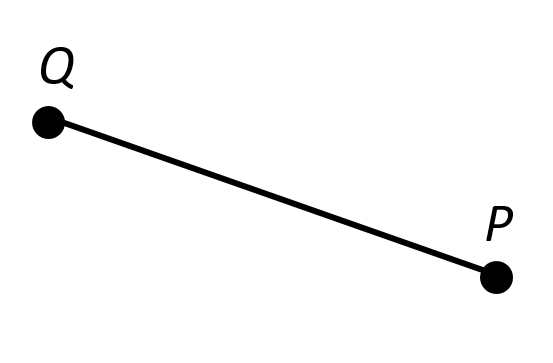
Question image
1
Point 
2
Line
3
Line Segment
4
Ray

9

Multiple Choice

Question image
1
Line
2
Point
3
Line Segment
4
Ray

10

Multiple Choice

A__________ is a fixed position in space and has no dimensions or size.
1
Point
2
Line
3
Plane
4
Cube

11

Multiple Choice

Question image
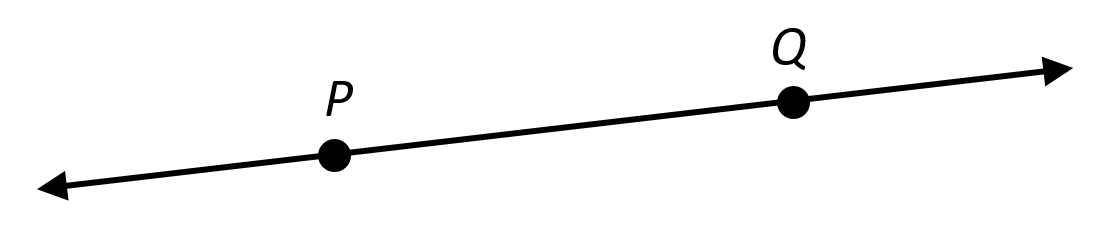
Name the image
1
Line
2
Ray
3
Line segment
4
Angle

12

Multiple Choice

Two lines intersect at a ....
1
angle
2
point
3
line
4
intersection

13

Multiple Choice

Question image

Which is the notation for the diagram shown?


1
2
3
4

None of these

14

Multiple Choice

Question image

Which is the notation for the diagram shown?


1
2
3
4

None of these

15

Multiple Choice

What is the term for a part of a line with two endpoints?
1
point
2
ray
3
angle
4
line segment

16

Multiple Choice

What is the term for a part of a line that has one endpoint and goes on endlessly in one direction?
1
line
2
line segment
3
ray
4
angle

17

Multiple Choice

Question image
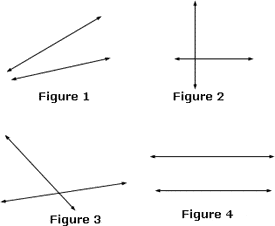
Which figure shows a set of perpendicular lines?
1
Figure 1
2
Figure 2
3
Figure 3
4
Figure 4

18

Multiple Choice

Question image
The yellow yard lines are an example of what type of line?
1
perpendicular lines
2
parallel lines
3
intersecting lines
4
number lines

19

Multiple Choice

Question image
The black lines on this Railroad Crossing sign are an example of what type of lines?
1
parallel lines
2
perpendicular lines
3
intersecting lines
4
interurban lines

20

Multiple Choice

Question image

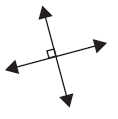
What do we call lines that intersect and form 90 degree angles?

1

Parallel

2

Perpendicular

3

Intersecting

21

Draw

Circle intersecting lines.

Box the parallel lines

Underline the perpendicular lines

22

media
media
media

Acute Angles, Right Angles, Obtuse Angles, Straight Angles,
Reflex Angles

Acute Angles are less than 90°

Right Angles are exactly 90°

Obtuse Angles are greater than 90° but less than 180°

Straight Angles are exactly 180°

Reflex Angles are greater than 180°but less than 360°

90°

180°

360°

zero

acute

right

obtuse

straight

reflex

full

23

Draw

DrAw the ions on the types of angles

24

media
media
media
media
media
media

Complementary Angles, Supplementary Angles,
Vertical Angles, and Adjacent Angles

Complementary Angles add up to
90 degrees.

Supplementary Angles add up to
180 degrees.

Vertical Angles are Opposite Angles
formed by two intersecting lines
and are always equal.

Adjacent Angles share a common
side and vertex but do not overlap.

Adjacent Angles

Opposite Angles

25

Multiple Choice

Question image

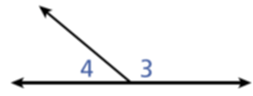
What type of angles are these?

1

Adjacent Angles

2

Linear Pair

3

Complementary Angles

4

Supplementary Angles

5

Vertical Angles

26

Multiple Select

Question image

What type of angles are these? (select 2)

1

Adjacent Angles

2

Linear Pair

3

Complementary Angles

4

Supplementary Angles

5

Vertical Angles

27

Fill in the Blank

28

Fill in the Blank

29

Multiple Choice

Question image

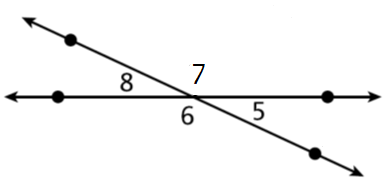
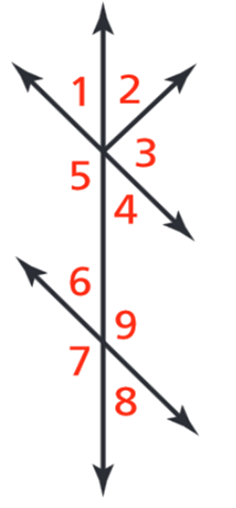
Which angles are vertical angles?

1

8 & 7\angle8\ \&\ \angle7

2

8 & 6\angle8\ \&\ \angle6

3

8 & 5\angle8\ \&\ \angle5

30

Fill in the Blank

31

Multiple Choice

Question image

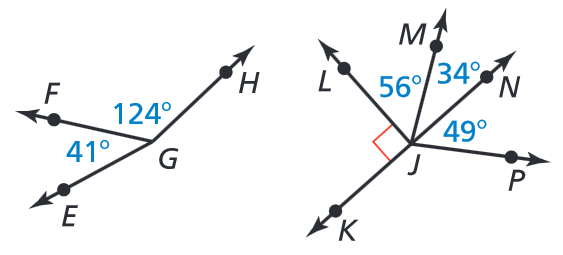
Which of the following angles is  90°90\degree  ?

1

FGH\angle FGH  

2

KJL\angle KJL  

3

PJK\angle PJK  

4

EGH\angle EGH  

32

Multiple Choice

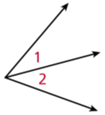
Question image

Which angle is a linear pair with 1\angle1  ?

1

2\angle2  

2

3\angle3  

3

4\angle4  

4

5\angle5  

5

6\angle6  

33

Multiple Choice

Question image
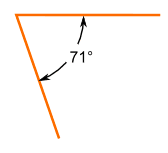
This is what kind of angle?
1
obtuse
2
right
3
straight
4
acute

34

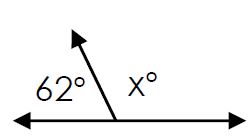
Multiple Choice

Question image
1

x = 118

2

x = 108

3

x = 28

4

x = 58

5

x = 62

35

Multiple Choice

Question image
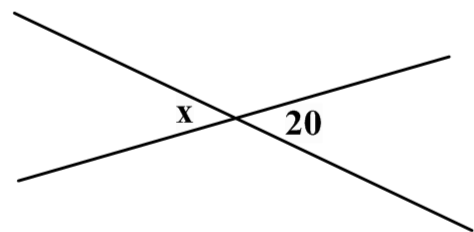
Find the missing angle.  Find x.
1
20o
2
70o
3
160o
4
180o

36

Multiple Choice

Question image

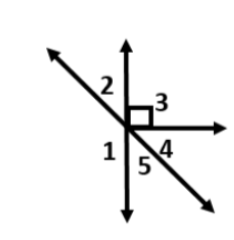
What angle is vertical to angle 2?

1

∠4

2

∠1

3

∠2

4

∠5

37

Multiple Choice

Question image
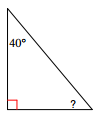
Find the measure of the missing angle.
1
90o
2
100
3
130o
4
50o

38

media
media
media
media
media
media

Angles as Fractions of a Circle

Angles As Fractions Of A Circle

1/4 90°

1/2 180°

3/4 270°

full circle 360°.

39

media
media
media

Angles of 90, 180, 270, and 360 Degrees

Visual representation of right
angles (90°),

straight angles (180°),

three-quarter circles (270°),

and full circles (360°).

40

Draw

Write the numerical fractions for each fractional name.

41

Draw

Draw lines to divide this circle into a half and two quarter.

42

Labelling

Now that your circle graph is drawn, label the graph with the correct percentages and fractions.

Drag labels to their correct position on the image

50%

25%

43

media
media
media
media
media
media

Guided Instruction: Determining Central Angle Measures

A diagram of a circle with four congruent sectors is shown.

Use the definition of a central angle to determine how many central angles are in
the circle with four congruent sectors.

Math Nation - Unit 7, Lesson 1 - Circle Graphs - Volume 1, PAGE 296

44

Hotspot

Complete the statements.

45

Math Response

If each central angle is 180°180\degree , you can represent that as the fraction 180360\frac{180}{360} . This is because a circle has a total of 360°360\degree . What is that fraction in its simplest form?

(write your answer as a fraction)

Type answer here
Deg°
Rad

46

media
media
media

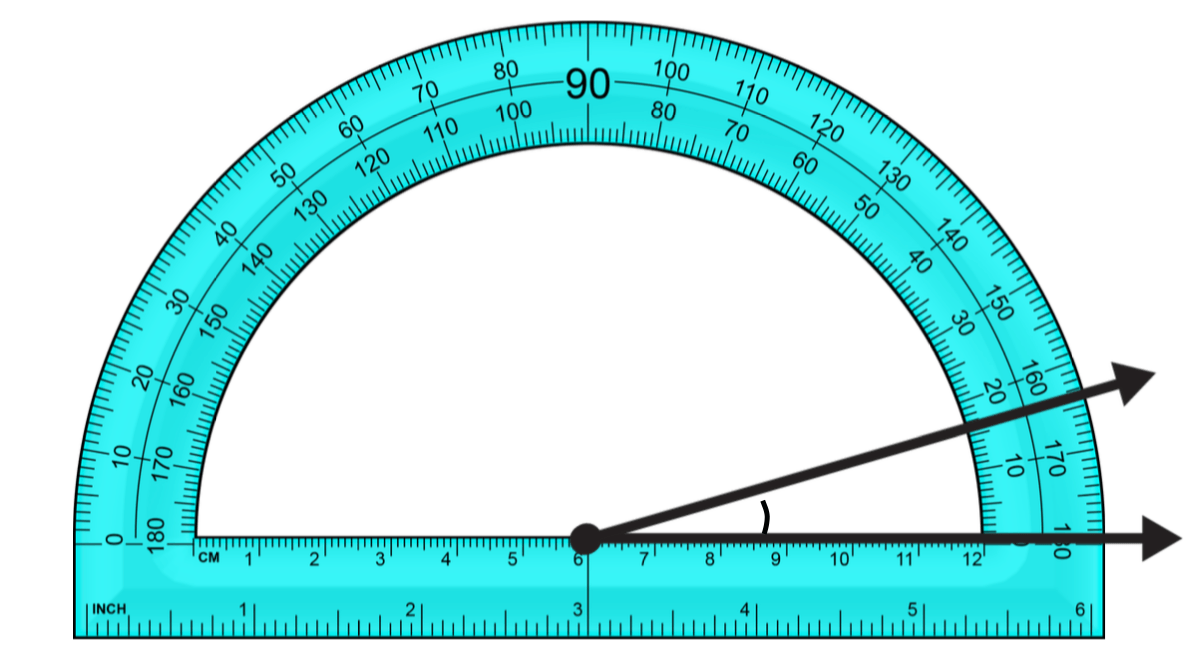
How to Measure Angles with a Protractor

Place the protractor's baseline along one side of the angle with the center mark at the vertex. The measurement is where the other side of the angle intersects the protractor.

47

Multiple Choice

Question image
Measure to the nearest 10 degrees.
1
10°
2
20°
3
170°
4
160°

48

Multiple Choice

Question image
Measure to the nearest 10 degrees.
1
7°
2
70°
3
110°
4
120°

49

Multiple Choice

Question image
Measure to the nearest 10 degrees.
1
20°
2
30°
3
160°
4
150°

50

Multiple Choice

Question image
Measure to the nearest 5 degrees.
1
65°
2
75°
3
115°
4
125°

51

Multiple Choice

Question image
what kind of angle is this? 
1
straight
2
acute
3
obtuse
4
right

52

Multiple Choice

Question image
What is the measure of the angle?
1
110 degrees. 
2
140 degrees.
3
150 degrees.
4
170 degrees. 

53

Draw

Pick 4 problems.

Determine the angle shown.

54

Poll

I feel _________ comfortable with this topic. ​ ​ ​ ​

very
extremely
slightly
mostly
media
media
media

Lines, Line Segments, and Rays

Words &

Definitions

Lines are straight and
extend infinitely in
both directions,
without beginning or
end.

Line Segments are
part of lines with
two endpoints,
indicating a specific
length.

Rays start at a point
and extend
infinitely in one
direction.

Show answer

Auto Play

Slide 1 / 54

SLIDE