

Matter

Presentation
•
English
•
9th Grade
•
Practice Problem
•
Hard

TORI BAUMER
FREE Resource
25 Slides • 0 Questions
1

MATTER UNIT
What Matter Is
Mass vs Weight
Three Phases of Matter
Classification of Matter
Matter Summary
Chemical & Physical Changes
Chemical & Physical Properties
Kenneth E. Schnobrich
2

MATTER
What is Matter??
3

Matter is generally defined as anything
that has mass and occupies space.
4

Mass vs Weight
Mass refers to a quantity of matter and the mass
remains the same no matter where you are.
Weight however is determined by the effect of
gravity on a quantity of matter.
5
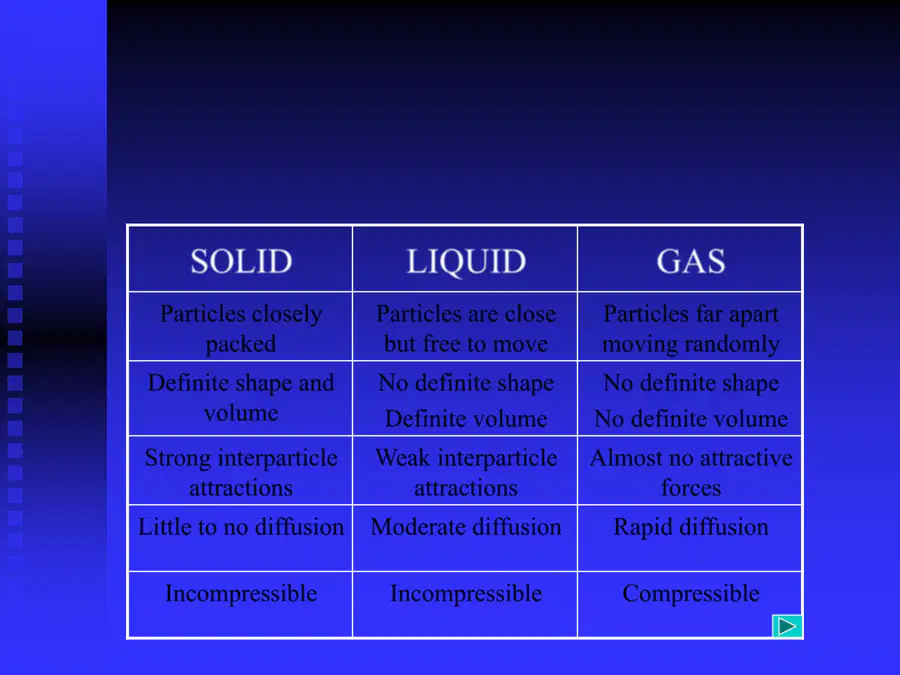
THE THREE PHASES
of
MATTER
SOLID
LIQUID
GAS
Particles closely
packed
Particles are close
but free to move
Particles far apart
moving randomly
Definite shape and
volume
No definite shape
Definite volume
No definite shape
No definite volume
Strong interparticle
attractions
Weak interparticle
attractions
Almost no attractive
forces
Little to no diffusion
Moderate diffusion
Rapid diffusion
Incompressible
Incompressible
Compressible
6
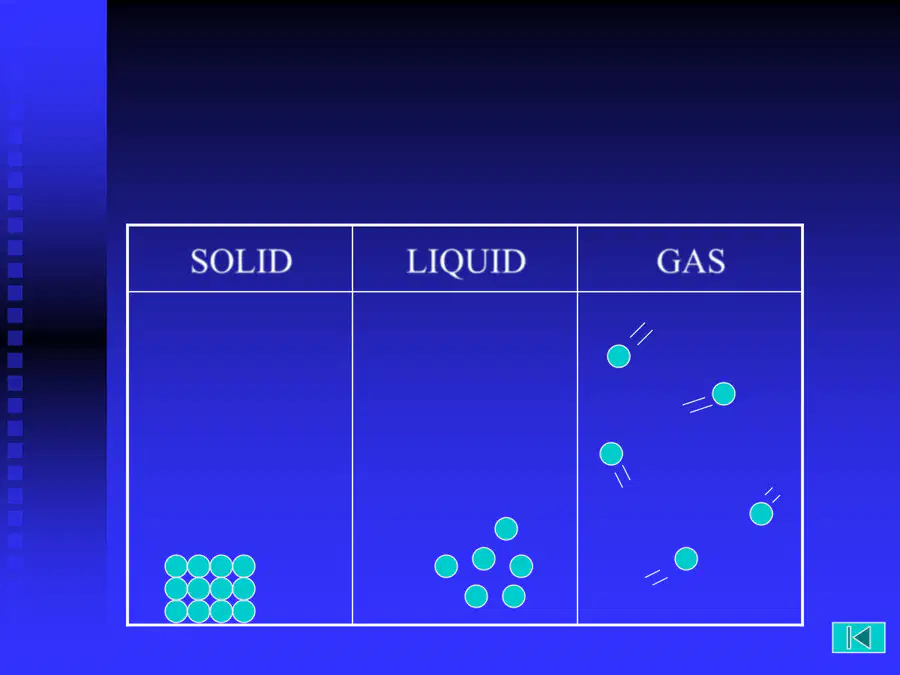
THE THREE PHASES
of
MATTER
SOLID
LIQUID
GAS
7

CLASSIFICATION OF
MATTER
PURE SUBSTANCES
Elements
Compounds
ELEMENTS - are the building blocks of
compounds
COMPOUNDS - are made up of 2 or more
different elements, chemically combined
in a definite ratio by mass
Pure Substances cannot be separated by physical means
8
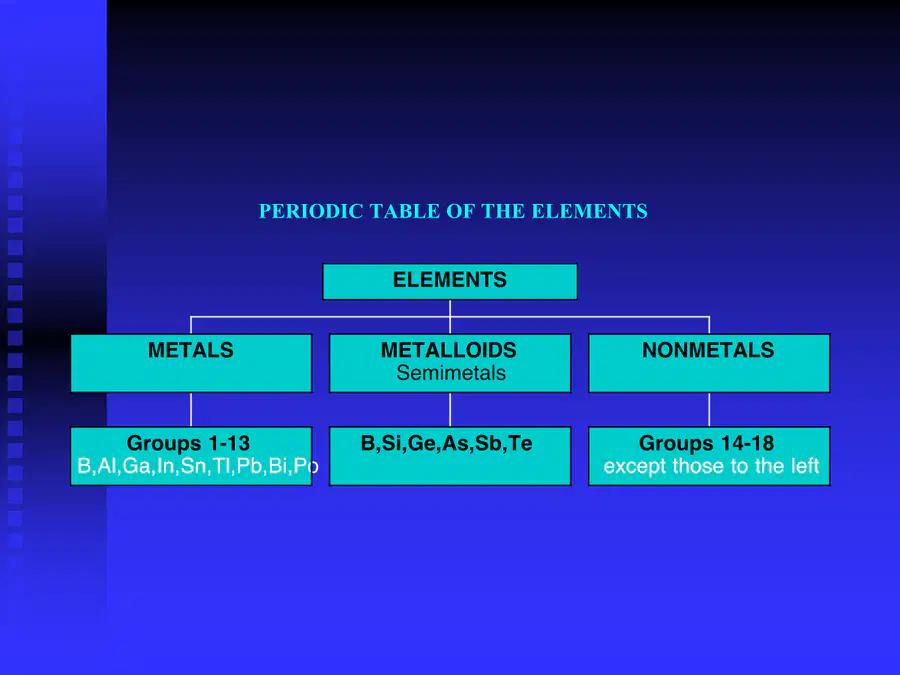
THE ELEMENTS
You should be looking at the Periodic Table
9

PROPERTIES OF METALS
1. They have high melting & boiling points
2. They exhibit heat and electrical conductivity
3. They exhibit metallic lustre
4. They are malleable
5. They are ductile
6. They have low specific heats
7. They have high densities
8. Most appear silvery-gray in color (Cu, Au)
9. They have strong interatomic forces of attraction
10. Most are solids at room temperature (Hg)
10

METALLOIDS
SEMIMETALS
THE SEMIMETALS HAVE PROPERTIES THAT ARE
VARIABLE DEPENDING ON WHAT THEY ARE
REACTING WITH - BUT THEY CAN BEHAVE AS
BOTH METALS AND NONMETALS
11

NONMETALS
1. They have low melting & boiling points
2. They exhibit no heat and electrical conductivity
3. They exhibit a variety of colors
4. They are brittle
5. They are generally gases (C,P,S,Se,Br,Te,I)* at
STP
6. They are dull in appearance
7. They generally show weak attractive forces
8. Many are diatomic* (H2. N2, O2, F2, Cl2, Br2. I2)
**Diatomic means 2 atoms per molecule
*Solids or Liquids at STP
12
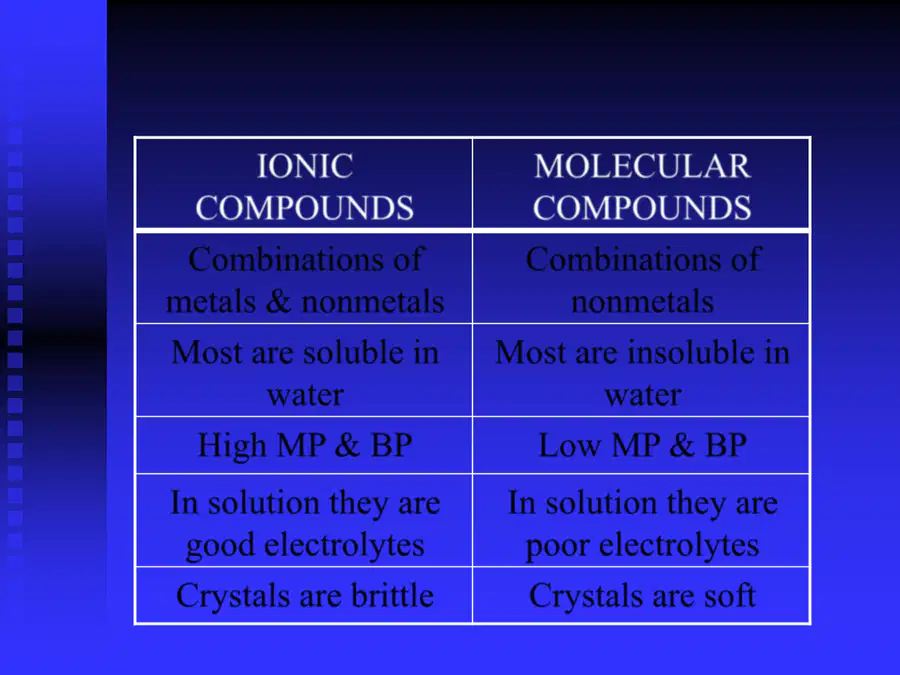
COMPOUNDS
IONIC
COMPOUNDS
MOLECULAR
COMPOUNDS
Combinations of
metals & nonmetals
Combinations of
nonmetals
Most are soluble in
water
Most are insoluble in
water
High MP & BP
Low MP & BP
In solution they are
good electrolytes
In solution they are
poor electrolytes
Crystals are brittle
Crystals are soft
13

IONIC COMPOUNDS
Ionic compounds are generally combinations of metals
and nonmetals.
METALS - tend to lose electrons and form cations.
Cations are simply ions having a positive charge.
Na -> Na+1or Ca -> Ca+2 or Al -> Al+3
NONMETALS - tend to gain electrons and form anions.
Anions are simply ions having a negative charge.
Cl -> Cl-1or S -> S-2 or N -> N-3or O -> O-2
14

MOLECULAR COMPOUNDS*
Covalent compounds are generally combinations of nonmetals
and nonmetals.
EXAMPLES:
CO2
H2O
CH4
C6H12O6
*molecular and covalent compounds are the same
15

MIXTURES - TWO TYPES
MIXTURES - have no definite composition and they are
easily separated by physical means unlike elements and
compounds.
HOMOGENEOUS MIXTURES - are called SOLUTIONS
and they appear uniform throughout.
HETEROGENEOUS MIXTURES - are very common
and they do not appear uniform throughout.
16
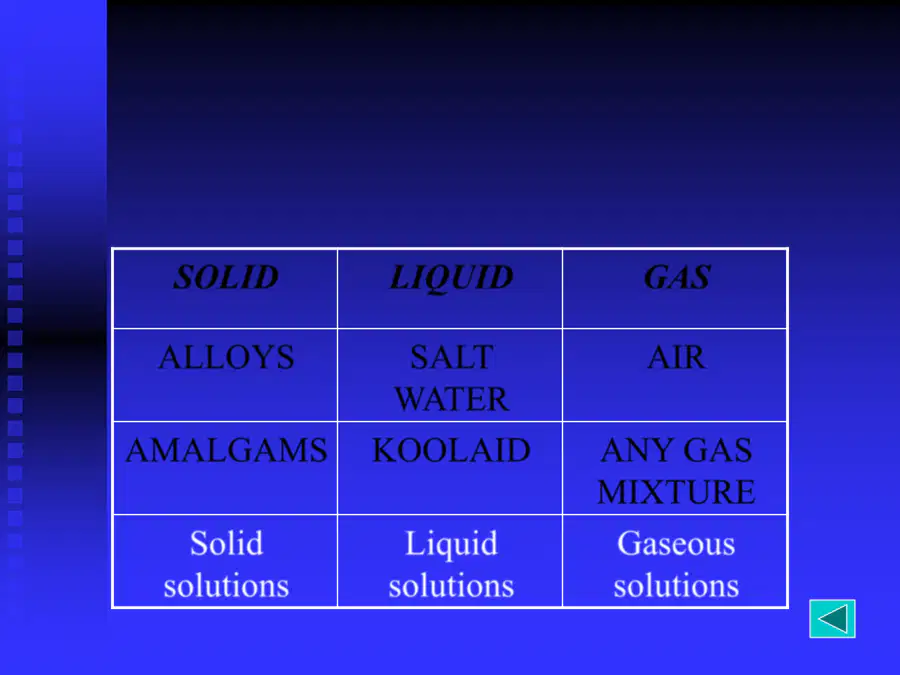
Examples of Homogeneous
Mixtures
SOLID
LIQUID
GAS
ALLOYS
SALT
WATER
AIR
AMALGAMS
KOOLAID
ANY GAS
MIXTURE
Solid
solutions
Liquid
solutions
Gaseous
solutions
17

EXAMPLES OF
HETEROGENEOUS
MIXTURES
A CHEESE, PEPPERONI, SAUSAGE, MUSHROOM,
AND HOT PEPPER PIZZA FROM LaNOVA
A RUBY TUESDAY’S BOWL OF BROCCOLI CHEESE
SOUP
A TIM HORTON’S CRANBERRY TEA BISCUIT
A HARRY’S HARBOR FRONT FRESH GARDEN
SALAD WITH ITALIAN DRESSING
18
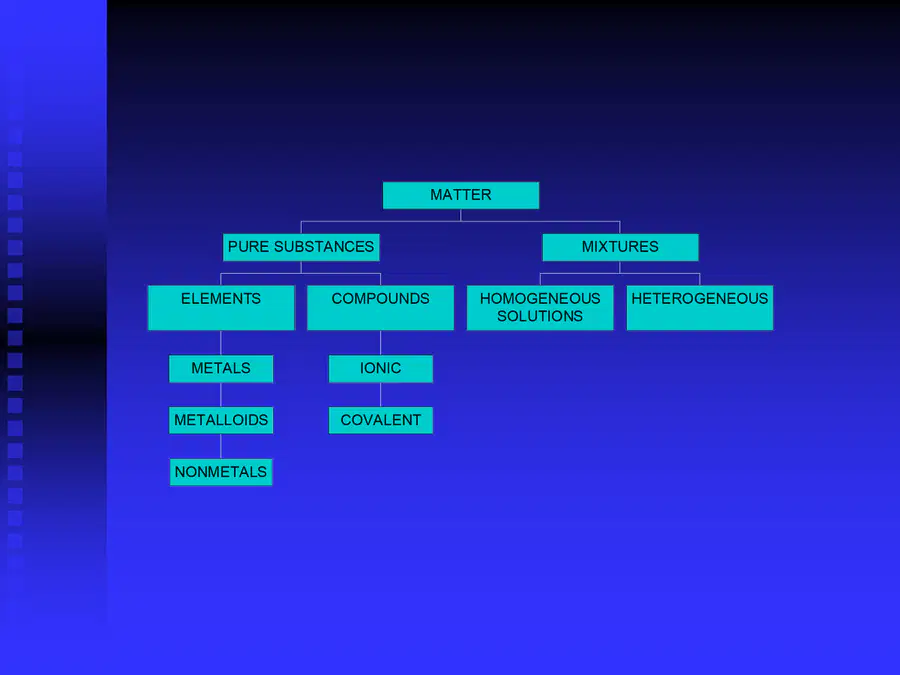
MATTER SUMMARY
Definitions of the terms above
19

DEFINITIONS:
Elements - these are the basic building blocks for all
compounds and cannot be separated by physical
or chemical means
Compounds - chemical combinations of 2 or more different
elements in a definite ratio by mass. Compounds
cannot be separated by physical means only by
chemical means
Pure substances - these are either elements or compounds
Mixtures - these are physical combinations of 2 or more pure
substances in no definite ratio by mass. Mixtures can
be separated by physical means
Homogeneous mixtures - are also called solutions and they
appear uniform throughout
Heterogeneous mixtures - the individual components of a
mixture of this type can be readily seen
20

Chemical & Physical
Properties & Changes
PHYSICAL PROPERTIES - are those properties that can be
determined using the physical senses
Color
Odor
Taste
Crystal structure
Density
Specific Heat
Heat of Vaporization
Heat of Fusion
Melting Point
Boiling Point
21
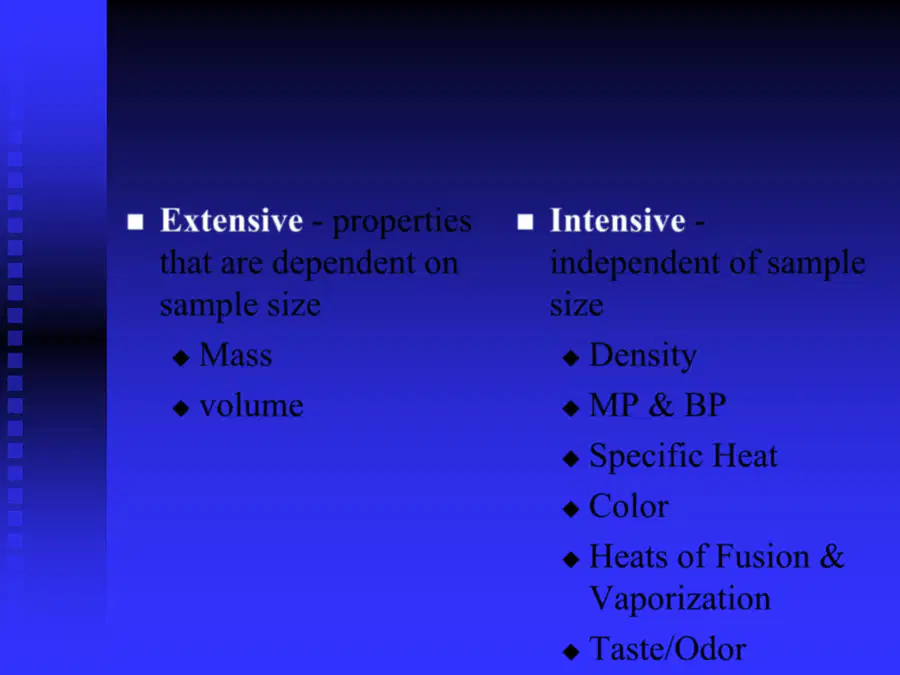
Extensive vs Intensive
Physical Properties
Extensive
-
properties
that are dependent on
sample size
Mass
volume
Intensive
-
independent of sample
size
Density
MP & BP
Specific Heat
Color
Heats of Fusion &
Vaporization
Taste/Odor
22
Chemical & Physical
Properties & Changes
CHEMICAL PROPERTIES - are those properties that identify
how one substance reacts with another
• Iron rusts
• Copper develops a patina
• Hydrogen combines with
Oxygen to form water
• Carbon combines with oxygen
to form CO2 or CO
• The element Na (sodium)
combines with water to
form H2 and NaOH
23
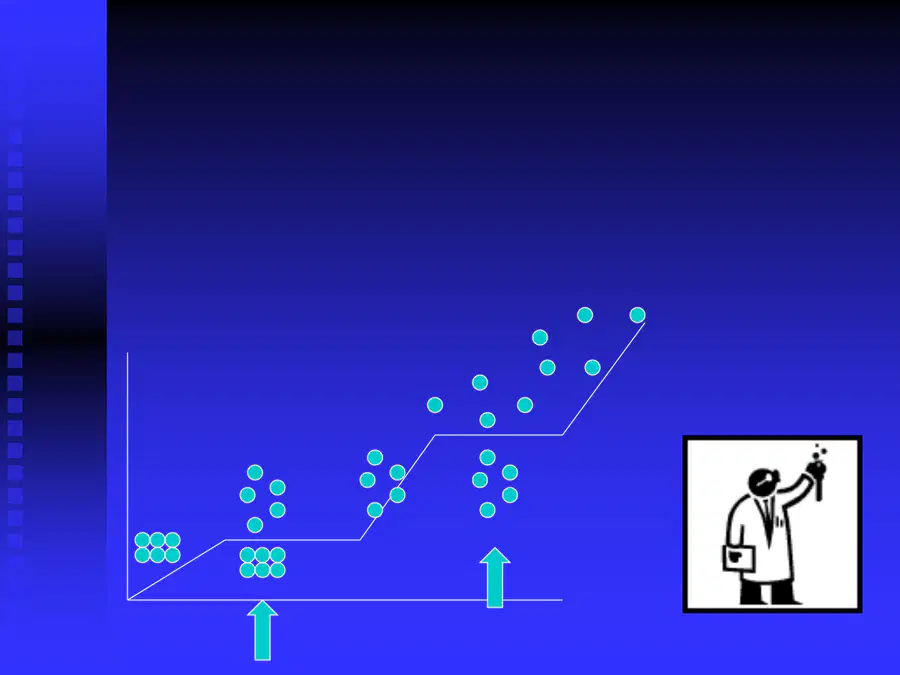
Chemical & Physical
Properties & Changes
PHYSICAL CHANGE - These are changes in a substance that
do not involve a change in composition
Most common: Phase changes
2 phases
2 phases
24
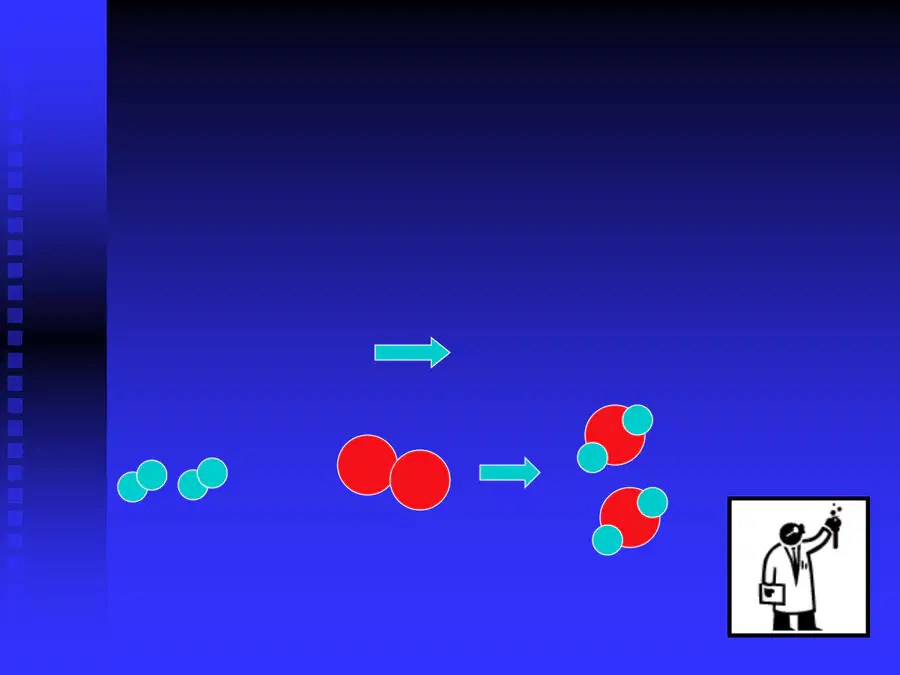
Chemical & Physical
Properties & Changes
CHEMICAL CHANGE - These are changes that do involve
a change in the composition of a substance
2H2(g) + O2(g)
2H2O(g)
+
Bonds are actually broken and made
25

REACTIONS OF THE ALKALI METALS
When you click on the link below you will see a demonstration
of the activities of the Alkali Metals in Group 1. It should be
noted that the reactions of Rubidium and Cesium may have been
exaggerated slightly. It is important to note that Rubidium and
Cesium are so reactive that they have to be kept in a closed vial
with an inert gas atmosphere prior to immersing in the water. All
of the Alkali metals will form oxides on their surfaces rather
quickly because of their reactivity. Do not try to duplicate these
demonstrations.
click
*Special Note – you may want to
Preview this YouTube video.
MATTER UNIT
What Matter Is
Mass vs Weight
Three Phases of Matter
Classification of Matter
Matter Summary
Chemical & Physical Changes
Chemical & Physical Properties
Kenneth E. Schnobrich
Show answer
Auto Play
Slide 1 / 25
SLIDE
Similar Resources on Wayground

20 questions
Too - Enough
Presentation
•
9th Grade
20 questions
Milestones Mixed Review 2
Presentation
•
8th Grade
20 questions
Simple Present vs Present Progressive
Presentation
•
9th Grade
20 questions
Writing Body Paragraphs
Presentation
•
9th Grade
21 questions
Stereotypes
Presentation
•
9th Grade
20 questions
Irregular Verbs
Presentation
•
6th Grade
16 questions
Grade 9 Advanced Revision
Presentation
•
9th Grade
19 questions
Should Cell Phones be banned in schools?
Presentation
•
9th Grade
Popular Resources on Wayground
10 questions
Factors 4th grade

Quiz
•
4th Grade
10 questions
Cinco de Mayo Trivia Questions

Interactive video
•
3rd - 5th Grade
13 questions
Cinco de mayo
Interactive video
•
6th - 8th Grade
20 questions
Math Review
Quiz
•
3rd Grade
20 questions
Main Idea and Details
Quiz
•
5th Grade
20 questions
Context Clues
Quiz
•
6th Grade
20 questions
Inferences
Quiz
•
4th Grade
19 questions
Classifying Quadrilaterals
Quiz
•
3rd Grade
Discover more resources for English
12 questions
Types of Conflict
Presentation
•
5th - 9th Grade
10 questions
Test Taking Strategies for State Reading Assessments
Interactive video
•
6th - 10th Grade
10 questions
Context Clues Review
Quiz
•
9th Grade
19 questions
Reading Comprehension Review
Quiz
•
9th Grade
45 questions
Most Dangerous Game Test Review
Quiz
•
9th Grade
20 questions
Figurative Language
Quiz
•
9th Grade
17 questions
Romeo& Juliet Act 1 Quiz
Quiz
•
9th - 10th Grade
50 questions
Romeo and Juliet Prologue & Acts 1-5 Test
Quiz
•
9th - 12th Grade