

Group Behaviour Part 4

Presentation
•
Other
•
University
•
Medium

Suman Amin
Used 14+ times
FREE Resource
9 Slides • 24 Questions
1
Part 4
2
Meaning
Status is a perceived social position or rank others give to a group or its members.
Even the smallest group shows differences in member status over time.
Status is a significant motivator and has major behavioural consequences when individuals perceive a disparity between their status and what others perceive it to be.
3
Multiple Choice
Which of the following people are likely to have low status in a group?
Those who are often the outstanding performers
people who can allocate resources
people whose contributions are critical to the group's success
a group's formal leader
people who have little control over the group's outcomes
4
Multiple Select
Select the sources of Status in the group.
The Positional power a person wields over others
A person’s ability to contribute to a group’s goals
An individual’s personal characteristics
5



The power a person wields over others
E.g. Because they're likely control the
group’s resources, people who control group outcomes tend to be perceived as high status.
Power a person wields over others
People who contribute to the group’s success tend to have high status.
E.g., star performer or Senior in the organisation.
Group Contribution
Individuals with certain desirable traits such as intelligence, wealth, or a friendly personality tend to hold higher status within a group.
Personal Characteristics
6
Multiple Choice
People who control the outcomes of a group through their power tend to be perceived as ________.
high conformists
deviants
low status
high status
7
Multiple Choice
Which of the following statements about status is not true?
Status is an important motivator.
Possession of personal characteristics that are positively valued by the group will give a
member higher status.
Low-status members are given more freedom to deviate from norms than are other members.
High-status members are better able to resist conformity pressures than lower status members
8
Multiple Choice
Low-status people ________.
speak out more often
criticize more often
are not likely to be fully utilized
interrupt others more
9




High-status individuals may be more likely to deviate from
norms when they have low identification (social identity) with the group
Norms
People tend to become more assertive when
they seek to attain higher status in a group
Group Interaction
Perceived inequity can lead to resentment and corrective behaviours.
Status Inequity
Assigning roles to each member of a group.
High-status group members are often given high-status roles like group leader or expert, while low-status members are given lower-status roles.
10
Multiple Choice
People with lower status are more capable of resisting pressure to conform than their peers with higher status.
True
False
11
Multiple Choice
If lower-status members tend to participate less actively in group discussions when they possess expertise and insights that could aid the group, failure to fully utilize these members reduces the group’s overall performance.
True
False
12
Open Ended
How can you encourage Lower-status members to participate actively?
13

Managers should be mindful of status differences in their work groups.
They should establish checks and balances so leaders do not justify unethical behaviour or unethically try to maintain their status.
They should actively encourage lower-status members to contribute and provide a psychologically safe environment to voice their ideas, thoughts, and concerns.
14
Multiple Choice
People of lower status tend to speak out more frequently, criticize more often, give more commands, use jargon to sound proficient, perform more favours for others, and interrupt others more regularly.
True
False
15
Multiple Choice
High-status group members tend to ________.
be more assertive
assist more
be more reflective
don't care about being well liked
16
Multiple Choice
Significant status differences within groups are linked to lower individual performance, poorer health, and stronger intentions for lower-status members, which may lead to them ...
Rejoicing
Stick around
leave the group
be full of gratitude.
17
Multiple Choice
Inequity in power and status tends to have more negative effects - It tends to drive interpersonal conflict.
True
False
18
Multiple Choice
Regardless of one’s status, however, having accurate knowledge of the status hierarchy (i.e., “who is who in my group”) leads to better performance and results in effective within-group networking
True
False
19
Multiple Choice
If your group is engaged in problem solving, which of the following is likely to be the most effective group size?
20
Does the size of a group affect the group’s overall behaviour?
Yes, but the effect depends on the outcome of interest (e.g., performance, creativity).
Groups with a dozen or more members are good for gaining diverse input(fact-finding or idea-generating)
Smaller groups of about seven members are better if the goal is
performance and productivity.

21
Multiple Choice
What term is used for the tendency for individuals to spend less effort when working collectively than when working individually?
22

Individuals tend to expend less effort when working collectively than when working alone.
How to Reduce it?
• Set group goals.
• Increase intergroup competition.
• Engage in peer evaluation.
• Select highly motivated people who prefer working in groups.
• Base group rewards on each member’s unique contribution.
Social loafing
23
Multiple Choice
Which of the following is an effective means of countering social loafing?
Increase the rewards the group is given if it succeeds.
Increase the size of the group.
Increase the group's workload.
Provide means by which individual efforts can be identified in the group.
24
Multiple Choice
Social loafing may be attributed to ________.
the rise of Internet usage
the fact that efficiency declines when individuals think that their contributions cannot be measured.
synergy
accountability is obvious
the more members, the greater the total productivity
25
Multiple Choice
All of the following are ways to prevent social loafing EXCEPT
Set group goals so the group has a common purpose to strive toward.
Increase intergroup competition.
Engage in peer evaluation to evaluate each member's contribution to the group.
Ensure the group results cannot be attributed to any single person
26
Multiple Choice
If the goal is problem solving, smaller groups are more effective than larger ones.
True
False
27
Multiple Choice
What term is used for the degree to which group members are attracted to one another and are motivated to stay in the group?
28

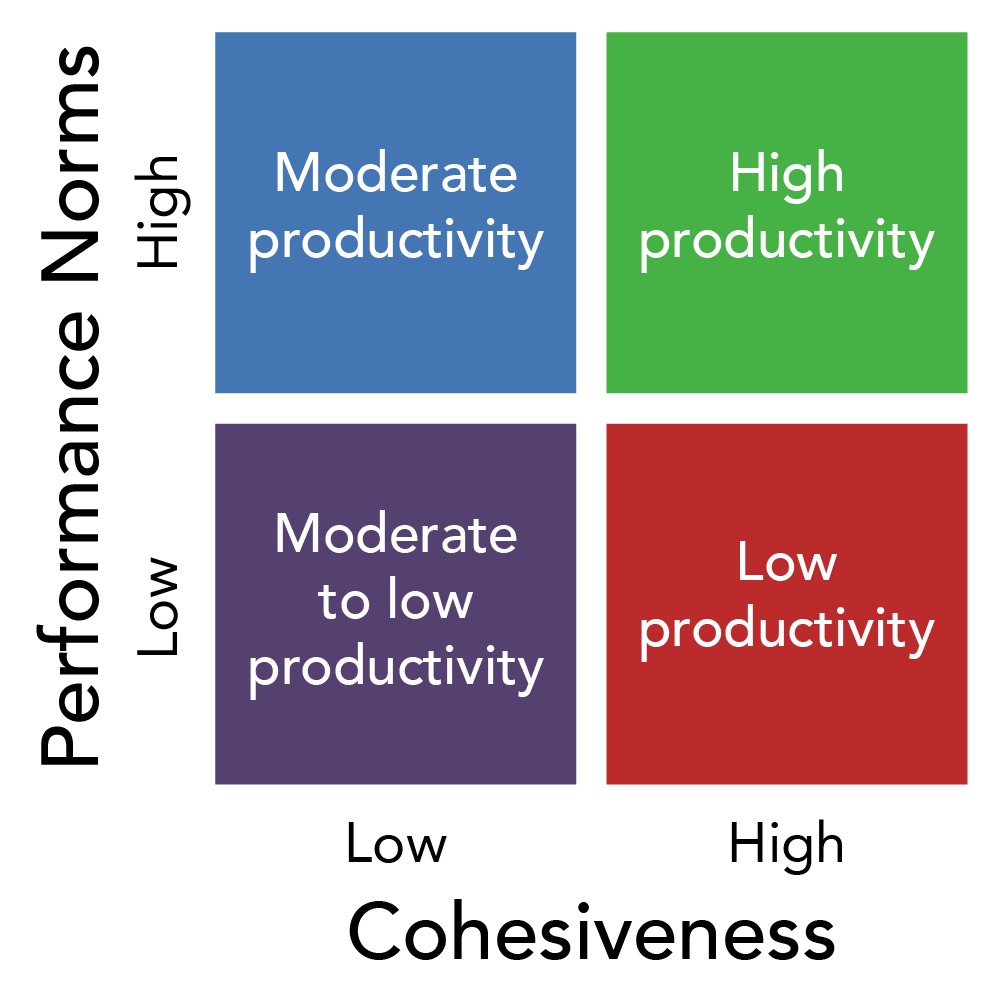
Cohesiveness defines the degree of closeness that the members feel with the group.
It identifies the members' desire to remain in the group and their commitment to the group.
Studies consistently show that the relationship between cohesion and productivity depends on the group's performance-related norms (expectations for quality, output, etc.).
Group Cohesiveness
29
30
Multiple Choice
Which of the following is not likely to increase group cohesiveness?
increasing the group size
members spending a lot of time together
competition with other groups is increased
the group is physically isolated
providing group rewards
31
Multiple Choice
Increasing the exclusivity of a group and making it harder to join can enhance its cohesiveness.
True
False
32
Multiple Choice
The relationship of cohesiveness and productivity depends on which norms established by the group?
status-related
decision-making
performance-related
conformity-related
33
Poll
Which video would you like to watch on group cohesiveness?
How to create a cohesive team by The Predictive Index
How to build teams that Win - Ted Talk by Prakash Iyer
Part 4
Show answer
Auto Play
Slide 1 / 33
SLIDE
Similar Resources on Wayground

27 questions
Module 11 - Sutainable Development
Presentation
•
University
28 questions
GAMES WEBINAR IKEBARAS 2021
Presentation
•
University
25 questions
光華國小109學年度家長代表大會-教務處報告
Presentation
•
University
25 questions
Week 10 - Textual Analysis + Module Summary
Presentation
•
University
28 questions
BMTI: Revision
Presentation
•
University
21 questions
Cold War Intro
Presentation
•
KG
26 questions
Boolean Operator 2
Presentation
•
KG
26 questions
Pharm Respiratory & Endocrine
Presentation
•
University
Popular Resources on Wayground
10 questions
Safety Day 2026 – Student Review

Quiz
•
9th Grade
21 questions
Continents and Oceans
Quiz
•
6th Grade
20 questions
Parts of Speech
Quiz
•
5th Grade
16 questions
Subject & Predicate
Quiz
•
5th Grade
25 questions
Multiplication Facts
Quiz
•
5th Grade
12 questions
Map Skills
Quiz
•
3rd Grade
22 questions
Continents and Oceans
Quiz
•
5th Grade
15 questions
Rounding Decimals
Quiz
•
5th Grade
Discover more resources for Other
20 questions
Disney Trivia
Quiz
•
University
10 questions
Spanish Greetings and Goodbyes!
Presentation
•
6th Grade - University
20 questions
Physical or Chemical Change/Phases
Quiz
•
8th Grade - University
39 questions
Unit 7 Key Terms
Quiz
•
11th Grade - University
25 questions
SER and Subject Pronouns
Quiz
•
8th Grade - University
38 questions
Unit 6 Key Terms
Quiz
•
11th Grade - University
19 questions
Key Concepts in Buddhism
Quiz
•
University
0 questions
Cell Domain Basic Review (Biology)
Quiz
•
University