Natural Selection
Presentation
•
•
Practice Problem
•
Hard
Jonathan Garcia
FREE Resource
22 Slides • 27 Questions
1
Fast lion vs. slow zebra Strong, healthy person vs. weak, sick person
Turn and talk: Who has the greatest
chance of survival?
2
Turn and talk:What does this phrase mean?
3
Who was Charles Darwin?
■ Charles Darwin
■ Set sail on the HMS Beagle in 1831
■ Became the ship’s naturalist
■ Arrived in the Galapagos Islands in 1835
■ Observed that the animals on the islands
were similar to those on the mainland
4
Darwin’s Theory of Natural Selection
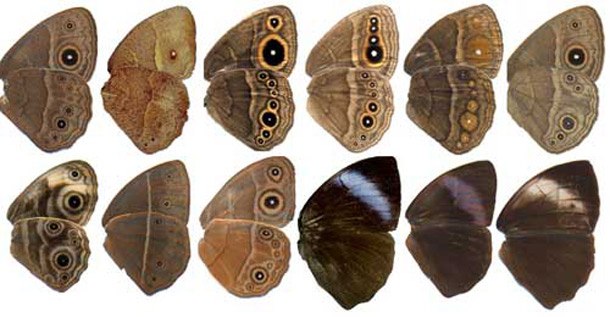
1.There is variation within any species
2. All organisms tend to over-reproduce
making competition for food and
water.
3.There is a struggle for survival which
can lead to extinction.
4.The fittest survive and pass on their
genes which may lead to new
species.
5.The environment determines who is
the fittest.
5
What did he say?
1. Variation: Variation exists within all
populations. Much of it is inherited because it is created by crossing over during meiosis.
6
What did he say?
2. Overpopulation:
Every population is
capable of producing
more offspring than
can survive. There
are limited
resources.
7
What did he say?
3. Struggle for Existence: Members of
each species for food, living space, etc.
8
What did he say?
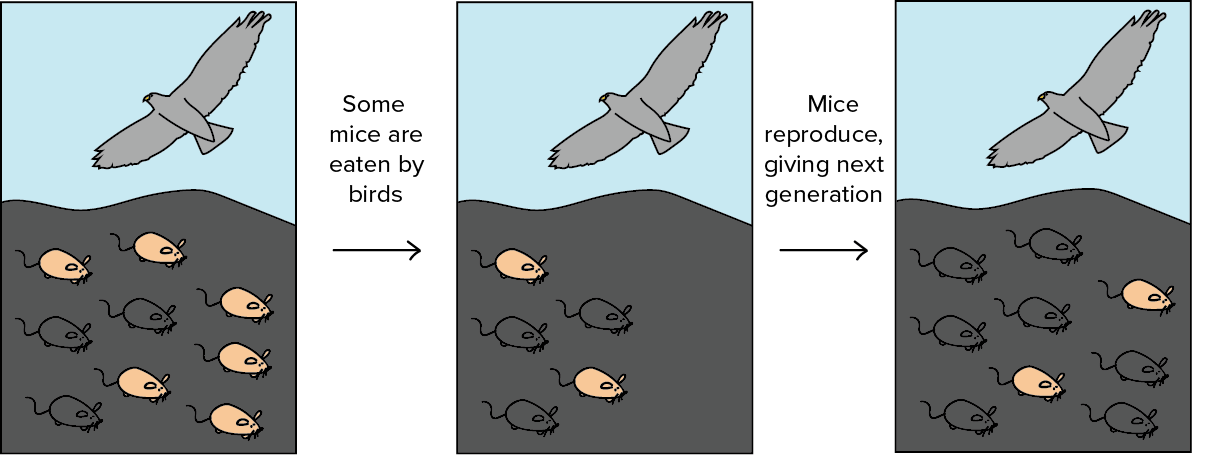
4. Selection:The organisms with the
best traits/adaptations will survive
and have the opportunity to pass on
it’s traits to offspring.
9
5. Environmental
Adaptations:
Organisms that
are better
adapted to their
environment
have a higher
chance of
survival.
Katydids have camouflage to
look like leaves.
Non-poisonous king snakes mimic
poisonous coral snakes.
10
Evolution Recap
11
Multiple Choice
This makes an organism more suited to its environment
species
lifespan
adaptation
mutation
12
Multiple Choice
Evolution
Natural Selection
Extinction
Artifical Selection
13
Multiple Choice
the best adapted
the fastest
the strongest
the most domesticated (tamed)
14
Multiple Choice
The light mice can reproduce more successfully than the dark mice
The hawks eat more dark mice than light mice because the dark mice taste better
The hawks eat more light mice than dark mice because they can see the light mice more easily
The hawks eat more dark mice than light mice because they can see the dark mice more easily
15
Multiple Choice
Natural Selection
Variation
Homeostasis
Extinction
16
Multiple Choice
Which of the following is the correct definition of natural selection?
The idea that organisms less equipped for their environment tend to survive longer
The idea that organisms more well equipped for their environment tend to survive longer
The idea that organisms more well equipped for their environment tend to not survive
None.
17
Multiple Choice
Which of the following represents genetic drift?
18
Multiple Choice
Which of the following represents migration?
19
Multiple Choice
Which of the following represents gene flow?
20
Match
the movement of genes into or out of a population
Random chance; small population
A sudden change in one or more characteristics due to a change in a gene
Occurs due to physical difference as a result of a genetic difference
The movement of organisms from one place to another
Gene Flow
Genetic Drift
Mutation
Non-Random Mating
Migration
Gene Flow
Genetic Drift
Mutation
Non-Random Mating
Migration
21
Multiple Choice
Which of the following best describes what the image represents?
Genetic Drift
Migration
Mutation
Natural Selection
22
Multiple Choice
Which of the following best describes what the image represents?
Natural Selection
Artificial Selection
Mutation
Genetic Drift
23
Multiple Choice
Which of the following does not show genetic drift?
24
Multiple Choice
Which scientist is considered the father of evolution?
Jean-Baptist Lamarck
Hershey and Chase
Charles Darwin
Carleous Linnaeus
25
Multiple Choice
Which of the following is an example of artificial selection?
Gorillas are in the wild and have a baby gorilla.
A group of ants in an ant pile are exterminated by an exterminator.
A black speckled rabbit is a new favorite among children, a white and black rabbit are picked to make black and white baby bunnies.
Wolves in the wild have pups.
26
Multiple Choice
White tigers are becoming extinct, to overcome this a male and female white tiger are paired together in captivity to help their population continue to grow. This is an example of:
Natural Selection
Gene Flow
Artificial Selection
Genetic Drift
27
Multiple Choice
Blue catfish are going extinct. A dam in a lake full of blue catfish bursts due to poor engineering and kills some of the blue catfish. This is an example of:
Natural Selection
Gene Flow
Mutation
Genetic Drift
28
Multiple Choice
Green rhinocerous beetles are some of the biggest beetles to exist on Earth. A green rhinocerous beetle leaves its group and wonders over to another group that only has red rhinocerous beetles and mates with the red beetles. This is an example of:
Gene Flow
Genetic Drift
Mutation
Migration
29
Natural Selection: How Does it Work?
By Stefan Mejia-Ott
30
Evolution results from a process called natural selection.
Natural Selection!
31
Natural selection is a process in which organisms better suited to their environment are able to survive and reproduce more offspring
32
These favorable traits and characteristics are then passed on to their babies through a process called inheritance.
33
Multiple Choice
Evolution is the result of a process called ____________
Natural Selection
Artificial Selection
Survival of the Weakest
Supernatural Selection
34
Multiple Choice
According to natural selection, organisms more suited to their environment are better able to
Sleep
Survive
Perish
Migrate
35
Multiple Choice
The process of passing down favorable traits to one's offspring is called
Artificial Selection
Mutations
Evolution
Inheritance
36
The process of natural selection happens when an individual’s genes become different in some way from the genes of others of its kind.
37
Differences in genes cause differences in an individual’s traits—such as how it looks or its behavior.
38
Multiple Choice
Natural selection happens when an individual's genes ______________ from the genes of other members of its species.
Become different
Stay the same
Become separated
39
Multiple Choice
Differences in genes can cause differences in __________ (Choose the best answer).
Mutations
RNA
Appearance
40
Changes in genetic material are called mutations.
41
Mutations can occur at any time during an organism’s life span.
42
Mutations can be inherited or happen randomly. They can also be caused by environmental factors such as too much sunlight.
43
Multiple Choice
Changes in genetic material are called _____________
Mutations
RNA
Genes
44
Multiple Choice
Mutations can be inherited or be
Chosen by the individual organism
Caused by environmental factors
Refused at any time
45
Most changes in genes either harm the individual or do not matter much.
46
But some changes help an individual to survive and reproduce.
47
For example, an animal may have better vision or faster legs. These traits may help it find food and avoid its enemies.
48
Multiple Choice
True or False? All changes in genes are harmless.
True
False
49
Multiple Choice
Some changes in genes can help organisms _____
Survive
Mutate
Rest
Fast lion vs. slow zebra Strong, healthy person vs. weak, sick person
Turn and talk: Who has the greatest
chance of survival?
Show answer
Auto Play
Slide 1 / 49
SLIDE

Similar Resources on Wayground
43 questions
Fossil Fuels
Presentation
•
5th - 9th Grade
43 questions
Plants and Animals
Presentation
•
3rd Grade
43 questions
Unit 1.4 | European Economics
Presentation
•
6th Grade - University
44 questions
Metals, Nonmetals, Metalloids
Presentation
•
6th Grade - University
44 questions
Symbiosis Lesson
Presentation
•
6th - 10th Grade
44 questions
EOC Biology Review 2 - Cell Cycle & Biomolecules
Presentation
•
9th Grade
45 questions
SS7G6: Environmental issues SW Asia
Presentation
•
7th Grade
43 questions
Light Waves
Presentation
•
8th - 11th Grade
Popular Resources on Wayground
6 questions
Secondary Safety Quiz
Presentation
•
9th - 12th Grade
10 questions
MyPath Diagnostic Overview
Presentation
•
6th - 8th Grade
20 questions
Lab Safety Quiz
Quiz
•
6th Grade
21 questions
Continents and Oceans
Quiz
•
6th Grade
20 questions
Adding and Subtracting Decimals
Quiz
•
5th Grade
20 questions
Parts of Speech
Quiz
•
5th Grade
16 questions
Subject & Predicate
Quiz
•
5th Grade
21 questions
Lab Safety
Quiz
•
10th Grade
Discover more resources for
6 questions
Secondary Safety Quiz
Presentation
•
9th - 12th Grade
10 questions
MyPath Diagnostic Overview
Presentation
•
6th - 8th Grade
20 questions
Lab Safety Quiz
Quiz
•
6th Grade
21 questions
Continents and Oceans
Quiz
•
6th Grade
20 questions
Adding and Subtracting Decimals
Quiz
•
5th Grade
20 questions
Parts of Speech
Quiz
•
5th Grade
16 questions
Subject & Predicate
Quiz
•
5th Grade
21 questions
Lab Safety
Quiz
•
10th Grade