Search Header Logo
River Transportation, Erosion and deposition

River Transportation, Erosion and deposition

Assessment

Presentation

Geography

9th Grade

Medium

Created by

Mohamed Majam

Used 11+ times

FREE Resource

0 Slides • 18 Questions

1

Fill in the Blank

This involves the wearing away of the river bed and banks due the minerals in the rocks dissolving in the water

2

Fill in the Blank

This is the wearing away of the bed and banks of the river by the materials being carried by the river

3

Fill in the Blank

This is the wearing away of the river bed and banks by the force of the water hitting against them

4

Multiple Choice

Traction refers to the way in which material in the river's load are bounced along the riverbed

1

True

2

False

5

Multiple Choice

When soluble particles are dissolved into the river it is called:

1

Hydraulic Action

2

Abrasion

3

Saltation

4

Solution

6

Multiple Choice

Which process involves large boulders and rocks being rolled along the river bed?

1

Saltation

2

Traction

3

Suspension

4

Solution

7

Multiple Choice

Which Process involves small pebbles and stones being bounced along the river bed?

1

Solution

2

Traction

3

Saltation

4

none of the above

8

Multiple Choice

Tiny particles such as silt are usually transported:

1

in solution

2

in suspension

3

by saltation

4

by traction

9

Multiple Choice

The load of the river is all the materials carried by the water

1

True

2

False

10

Multiple Choice

How many ways is the load transported in the river?

1

3

2

4

3

2

4

1

11

Multiple Choice

Which method of transportation is 'bouncing' medium sized particles along the river bed?
1
Traction
2
Saltation
3
Suspension
4
Solution

12

Multiple Choice

What is the edge of the river basin called?

1

waterside

2

waterway

3

watershed

4

water

13

Multiple Choice

Name where the river starts

1

source

2

trubutary

3

mouth

4

delta

14

Multiple Choice

Question image

Which landform is produced at location E where the Mississippi River enters the Gulf of Mexico?

1

delta

2

drumlin

3

tributary

4

floodplain

15

Multiple Choice

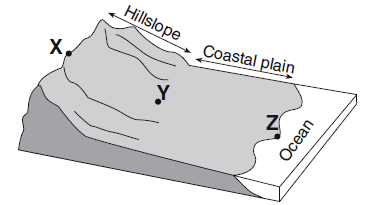
Question image

Compared to the stream velocity between point X and point Y, the stream velocity between point Y and point Z is most likely

1

greater, since the slope of the land decreases

2

greater, since the slope of the land increases

3

less, since the slope of the land decreases

4

less, since the slope of the land decreases

16

Multiple Choice

Question image

The three areas separated by highland divides are called

1

Tributaries

2

meanders

3

watersheds

4

floodplains

17

Multiple Choice

Give reasons for the differences in cross sections of rivers in the upper and lower courses
1
In the upper course rivers are narrow and swallow because the river is less powerful and discharge relatively low. In the lower course the river is wider and deeper as the river carries more load, discharges more and has more power to erode.
2
In the upper course rivers are wide and deep because the river is less powerful and discharge relatively low. In the lower course the river is narrow and shallow as the river carries more load, discharges more and has less power to erode.
3
•As a river moves from its upper to its lower course, it tends to carry more load, is wider, deeper, faster flowing and discharge increases.

18

Multiple Choice

A river may erode by the processes of corrosion, attrition, corrasion or hydraulic power. For hydraulic power describe how it works
1
•This is when river water and its load are thrown against the river banks causing erosion.
2
•Water and air are forced into cracks on the river bank, exerting a pressure. When this process is repeated many times it causes erosion.
3
A river carries large amounts of load that are constantly smashing into each other and breaking into smaller particles. This makes the load smaller and more rounded over time.

This involves the wearing away of the river bed and banks due the minerals in the rocks dissolving in the water

Show answer

Auto Play

Slide 1 / 18

FILL IN THE BLANK