Search Header Logo
waves through different media

waves through different media

Assessment

Presentation

•

Science

•

6th - 8th Grade

•

Practice Problem

•

Medium

•
NGSS
MS-ESS1-1, MS-PS4-1, MS-PS4-2

+13

Standards-aligned

Created by

Benevolence Yangsi

Used 27+ times

FREE Resource

28 Slides • 36 Questions

1

Introduction to Wave pt 3: EM vs Mechanical Waves

by Ms Yangsi

2

​Types of Waves

  • Waves may be categorized based on whether or not they need a medium.

  • ​There are two types of waves:

    • 1.) Mechanical waves: require a medium (matter) to travel.

      2.) Electromagnetic (EM) waves: do NOT require a medium to travel.

media

3

​Mechanical waves

  • ​These require a medium for the vibrations to travel and so cannot travel through space (vacuum)

  • ​

  • ​May either move as transverse or longitudinal waves.

  • ​

  • ​Ex. sound, water wave, slinky,

media

4

​​Mechanical waves

  • ​The speed at which they travel depends on either the type of wave or the medium they are in.

  • ​

  • ​They travel fastest in more dense medium. Therefore, they move fastest in solids and slowest in gases.

  • ​

  • ​Generally, these have longer wavelengths than electromagnetic waves.

media

5

media

6

​Electromagnetic Wave

  • ​A waves that does NOT require a medium (matter to travel), has an electric field component and a magnetic field component.

​

  • ​These two fields move perpendicular to the propagation of the wave and so they are all transverse waves

media

7

​Electromagnetic waves

  • ​All electromagnetic waves travels at the speed of light 3.0 x 10⁸ m/s in a VACUUM. However, they travels at different speeds when traveling through matter.

  • They travel fastest in less dense medium, so fastest in gases and slowest in solids.

  • Ex: Radio waves, Microwaves, Infrared, Visible Light, Ultraviolet, X-rays, and Gamma Ray.

media

8

​Electromagnetic Spectrum

  • ​Shows a visual display of various electromagnetic waves to compare their relative wavelengths and frequencies.

media

9

Multiple Choice

Which type of waves must have a medium in order to travel?

1

electromagnetic wave

2

mechanical wave

10

Multiple Choice

Mechanical waves usually travel fastest through:

1

solids

2

liquids

3

gases

11

Multiple Choice

Question image

What type of wave is this?

1

Electromagnetic

2

Mechancial

3

Both Electromagnetic and Mechanical

12

Multiple Choice

Question image

A microwave is an example of what type of wave?

1

electromagnetic wave

2

mechanical wave

13

Multiple Choice

Question image

A water wave is an example of what type of wave?

1

electromagnetic wave

2

mechanical wave

14

Multiple Choice

Wave with the longest wavelength
1
microwave
2
radio
3
gamma
4
visible light

15

Multiple Choice

When the wavelength increases the frequency will

1

increase

2

decrease

3

remain same

4

none of these

16

Multiple Choice

EM waves  
1
Must travel through a vacuum
2
Can travel through a medium or a vacuum
3
Are the same type of wave as mechanical waves
4
Can only travel through a vacuum

17

Multiple Choice

All electromagnetic waves have the same...
1
frequency
2
speed
3
wavelength
4
energy

18

Multiple Choice

When a wave is travelling through matter, what happens to the matter?

1

The matter is pulled along behind the wave as that makes it a longitudinal wave.

2

The wave is making the matter move back and forth as that will make a transverse wave.

3

The wave is making the matter move up and down.

4

The matter is pulled along behind the wave as that makes it a compressional wave.

5

The matter does not move along with the wave.

19

Multiple Choice

It depends on the medium in which the wave is traveling. It varies in solids, liquids and gases.

1

Frequency

2

Wave speed

3

Amplitude

4

Wavelength

20

Multiple Choice

Question image

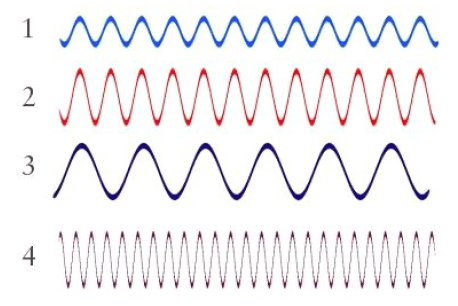
Which wave in the diagram has the greatest wavelength?

1

1

2

2

3

3

4

4

21

media

22

media

23

media

24

media

25

Multiple Choice

What is the highest point of a wave called?

1

rest position

2

trough

3

crest

4

amplitude

26

Multiple Choice

What is the lowest point of a wave called?

1

crest

2

trough

3

amplitude

4

rest position

27

Multiple Choice

What is the maximum distance a wave vibrates from its rest position?

1

crest

2

trough

3

amplitude

4

rest position

28

media

29

media

30

media

31

Multiple Choice

True or false: A wavelength can be measured only crest to crest or compression to compression

1

True

2

False

32

media

33

media

34

Multiple Choice

Frequency is measured in ______.

1

hertz

2

millimeters

3

seconds

4

minutes

35

Fill in the Blank

The higher the frequency, the _______ the wavelength./

36

Multiple Choice

What is the number of waves in a given amount of time called?

1

wave speed

2

wave length

3

frequency

4

amplitude

37

Multiple Choice

Higher frequency means the wave can carry more _____.

1

water

2

matter

3

amplitudes

4

energy

38

media

39

media

40

media

41

Multiple Choice

Which of the following is not one of the 4 basic properties of wave?

1

time

2

wave speed

3

amplitude

4

frequency

42

Multiple Choice

How does a wave's energy change as the wavelength is increased?

1

it doesn't change the energy remains the same

2

it increases with the wavelength increase

3

it decreases because the frequency decreases

4

it decreases because the wave length decreases.

43

Multiple Choice

How does a wave's energy change as the frequency is increased?

1

the energy increases because there are more waves passing by

2

the energy is deceased because there is a smaller wavelength

3

the energy is increased because there is a larger wavelength

4

the energy is decreased because there is a larger wavelength

44

Multiple Choice

How can you increase the amplitude of a wave in a rope?

1

make smaller movements

2

make larger movements

3

you can increase it

4

it can only be decreased

45

Multiple Choice

How can you increase the frequency of a wave of a rope?

1

move it slower

2

move rope in circles

3

move rope faster

4

stop moving the rope

46

media

47

Multiple Choice

The angle of incidence (incoming ray) will always equal the ray of reflection (outgoing ray).

1

True

2

False

48

Multiple Choice

What type of interaction is described a the bending of a wave as it passes at an angle from one medium to another?

1

Reflection

2

Refraction

3

Diffraction

4

Interference

49

media

50

media

51

Multiple Select

What changes as a wave passes through a new medium?

1

Speed

2

Wavelength

3

Amplitude

4

Direction of the wave

52

media

53

media

54

media

55

Multiple Choice

There is _______ relationship between the size of the opening a wave passes through and the amount of diffraction it experiences.

1

no apparent

2

a direct

3

an indirect

56

Multiple Choice

What type of wave interaction is the interaction between waves that meet and overlap?

1

Reflection

2

Transmission

3

Transmutation

4

Interference

57

media

58

media

59

Multiple Choice

Question image

What type of interaction does this picture represent?

1

Reflection

2

Interference

3

Refraction

4

Diffraction

60

Multiple Choice

Question image

What type of interaction does this picture represent?

1

Reflection

2

Interference

3

Refraction

4

Diffraction

61

Multiple Choice

Question image

What type of interaction does this picture represent?

1

Reflection

2

Interference

3

Refraction

4

Diffraction

62

Multiple Choice

Question image

What type of interaction does this picture represent?

1

Reflection

2

Interference

3

Refraction

4

Diffraction

63

Multiple Choice

Question image

What type of interaction does this picture represent?

1

Reflection

2

Interference

3

Refraction

4

Diffraction

64

Multiple Choice

Question image

What type of interaction does this picture represent?

1

Reflection

2

Interference

3

Refraction

4

Diffraction

Introduction to Wave pt 3: EM vs Mechanical Waves

by Ms Yangsi

Show answer

Auto Play

Slide 1 / 64

SLIDE