
Unit 3 Energy Test Review
Presentation
•
Science
•
7th Grade
•
Practice Problem
•
Hard
+7
Standards-aligned
8th Grade ELA
Used 64+ times
FREE Resource
30 Slides • 30 Questions
1
Unit 3a Energy Test
Review and Practice
2
Energy is the ability to do work or cause change.
3
Multiple Select
Check all the answers that apply. Energy is the ability to
Do work
Cause change
Change shapes
Change direction
4
Potential Energy
Energy that is stored based on an objects location or state.
5
Multiple Choice
Which of the following is an example of potential energy?
a phone sitting on a desk
a car driving down the road
a rubber band flying through the air
a pot with boiling water
6
Gravitational Potential Energy
7
8
Gravitational Potential Energy
Influenced by mass
More mass = more GPE
9
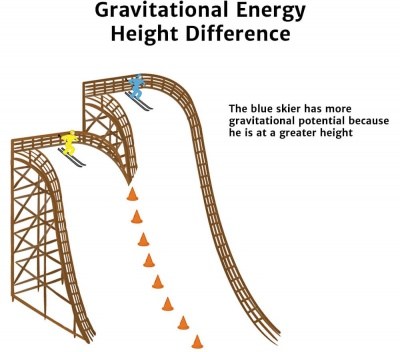
Gravitational Potential Energy
The further something is from the ground the more potential energy it has
Higher up = more GPE
10
Multiple Select
Select all the factors that influence gravitational potential energy.
Hardness
Mass
Amount of stretch
Amount of compression
Distance from the ground
11
Multiple Choice
Books are sitting on a bookshelf. Which book has the greatest gravitational potential energy?
a 1 lb book 1 foot away from the ground
a 1 lb book 3 feet away from the ground
a 2 lb book 1 foot away from the ground
a 2 lb book 3 feet away from the ground
12
Multiple Choice
The diagram shows two frogs sitting on a bookshelf. Both frogs weigh 5 ounces. Frog A (left) is 4 feet off of the floor. Frog B (right) is sitting 2 feet off of the floor.
How can you describe the potential energy of the two Frogs?
Neither frog has potential energy
Both frogs have the same potential energy
Frog A has more potential energy than frog B
Frog B has more potential energy than frog A
13
Multiple Choice
The diagram shows two frogs sitting on a bookshelf. Both frogs weigh 5 ounces. Frog A (left) is 4 feet off of the floor. Frog B (right) is sitting 2 feet off of the floor.
How can you decrease the potential energy of frog A?
Put frog A on a higher shelf.
Put frog A on a lower shelf.
Increase the weight of frog A.
Put frog A on top of the bookshelf.
14
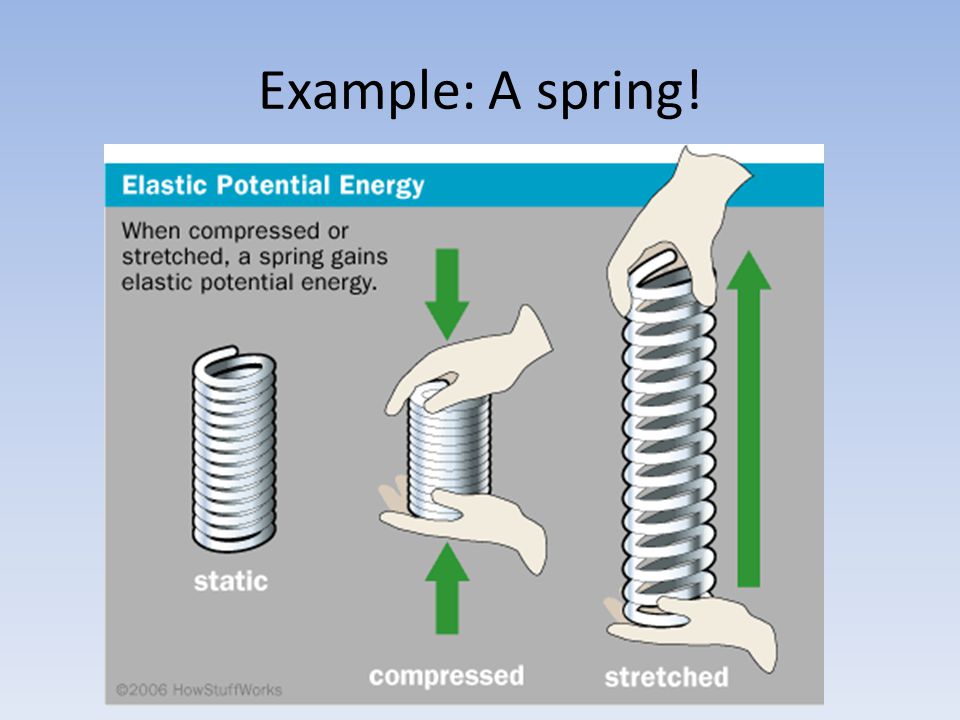
Potential Elastic Energy
Another form of potential energy
Has to do with being stretched or compressed
15
THREE things impact elastic energy!
16
#1 Impact - Stretching
Stretching something stores energy. Stretching it more stores more energy.
17
#2 Impact - Compression
Squishing something stores elastic energy. If you compress it more, you store more energy.
18
19
#3 Impact - How hard it is to stretch or compress something also impacts elastic energy.
20
Energy in = energy stored
When you put more energy into stretching or compressing something, that extra energy is stored in the object as elastic potential energy.
Harder materials need more force applied to change the shape.
21
Energy can transform from one type to another. Potential > Kinetic > Elastic
22
Multiple Select
Select all the factors that influence elastic potential energy. Hint: There are THREE!!!
Hardness
Mass
Amount of stretch
Amount of compression
Distance from the ground
23
Multiple Select
Someone is bouncing a ball. What types of energy are involved in bouncing the ball? Select all that apply. Hint: There are THREE
potential gravitational energy
potential elastic energy
kinetic energy
bounce energy
24
Energy Relationships
On tests you may see a chart like this showing 2 objects.
The column shows us how much of each energy type the object has.
Example: Car A has the most gravitational potential energy and the least kinetic energy.
Read the column to learn about the object
25
Multiple Choice
This diagram shows a ball bouncing. In position A, the ball has hit the ground and is compressed. In position B, the ball is halfway in the air. In position C, the ball is at the highest point in the bounce.
Which table shows the correct relationship between gravitational potential energy and elastic energy?
Amount of compression
26
Gravitational Energy and Kinetic Energy
Gravitational energy and potential energy are always exchanging
At the highest point an object has the most potential energy and the least kinetic energy
At the lowest point the object has the most kinetic energy and the least potential energy
In the middle the object will be a mix of potential and kinetic
27
Energy Relationships
On tests you may see a chart like this showing 2 objects.
The column shows us how much of each energy type the object has.
Example: Car A has the most gravitational potential energy and the least kinetic energy.
Read the column to learn about the object
28
Multiple Choice
A roller coaster is on a track. This picture shows 4 possible positions for the roller coaster.
Which table shows the correct relationship between gravitational potential energy and kinetic energy?
29
Multiple Choice
Ms. Welch, the seventh-grade science teacher, set up a pendulum in the science classroom. The pendulum is an object suspended on a string and allowed to swing back and forth. She starts the pendulum swinging. The picture shows the position of the pendulum as it swings from left to right.
At which position is the potential energy of the pendulum the greatest?
A
B
C
D
30
Multiple Choice
Ms. Welch, the seventh-grade science teacher, set up a pendulum in the science classroom. The pendulum is an object suspended on a string and allowed to swing back and forth. She starts the pendulum swinging. The picture shows the position of the pendulum as it swings from left to right.
At which position is the kinetic energy of the pendulum the least?
A
B
C
D
31
Multiple Choice
Ms. Welch, the seventh-grade science teacher, set up a pendulum in the science classroom. The pendulum is an object suspended on a string and allowed to swing back and forth. She starts the pendulum swinging. The picture shows the position of the pendulum as it swings from left to right.
At which position is the kinetic energy of the pendulum the greatest?
A
B
C
D
32
Multiple Choice
Ms. Welch, the seventh-grade science teacher, set up a pendulum in the science classroom. The pendulum is an object suspended on a string and allowed to swing back and forth. She starts the pendulum swinging. The picture shows the position of the pendulum as it swings from left to right.
What form of energy does the pendulum represent?
Radiant energy
Elastic energy
Chemical energy
Mechanical energy
33
Thermal Energy
The faster something's particles are moving, the hotter it will feel. This is thermal energy.
34
Multiple Choice
Particles in a warmer block will have ________ kinetic energy and move ______than the particles in the colder block.
more/slower
less/slower
less/faster
more/faster
35
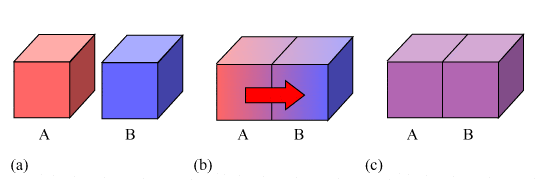
Thermal Energy Movement
Thermal energy always moves from the hotter object to the cooler object.
The particles bump and shove each other until the cooler ones are also moving quickly.
It stops when both things are the same temperature.
36
37
38
Multiple Choice
A mug is cool when it is in the cabinet. After hot water is added, it is too hot to hold comfortably.
Choose the best explanation for this scenario:
As the temperature of the mug increased due to the hot water, the particles in the mug moved slower and the thermal energy increased.
As the temperature of the mug increased due to the hot water, the particles in the mug moved slower and the thermal energy decreased.
As the temperature of the mug increased due to the hot water, the particles in the mug moved faster and the thermal energy increased.
As the temperature of the mug increased due to the hot water, the particles in the mug moved faster and the thermal energy decreased.
39
Multiple Choice
Which best describes the transfer of heat due to the movement of gases or liquids?
radiation
convection
evaporation
condensation
40
Multiple Choice
Select the arrow that would accurately diagram this thermal energy transfer
↺
↻
←
→
41
Multiple Choice
Which example shows us an example of conduction?
lava lamp
fire
spoon in soup
42
Multiple Choice
Which letter is an example of radiation?
A
B
C
43
44
45
Multiple Choice
Which mug has the largest amount of thermal energy?
a. Is a small mug. It is 100°F
b. Is a large mug. It is 120°F
c. Is a small mug. It is 120°F
A
B
C
46
Multiple Select
An ice cube with food coloring is placed in a glass of room temperature water. Dye begins to drop down from the ice cube to the bottom of the glass. Which of the following statements are true about the image?
Cold dye is more dense than hot dye
Particles in cold dye move more quickly
Particles in cold dye move more slowly
Particles in cold dye sink
If the water were heated, the dye would spread out more quickly
47
Multiple Choice
Blobs in a lava lamp cool and drop down to the bottom of the lava lamp. Which of the following statements is true about this image?
This is an example of convection
This is an example of radiation
This is an example of conduction
48
Open Energy Systems
Open systems allow energy and matter to come and go.
49
Closed Energy Systems
Closed energy systems only let energy come and go. Matter is trapped inside.
50
Isolated Energy Systems
Systems that NOTHING can come or go from are called isolated systems. There are no true isolated systems on Earth. The closest we can get is a thermos, cooler, or bank safe.
51
Multiple Choice
A hot pot with a closed lid is placed on a table. Something is placed in between the pot and the table to protect the table from heat. Why does the table need protection from heat?
The pot is an open system, heat and matter can enter and leave the pot
The pot is a closed system, heat can escape but matter cannot
The pot is an isolated system, heat and energy cannot escape
The pot is an open system, heat can escape but matter cannot
52
Energy is never created or destroyed.
Energy just transforms or transfers.
53
Multiple Choice
What does the Law of Conservation of Energy say about energy in the universe?
Energy is constantly created
Energy is constantly destroyed
Energy is never created or destroyed
All matter is being converted into energy
54
Multiple Choice
How do batteries supply energy to devices?
They create energy to give to the device
They store energy from another source for the device to use later
They move chemical energy from the wall to the device
They destroy leftover energy so it does not interfere with the device
55
Energy Transfers
Energy moves from one object to another object
56
Energy Transformation
57
Multiple Choice
Which device transforms mechanical energy into electrical energy?
Wind turbine
Fan
Mixer
Radio
58
Multiple Choice
Mrs. Kucalaba is using a battery operated drill to drill screws into a wood deck that she is building.
Which energy transformation explains how Mrs. Kucalaba was able to use a drill without an electrical cord being attached?
Chemical energy was transformed into mechanical energy
Mechanical energy was transformed into electrical energy
Sound energy was transformed into electrical energy
Kinetic energy was transformed into potential energy
59
Multiple Choice
Mrs. Kucalaba's drill is 75% energy efficient This means that 75% of the electricity used by the drill is used to drill holes or screw in screws.
Which statement best explains what happens to the other 25% of the electricity that goes into her drill?
The leftover energy is destroyed
The leftover energy is changed into heat and sound energy
The left over energy is changed into chemical energy
The leftover energy becomes potential electrical energy
60
Multiple Choice
Mrs. Cristell is bored. She decides to fidget with a paperclip. She grabs the paperclip and bends it repeatedly. It gets warm where she is bending it and then it breaks.
What type of energy transformation occurs when the metal is bent repeatedly?
Heat energy to mechanical energy
Metal energy to broken energy
Mechanical energy to heat energy
Boredom energy to fidget energy
Unit 3a Energy Test
Review and Practice
Show answer
Auto Play
Slide 1 / 60
SLIDE

Similar Resources on Wayground
56 questions
Unit 3 Study Guide: Atoms & Periodic Table
Presentation
•
6th - 8th Grade
56 questions
2024 March Mammal Madness Slide show
Presentation
•
6th - 8th Grade
53 questions
Introduction to Punnet Squares
Presentation
•
6th - 8th Grade
54 questions
Forces, Friction, & Newton's Laws - review
Presentation
•
7th Grade
54 questions
3.5 Pressure on solids
Presentation
•
7th Grade
53 questions
Geological Processes Test Review
Presentation
•
6th - 8th Grade
53 questions
Cells
Presentation
•
7th Grade
56 questions
Pollination
Presentation
•
7th Grade
Popular Resources on Wayground
20 questions
STAAR Review Quiz #3
Quiz
•
8th Grade
20 questions
Equivalent Fractions
Quiz
•
3rd Grade
6 questions
Marshmallow Farm Quiz
Quiz
•
2nd - 5th Grade
20 questions
Main Idea and Details
Quiz
•
5th Grade
20 questions
Context Clues
Quiz
•
6th Grade
20 questions
Inferences
Quiz
•
4th Grade
19 questions
Classifying Quadrilaterals
Quiz
•
3rd Grade
12 questions
What makes Nebraska's government unique?
Quiz
•
4th - 5th Grade
Discover more resources for Science
19 questions
Introduction to Properties of Waves
Presentation
•
6th - 8th Grade
16 questions
Interactions within Ecosystems
Presentation
•
6th - 8th Grade
45 questions
Food Webs
Quiz
•
6th - 8th Grade
16 questions
Photosynthesis and Cellular Respiration Review
Quiz
•
7th Grade
20 questions
Abiotic & Biotic Factors
Quiz
•
7th Grade
20 questions
Asexual/Sexual Reproduction
Quiz
•
7th Grade
20 questions
Energy Transformations
Quiz
•
6th - 8th Grade
20 questions
Food Webs + Energy Pyramids
Quiz
•
7th Grade