Chemical Equations/Thermal Energy & Chemical Processes
Presentation
•
Science
•
7th Grade
•
Practice Problem
•
Medium
+8
Standards-aligned
Levorn Miller
Used 8+ times
FREE Resource
27 Slides • 29 Questions
1
2
3
Chemical Equations Basics - Use the video to answer the questions on slides 4 through 7.
4
Multiple Choice
The '+' on the reactant side of a chemical equation means that
there are multiple molecules being combined
the number of molecules are increasing in the reaction
energy is being added
5
Multiple Choice
The word 'yield' which is represented by the arrow means
the direction the molecules are moving
to produce
to react with
6
Multiple Choice
The large number in front of a chemical formula is called a
reactant
compound
coefficient
7
Multiple Choice
Atoms are neither created nor destroyed in a chemical reaction. This means the total number of atoms are
conserved
increased
decreased
8
9
10
Use the video on slide 11 to answer the questions on slides 12 through 17.
11
12
Multiple Choice
a subscript
a coefficient
a variable
a divisor
13
Multiple Choice
In the chemical formula CaCl2, how man Chlorine atoms are there?
3
4
1
2
14
Multiple Choice
In the chemical formula CO2 how many Carbon atoms exist?
1
2
3
4
15
Multiple Choice
H2SO4
6
5
7
3
16
Multiple Choice
three hydrogen (H)
one sulfur (S)
four oxygen (O)
H3SO4
HSO4
H4S3O
H2O
17
Multiple Choice
3
6
12
24
18
19
20
21
22
Chemical Equations Brainpop
After viewing the video, you will answer the questions. All questions on slides 23 through 26 are based on the video.
Some text here about the topic of discussion
23
Multiple Choice
Which of the following is a chemical reaction?
Sodium and chlorine atoms bond to form salt molecules
Ice melts to form wdryater
Carbon dioxide freezes to form dry ice
Salt and water mix to form salt water.
24
Multiple Choice
2H2O 🡪 4H + O2
The reactants are on the right side of the arrow and the products are on the left side.
The reactants are on the left side of the arrow and the products are on the right side.
25
Multiple Choice
The chemical symbol "Ni" most likely represents:
Carbon
Lead
Nickel
Antimony
26
Multiple Choice
How do the products of chemical reactions compare to their reactants?
The products usually weigh more than the reactants.
The products often have completely different properties than the reactants.
The products usually have more atoms than the reactants.
The products are usually more toxic than the reactants.
27
28
Law of Conservation of Mass Brainpop
After viewing the video, you will answer the questions. All questions on slides 29 through 36 are based on the video.
Some text here about the topic of discussion
29
Multiple Choice
In science, a law is:
A rule governing what you are permitted to do.
A generalization about how the physical universe works.
A legal document that describes a rule of conduct.
30
Multiple Choice
What is true of a substace with a lot of mass?
It contains a lot of matter
It has a large volume
It has a high density.
It has a low frequency.
31
Multiple Choice
The law of conservation of mass says that substances can neither be created nor destroyed.
true
false
32
Multiple Choice
Mass and weight are the same thing.
true
false
33
Multiple Choice
Sodium and chlorine combine to form sodium chloride, or table salt. Sodium and chlorine are:
Producers
Reactants
Products
Yields
34
Multiple Choice
When sodium and chlorine combine to form sodium chloride, sodium chloride is the:
Product
Reactant
35
Multiple Choice
4 grams of hydrogen and 32 grams of oxygen will combine to form:
32 grams of oxygen
36 grams of water
36
Multiple Choice
In a chemical reaction, 4 grams of sodium must combine with how many grams of chlorine to produce 10 grams of table salt?
4
6
8
10
37
38
39
40
41
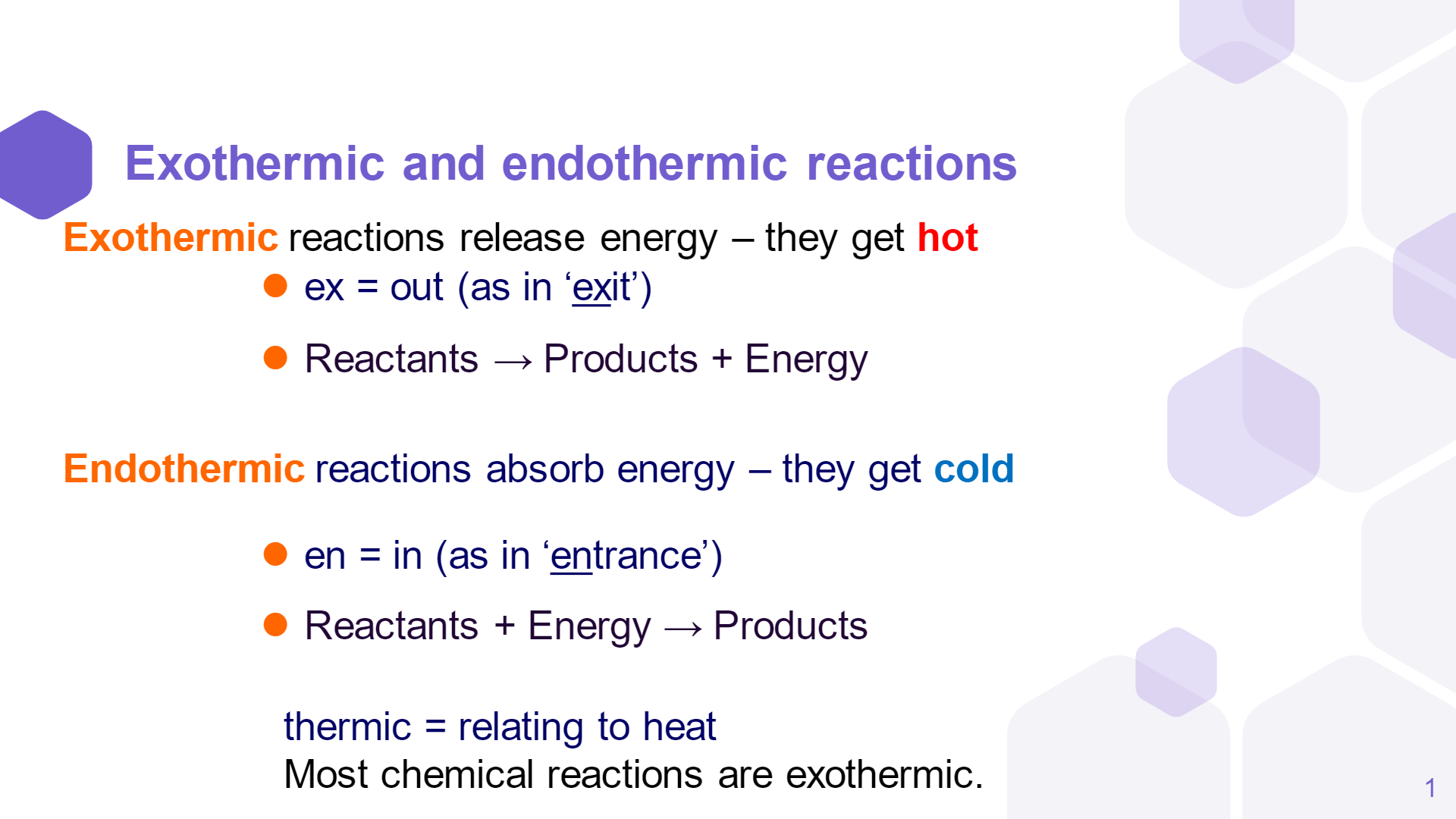
Endothermic & Exothermic Reactions
42
Multiple Choice
What term is given to a reaction which transfers heat energy to the surroundings?
Endothermic
Reversible
Exothermic
Exotermic
43
Multiple Choice
44
Multiple Choice
taken in or absorbed
given out or released
45
Multiple Choice
taken in or absorbed
given out or released
46
Multiple Choice
Exothermic
Endothermic
47
Multiple Choice
In an endothermic reaction, heat is ...
taken in
given out
48
49
50
51
52
53
54
55
56
Open Ended
Provide a response to the Factors That Affect Rates of Chemical Reactions you saw on slide 55. This can be an audio recording response or a typed response.
Show answer
Auto Play
Slide 1 / 56
SLIDE

Similar Resources on Wayground
51 questions
Mixtures, Solubility, and Acid/Base Solutions Chapter 11
Presentation
•
7th Grade
48 questions
Calculating Density Guided Lesson
Presentation
•
6th Grade
53 questions
2.8 Work, Energy & Machines
Presentation
•
7th Grade
50 questions
SCIENTIFIC METHOD
Presentation
•
7th Grade
54 questions
U0: The Nature and Practice of Science
Presentation
•
7th Grade
50 questions
Erosion & Deposition
Presentation
•
6th Grade
50 questions
Inner Planets
Presentation
•
6th Grade
49 questions
Heredity
Presentation
•
7th Grade
Popular Resources on Wayground
20 questions
STAAR Review Quiz #3
Quiz
•
8th Grade
20 questions
Equivalent Fractions
Quiz
•
3rd Grade
6 questions
Marshmallow Farm Quiz
Quiz
•
2nd - 5th Grade
20 questions
Main Idea and Details
Quiz
•
5th Grade
20 questions
Context Clues
Quiz
•
6th Grade
20 questions
Inferences
Quiz
•
4th Grade
19 questions
Classifying Quadrilaterals
Quiz
•
3rd Grade
12 questions
What makes Nebraska's government unique?
Quiz
•
4th - 5th Grade
Discover more resources for Science
19 questions
Introduction to Properties of Waves
Presentation
•
6th - 8th Grade
16 questions
Interactions within Ecosystems
Presentation
•
6th - 8th Grade
45 questions
Food Webs
Quiz
•
6th - 8th Grade
16 questions
Photosynthesis and Cellular Respiration Review
Quiz
•
7th Grade
20 questions
Abiotic & Biotic Factors
Quiz
•
7th Grade
20 questions
Asexual/Sexual Reproduction
Quiz
•
7th Grade
20 questions
Energy Transformations
Quiz
•
6th - 8th Grade
20 questions
Food Webs + Energy Pyramids
Quiz
•
7th Grade