

Chapter 4-Costs

Presentation
•
Computers
•
12th Grade
•
Hard

Steve Howard
FREE Resource
33 Slides • 31 Questions
1


Horngren’s Financial & Managerial
Accounting
Eighth Edition
Chapter 4
Cost Management
Systems: Activity-Based,
Just-in-Time, and Quality
Management Systems
Copyright © 2024, 2020, 2017 Pearson Education, Inc. All Rights Reserved
2


Copyright © 2024, 2020, 2017 Pearson Education, Inc. All Rights Reserved
Learning Objectives (1 of 3)
4.1 Assign direct costs and
allocate indirect costs using
predetermined overhead
allocation rates with single and
multiple allocation bases
4.2 Use activity-based costing
(ABC) to compute
predetermined overhead
allocation rates and allocate
indirect costs
3


Copyright © 2024, 2020, 2017 Pearson Education, Inc. All Rights Reserved
Learning Objectives (2 of 3)
4.3 Use activity-based
management (ABM) to make
decisions
4.4 Use activity-based
management (ABM) in a
service company
4


Copyright © 2024, 2020, 2017 Pearson Education, Inc. All Rights Reserved
Learning Objectives (3 of 3)
4.5 Describe a just-in-time (JIT)
management system and record
its transactions
4.6 Describe quality management
systems (QMS) and use the four
types of quality costs to make
decisions
5


Copyright © 2024, 2020, 2017 Pearson Education, Inc. All Rights Reserved
Learning Objective 4.1
Assign direct costs and allocate
indirect costs using
predetermined overhead
allocation rates with single and
multiple allocation bases
6


Copyright © 2024, 2020, 2017 Pearson Education, Inc. All Rights Reserved
How Do Companies Assign and
Allocate Costs? (1 of 3)
Product costs consist of direct materials, direct labor, and
manufacturing overhead.
• Easily traced and assigned to the product:
– Direct materials costs
– Direct labor costs
• Allocated to the product:
– Manufacturing overhead costs
7


Copyright © 2024, 2020, 2017 Pearson Education, Inc. All Rights Reserved
Single Plantwide Rate (1 of 4)
A single plant wide rate is
called the predetermined
overhead allocation rate
and is calculated before the
period begins.
• Traditional approach of
allocating manufacturing
overhead
• Simplest method
• One allocation base used
and applied to all units
Exhibit M:4-2 Single Plantwide Rate
8
Multiple Choice
9
Multiple Choice
10
Multiple Choice
11
Multiple Choice
12


Copyright © 2024, 2020, 2017 Pearson Education, Inc. All Rights Reserved
How Is an Activity-Based Costing
System Developed? (1 of 3)
• Activity based-management (ABM)
– Focuses on the primary activities the business
performs
– Uses cost information to make decisions that lead to
greater profits
• Activity-based costing (ABC) is the process of
determining the cost of the activities as building blocks for
allocating indirect costs to products and services.
13


Copyright © 2024, 2020, 2017 Pearson Education, Inc. All Rights Reserved
How Is an Activity-Based Costing
System Developed? (2 of 3)
Exhibit M:4-4 Examples of Activities and Allocation Bases
Activity
Allocation Base
Quality Inspection—Inspecting raw
materials or finished products
Number of inspections
Warranty Services—Providing service
for defective products
Number of service calls
Shipping—Shipping finished products
to customers
Number of pounds of product shipped
Setup—Setting up machines for
production
Number of batches
Machining—Machine usage
Number of machine hours
Purchasing—Purchasing raw
materials
Number of purchase orders
14
Multiple Choice
Activity-based costing:
Uses a plant-wide overhead rate to assign overhead
Is not expensive to implement
Typically applies overhead costs using direct labor-hours
Uses multiple activity rates
15
Multiple Choice
Product design is an example of which activity-level group?
Product-level activity
Facility-level activity
Batch-level activity
Unit-level activity
16
Multiple Choice
Which of the following characteristics would be an indicator that a company would benefit from switching to activity-based costing?
Only one homogenous product is produced on a continuous basis
The existing cost system is reliable and predictable
Overhead costs are high and increasing with no apparent reason
The costs of implementing ABC outweigh the benefits
17


Copyright © 2024, 2020, 2017 Pearson Education, Inc. All Rights Reserved
How Is an Activity-Based Costing
System Developed? (3 of 3)
Developing an activity-based costing system involves four
steps:
1. Identify activities and estimate their total indirect costs.
2. Identify the allocation base for each activity and estimate
the total quantity of each allocation base.
3. Compute the predetermined overhead allocation rate for
each activity.
4. Allocate indirect costs to the cost object.
18
Multiple Choice
In activity based costing, a cost driver is:
an overhead cost
a direct product cost
a resource consuming activity that causes overheads
a variable cost
19


Copyright © 2024, 2020, 2017 Pearson Education, Inc. All Rights Reserved
Step 1: Identify Activities and Estimate
Their Total Indirect Costs (1 of 2)
• Identify activities used to allocate manufacturing overhead.
• Examples of activities include:
– Quality inspections—inspecting raw materials or
finished products
– Shipping—shipping finished products to customers
– Setups—setting up machines for production
– Purchasing—purchasing raw materials
20


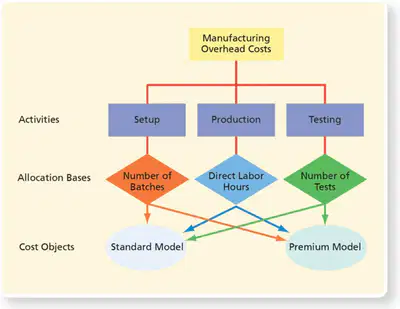
Copyright © 2024, 2020, 2017 Pearson Education, Inc. All Rights Reserved
Step 1: Identify Activities and Estimate
Their Total Indirect Costs (2 of 2)
Exhibit M:4-5 ABC System
21
Multiple Choice
An activity-based costing system is one that:
traces costs to activities and then to products.
traces costs to resources and then to activities.
traces activities to costs and then to resources.
traces products to activities and then to resources.
22


Copyright © 2024, 2020, 2017 Pearson Education, Inc. All Rights Reserved
Step 2: Identify the Allocation Base for Each Activity
and Estimate the Total Quantity of Each Allocation
Base
Smart Touch Learning determines that setup, production, and
testing are the ABC allocation bases.
Exhibit M:4-6 Smart Touch Learning—Allocation Base Summary
Activity
Allocation Base
Standard
Model
Premium
Model
Total
Setup
Number of batches
20 batches
25 batches
45 batches
Production
Direct labor hours
(DLHr)
10,000 DLHr
2,500 DLHr
12,500 DLHr
Testing
Number of tests
6,000 tests
4,000 tests
10,000 tests
23


Copyright © 2024, 2020, 2017 Pearson Education, Inc. All Rights Reserved
Traditional Costing Systems Compared
with ABC Systems
Single plantwide allocation rate
Blank
Standard Model
Premium Model
Direct materials cost per unit
$ 150.00
$ 200.00
Direct labor cost per unit
88.00
148.00
Manufacturing overhead cost per unit
35.20
59.20
Total cost per unit
$ 273.20
$ 407.20
Multiple department allocation rates
Blank
Standard Model
Premium Model
Direct materials cost per unit
$ 150.00
$ 200.00
Direct labor cost per unit
88.00
148.00
Manufacturing overhead cost per unit
33.58
65.68
Total cost per unit
$ 271.58
$413.68
Activity-based allocation rates
Blank
Standard Model
Premium Model
Direct materials cost per unit
$ 150.00
$ 200.00
Direct labor cost per unit
88.00
148.00
Manufacturing overhead cost per unit
30.80
76.80
Total cost per unit
$ 268.80
$ 424.80
24



Copyright © 2024, 2020, 2017 Pearson Education, Inc. All Rights Reserved
Learning Objective 4.3
Use activity-based
management (ABM) to
make decisions
25


Copyright © 2024, 2020, 2017 Pearson Education, Inc. All Rights Reserved
How Can Companies Use Activity-Based
Management to Make Decisions?
• Activity-based management (ABM) uses activity-based
costs to make decisions that increase profits while
meeting customer needs.
• ABM decisions include:
– Pricing and product mix
– Cost management
26
Multiple Choice
What is the role of management accountant in ABM and ABC ?
Creation of the ABC database
Maintenance of the ABM data warehouse
Target and life-cycle cost and profit analysis
All of the above
27
Multiple Choice
What is definition of Activity-Based Costing (ABC)?
a costing method that assigns overhead and indirect costs to related products and services
a system for determining the profitability of every aspect of a business so that its strengths can be enhanced and its weaknesses can either be improved or eliminated altogether
system that records, researches, and analyzes activities that lead to costs for a company
an aggregate of all the costs associated with performing a particular business task, such as making a particular product
28
Multiple Choice
ABC becomes ABM when it used to
Design products and services
Signal either continues or discontinues
Guide product mix & investment decisions
Choose among alternative suppliers
All of the above
29


Copyright © 2024, 2020, 2017 Pearson Education, Inc. All Rights Reserved
Pricing and Product Mix Decisions (1 of 3)
• Pricing decision:
– If the cost per unit changes, should the selling price
also change?
• Product mix decision:
– Compare the gross profit of two products and sell
the product with the greatest gross profit to
maximize total gross profit, considering limited
production capabilities.
30


Copyright © 2024, 2020, 2017 Pearson Education, Inc. All Rights Reserved
Cost Management Decisions (2 of 4)
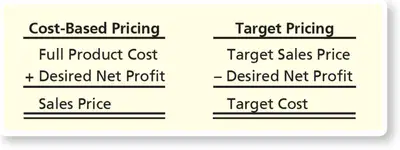
• Target pricing:
– The target price is the amount customers are willing to pay
for a product or service.
– The target cost is the maximum cost to develop, produce,
and deliver the product or service and earn the desired
profit.
• Cost-based pricing:
– The full product cost is the cost to develop, produce, and
deliver the product or service.
– Desired profit is added to this full product cost to determine
sales price.
31
Multiple Choice
A _______ is variable by nature and will increase or decrease in relation to increases and decreases in sales revenue.
direct cost
indirect cost
32
Multiple Choice
An __________ is one that cannot be identified with and traceable to a particular operating department or division.
direct cost
indirect cost
33
Multiple Choice
_________ costs that are not within the manager's control or influence.
Controllable
Noncontrollable
34
Multiple Choice
A ________ is one that is shared by, and thus is the responsibility of, two or more departments or areas.
sunk cost
joint cost
discretionary cost
opportunity cost
35
Multiple Choice
_________ are not expected to change in the short run of an operating period of a year or less, and will not vary with increases or decreases in sales revenue.
Fixed costs
Variable costs
36
Multiple Choice
A __________ is one that changes in direct proportion to a change in sales revenue.
fixed cost
variable cost
37


Copyright © 2024, 2020, 2017 Pearson Education, Inc. All Rights Reserved
Cost Management Decisions (3 of 4)
Exhibit M:4-8 Cost-Based Pricing Versus Target Pricing
38


Copyright © 2024, 2020, 2017 Pearson Education, Inc. All Rights Reserved
Learning Objective 4.4
Use activity-based
management (ABM) in a
service company
39


Copyright © 2024, 2020, 2017 Pearson Education, Inc. All Rights Reserved
How Can Activity-Based Management
Be Used in Service Companies? (1 of 3)
For service companies, we use the same steps to develop
overhead rates that we use for manufacturing companies:
1. Identify activities and estimate their total indirect costs.
2. Identify the allocation base for each activity and estimate
the total quantity of each allocation base.
3. Compute the predetermined overhead allocation rate for
each activity.
4. Allocate indirect costs to the cost object.
40


Copyright © 2024, 2020, 2017 Pearson Education, Inc. All Rights Reserved
How Can Activity-Based Management
Be Used in Service Companies? (2 of 3)
Get Well Hospital decides to use ABM to allocate overhead
costs to Henry Whitestone, a patient at the hospital.
Step 1
Activity
Step 1
Estimated
Overhead Costs
Step 2 Allocation
Base
Step 2
Estimated
Quantity of
Allocation Base
Step 3
Predetermined
Overhead
Allocation Rate
Admission
$ 80,000
Number of staff-hours
800 hours
$100 per staff-hour
Procedures
200,000
Number of tests
2,500 tests
$ 80 per test
Care
120,000
Number of nurse-hours
3,000 hours
$ 40 per nurse-hour
Total
$ 400,000
Blank
Blank
Blank
41


Copyright © 2024, 2020, 2017 Pearson Education, Inc. All Rights Reserved
How Can Activity-Based Management
Be Used in Service Companies? (3 of 3)
Total overhead costs are allocated to Henry Whitestone as
follows:
Step4
Activity
Step4 Predetermined
Overhead Allocation
Rate
Step 4
times
Step4 Actual
Quantity of the
Allocation Base
Used
Step4
Allocated
Overhead
Costs
Admission
$100 per staff-hour
times
1 staff-hour
$ 100
Procedures
$80 per test
times
5 tests
400
Care
$40 per nurse-hour
times
20 nurse-hours
800
Blank
Blank
Blank
Blank
$ 1,300
42


Copyright © 2024, 2020, 2017 Pearson Education, Inc. All Rights Reserved
Learning Objective 4.5
Describe a just-in-time (JIT)
management system and
record its transactions
43


Copyright © 2024, 2020, 2017 Pearson Education, Inc. All Rights Reserved
How Do Just-In-Time Management
Systems Work? (1 of 3)
A just-in-time management system reduces inventory
costs.
• Raw materials and finished goods are completed just in
time for delivery to customers.
• The cost of buying, storing, and moving inventory can be
significant for companies.
44


Copyright © 2024, 2020, 2017 Pearson Education, Inc. All Rights Reserved
How Do Just-In-Time Management
Systems Work? (2 of 3)
Exhibit M:4-9 Production Flow Comparison: Just-in-Time Versus
Traditional Production
45


Copyright © 2024, 2020, 2017 Pearson Education, Inc. All Rights Reserved
Just-In-Time Costing (1 of 2)
Just-in-time costing is a costing system that simplifies
accounting for companies.
• It tracks costs after the units are completed.
• It combines Raw Materials Inventory and Work-in-Process
Inventory into Raw and In-Process Inventory.
• The Conversion Costs account combines direct labor
and manufacturing overhead costs.
46
Multiple Choice
47
Multiple Choice
Prime cost =
Indirect materials + Indirect labour + Indirect expenses
Total material + Total labour + Other expenses
Total cost + selling costs + distribution costs
Direct material + Direct labour + Direct expenses
48
Multiple Choice
Supply and demand is used in combination with which of the following inventory management methods?
LIFO method
FIFO method
Just In Time (JIT) method
Just In Case (JIC) method
49


Copyright © 2024, 2020, 2017 Pearson Education, Inc. All Rights Reserved
Just-In-Time Costing (2 of 2)
Exhibit M:4-10 Comparison of Traditional and Just-in-Time Costing
Blank
Traditional
Just-in-Time
Production activity
Records the costs of products
as they move through the
manufacturing process
Records the costs of
products when units are
completed
Inventory accounts
Raw Materials Inventory Work-
in-Process Inventory Finished
Goods Inventory
Raw and In-Process
Inventory Finished Goods
Inventory
Manufacturing costs
Direct materials Direct labor
Manufacturing overhead
Direct materials Conversion
costs
50



Copyright © 2024, 2020, 2017 Pearson Education, Inc. All Rights Reserved
Learning Objective 4.6
Describe quality management
systems (QMS) and use the
four types of quality costs to
make decisions
51


Copyright © 2024, 2020, 2017 Pearson Education, Inc. All Rights Reserved
How Do Companies Manage Quality
Using a Quality Management System?
• A system that help managers improve the business’s
performance by providing quality products and services is
called a quality management system (QMS).
• The goals of quality management systems are to:
– Improve performance
– Increase customer satisfaction
– Increase profits
52


Copyright © 2024, 2020, 2017 Pearson Education, Inc. All Rights Reserved
Data Analytics in Accounting
• Quality management software, such as Greenlight
Guru and MasterControl, is available to help
companies improve quality.
• These enterprise systems use analytic tools and real-
time data to assist management with compliance
control, customer satisfaction management, and risk
management.
53


Copyright © 2024, 2020, 2017 Pearson Education, Inc. All Rights Reserved
The Four Types of Quality Costs (1 of 2)
• Prevention costs―Costs incurred to avoid poor-quality
goods or services.
• Appraisal costs―Costs incurred to detect poor-quality
materials, goods, or services.
• Internal failure costs―Costs incurred to correct goods
or services before delivery to customers.
• External failure costs―Costs incurred after delivery to
the customer has occurred.
54
Multiple Choice
55
Multiple Choice
56
Multiple Choice
57
Multiple Choice
When products are checked throughout the production process this is called
Quality Circles
Quality Assurance
Quality Control
58
Multiple Choice
When products are checked at the end of the production process this is called
Quality Assurance
Quality Circles
Quality Control
59
Multiple Choice
60
Multiple Choice
What is a high quality product?
A product that does not meet customer expectations but fulfills the customers needs at a price they are willing to pay
A product that meets customer expectations but not at a price they are willing to pay
A product that meets customer expectations and fulfills the customers needs at a price they are willing to pay
61
Multiple Choice
Quality Assurance is carried out
At the end of production
During all stages of production
During some stages of production
62
Multiple Choice
Total Quality Management involves
Management
management, workforce, suppliers, and even customers, in order to meet or exceed customer expectations.
management and customers, in order to meet or exceed customer expectations.
63

Copyright © 2024, 2020, 2017 Pearson Education, Inc. All Rights Reserved
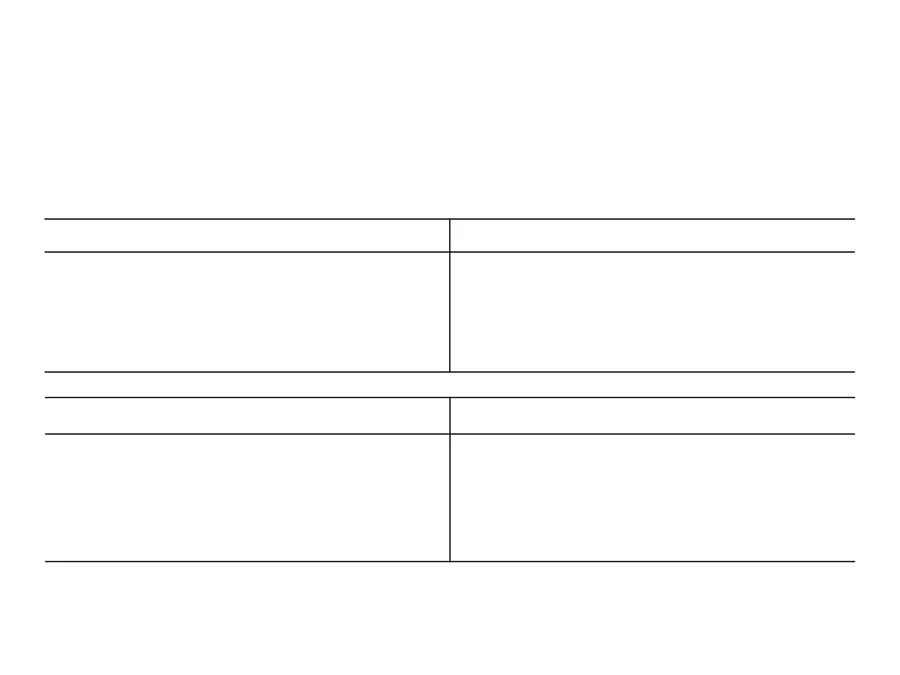
The Four Types of Quality Costs (2 of 2)
Exhibit M:4-13 Four Types of Quality Costs
Prevention Costs
Appraisal Costs
•Employee training
•Evaluation of the quality of suppliers‘
processes
•Preventive maintenance on equipment
•Inspection at various stages of
production
•Inspection of final products or services
•Product testing
Internal Failure Costs
External Failure Costs
•Any production problem that causes
manufacturing to stop
•Reworking of substandard products
•Rejected products
•Lost profits due to unhappy customers
•Warranty costs
•Service costs at customer sites
•Sales returns due to product defects
64
Multiple Choice
Horngren’s Financial & Managerial
Accounting
Eighth Edition
Chapter 4
Cost Management
Systems: Activity-Based,
Just-in-Time, and Quality
Management Systems
Copyright © 2024, 2020, 2017 Pearson Education, Inc. All Rights Reserved
Show answer
Auto Play
Slide 1 / 64
SLIDE
Similar Resources on Wayground

56 questions
Y12 Enterprise Project Wk1
Presentation
•
12th Grade
52 questions
D.3 Pricing and Output Decisions
Presentation
•
12th Grade
52 questions
Module 1: Practical Research 2
Presentation
•
12th Grade
50 questions
L1: Flowcharts-and-pseudoco
Presentation
•
12th Grade
60 questions
What is information technology
Presentation
•
University
56 questions
Inflation
Presentation
•
University
55 questions
Sosial Media Optimalisasi
Presentation
•
University
59 questions
Y12 EC Project Sample Lesson 1-Review
Presentation
•
12th Grade
Popular Resources on Wayground
10 questions
Safety Day 2026 – Student Review

Quiz
•
9th Grade
21 questions
Continents and Oceans
Quiz
•
6th Grade
20 questions
Parts of Speech
Quiz
•
5th Grade
16 questions
Subject & Predicate
Quiz
•
5th Grade
25 questions
Multiplication Facts
Quiz
•
5th Grade
12 questions
Map Skills
Quiz
•
3rd Grade
22 questions
Continents and Oceans
Quiz
•
5th Grade
15 questions
Rounding Decimals
Quiz
•
5th Grade