Solar vs Lunar Eclipse
Presentation
•
Science
•
9th - 12th Grade
•
Medium
+9
Standards-aligned
Takia Miller
Used 14+ times
FREE Resource
36 Slides • 29 Questions
1
Solar Eclipses vs. Lunar Eclipses
Do you know the difference?
2
Eclipses
I can explain the different positions of the Earth, Moon, and Sun that result in eclipses.
The moon revolves around Earth, creating moon phases and eclipses. Solar eclipses occur when the moon blocks sunlight from Earth’s surface, while lunar eclipses occur when Earth blocks sunlight from reaching the moon’s surface
3
How can I remember the different types of Eclipses?
An easy way to remember is in the name:
In a solar eclipse, the SUN gets darker
In a lunar eclipse, the MOON gets darker
4
5
Different Shadows
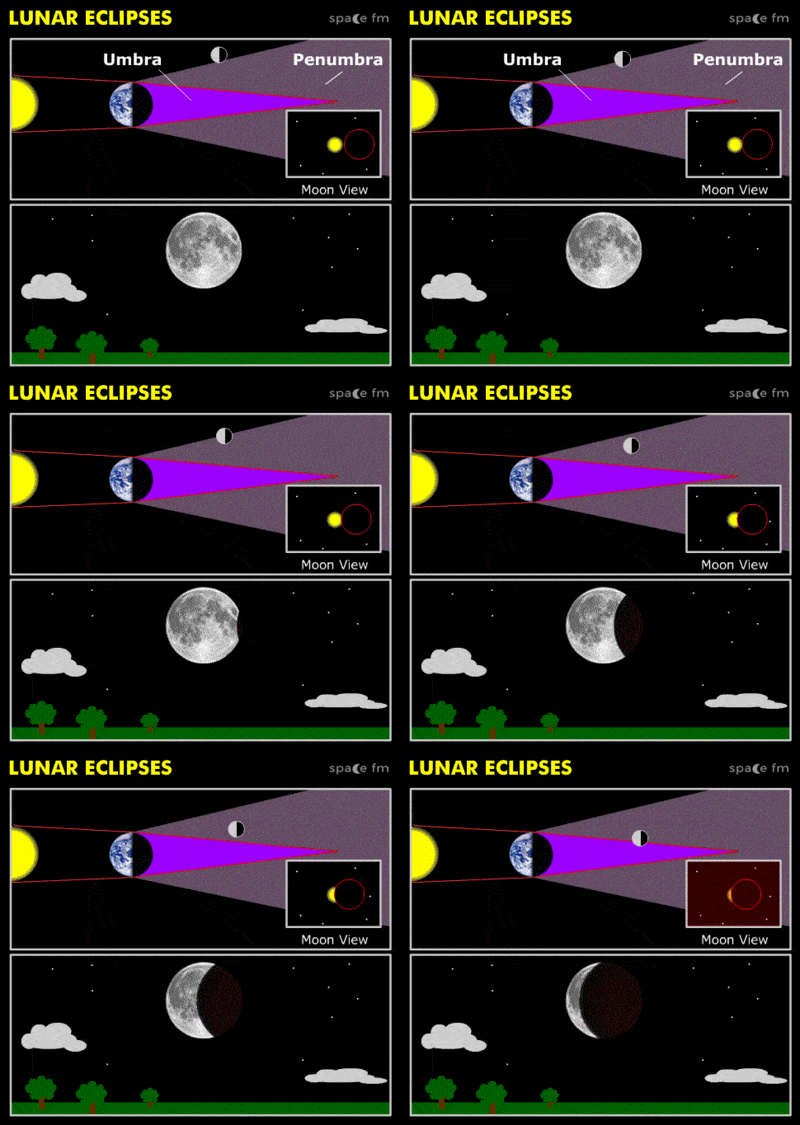
UMBRA - the fully shaded inner region of a shadow cast by an opaque object
PENUMBRA - the partially shaded outer region of the shadow cast by an opaque object.
6
7
8
9
Multiple Select
What do we call the darker part of the shadow?
Umbra
Penumbra
Thanos
Darth
10
Multiple Select
___________ is the lighter part on the edges of the shadow.
Umbra
Penumbra
Opaque object
Screen
11
Multiple Select
Light ________ pass through an opaque object.
Can
Will
Cannot
Must
12
Multiple Select
The size of the shadow changes according to the ___________ between the object and the light source.
Distance
Brightness
Orientation
Screen
13
What is an Eclipse?
The total or partial obscuring of one celestial body by another.
An eclipse is an astronomical event; one object in the sky moves into the shadow of another object.
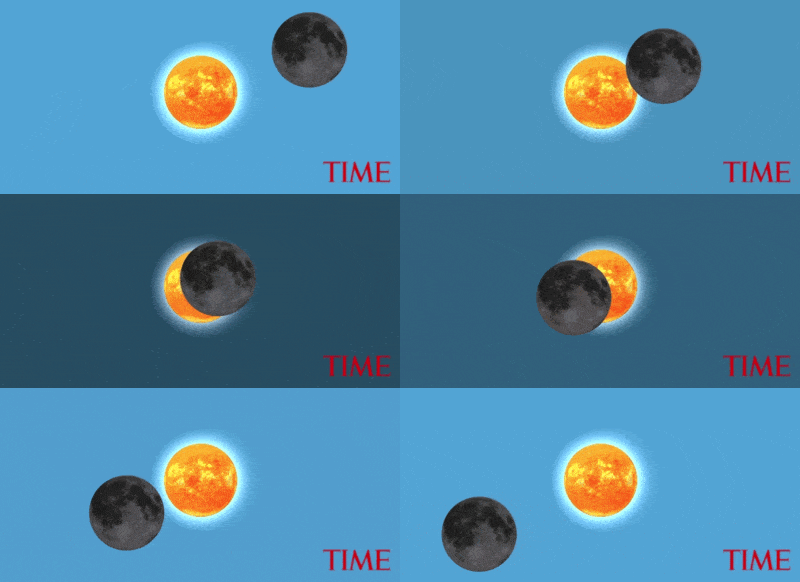
Solar eclipse = New moon shadow crosses the Earth's surface
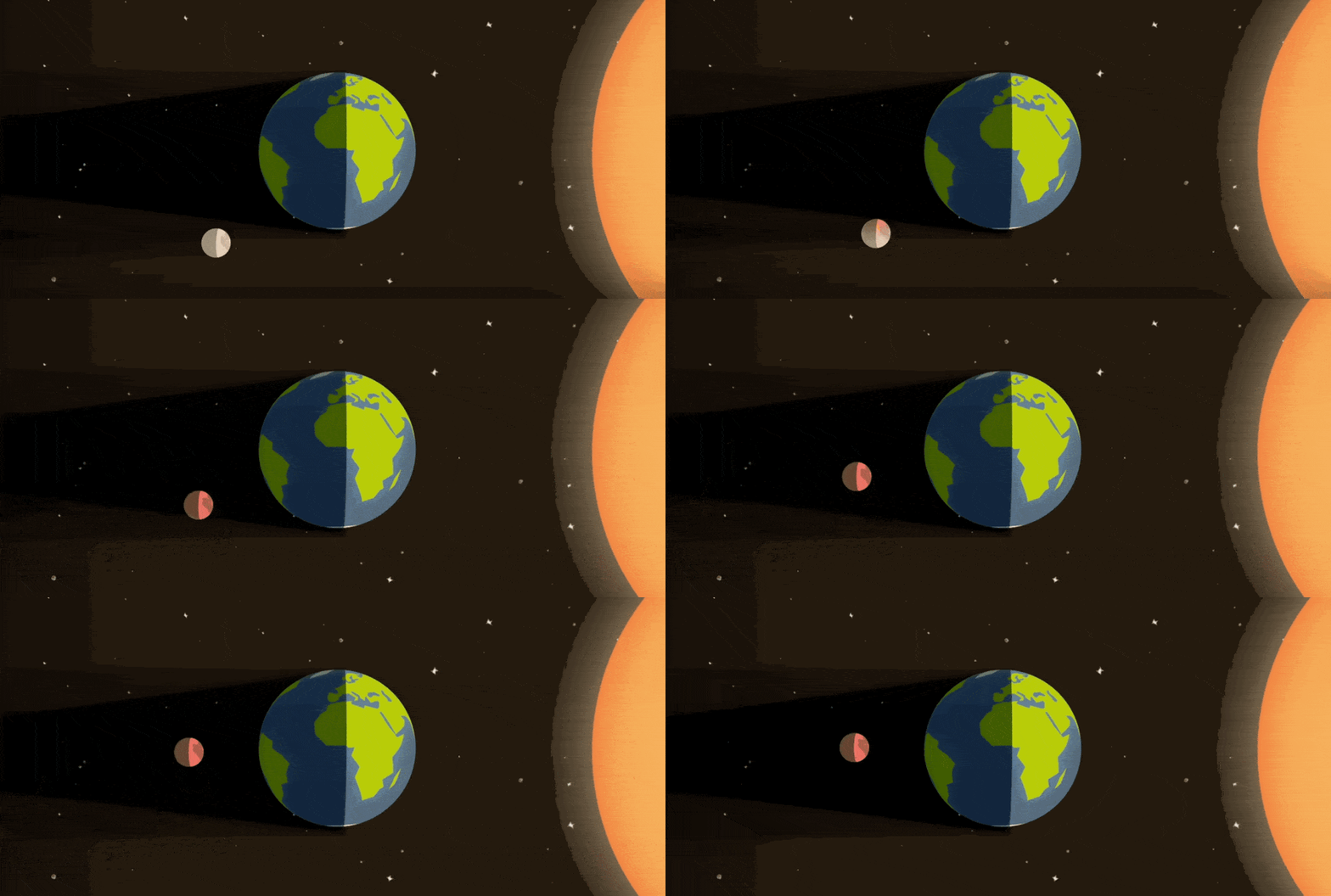
Lunar eclipse = Earth shadow darkens the full moon
14
15
Open Ended
What happens during a SOLAR eclipse?
16
What type of ECLIPSE is shown here?
17
Solar Eclipses
Only happen during NEW MOON phase
Happen 2-5 times per year on different parts of Mother Earth
There are different types of solar eclipses: total, partial, & annual.
18
Total Solar Eclipse
Happen when the sun is completely blocked by the moon.
Only visible from a specific part of the Earth. The moon is considerably smaller and this its shadow will only pass through a narrow path on Earth’s surface.
Areas around that path will only see a partial solar eclipse.
19
Partial Solar Eclipses
When the Moon doesn’t completely cover the Sun.
The Moon passes off-center and only a portion of the Sun is obscured.
20
Annular Eclipse
The Moon doesn’t cover the entirety of the Sun, even if the Moon’s completely centered in front of it. This happens because the Moon’s orbit is an elliptical and the Moon is closer to the Earth.
During this kind of eclipse, the bright ring around the Moon is called the “ring of fire.”
21
During this kind of eclipse, the bright ring around the Moon is called the “ring of fire.”
22
Eclipses look different depending on your location/viewpoint.
23
Multiple Choice
A _________ is the blocking of the Sun's light that occurs during a new moon when the moon's shadow falls on earth.
solar eclipse
lunar eclipse
umbra
penumbra
24
Multiple Choice
A solar eclipse only happens during the day.
True
False
25
Multiple Choice
The moon phase for a solar eclipse is a full moon.
True
False
26
Multiple Choice
For a solar eclipse to occur, the alignment must be ?
none of the above
Sun, moon, Earth
Earth, sun, moon
sun, Earth, moon
27
Multiple Choice
What type of eclipse is this an example of?
Lunar Eclipse
Solar Eclipse
28
Multiple Choice
The moon's orbit is tilted about _____ degrees relative to Earth's orbit around the sun.
5
23.5
27.3
29.5
29
Multiple Choice
A total solar eclipse is visible from
only within the moon's penumbra.
only within the moon's umbra.
only the dark side of Earth.
all over Earth.
30
Open Ended
What happens during a LUNAR eclipse?
31
32
ECLIPSES
A lunar eclipse happens when the earth passes in between the moon and the sun. EARTH SHADOW
A solar eclipse happens when the moon passes in between the earth and the sun. MOON SHADOW
33
34
SOLAR vs. LUNAR
SOLAR eclipse = NEW MOON
Part of the earth darkens
LUNAR eclipse = FULL MOON
Moon darkens/changes color
35
Solar eclipse = MOON SHADOW
36
LUNAR ECLIPSE = FULL MOON
37
TOTAL - Earth's shadow completely covers the moon
PARTIAL - part of the Moon's visible surface moves into the umbra of the Earth's shadow.
PENUMBRAL - only the more diffuse outer shadow of Earth falls on moon’s face.
38
TOTAL - Moon is completely covered by Earth's shadow
39
PENUMBRAL - moon passes through Earth's penumbra
40
41
Blood Moons...
During a lunar eclipse, Earth gets in the way of the sun's light hitting the moon. The moon can also look reddish because Earth's atmosphere absorbs the other colors while it bends some sunlight toward the moon.
42
BLOOD MOONS
43
44
Multiple Choice
What type of eclipse is this an example of?
Lunar Eclipse
Solar Eclipse
45
Open Ended
What happens during a LUNAR eclipse?
46
Open Ended
What happens during a SOLAR eclipse?
47
Choose open in a new tab to go to the Eclipse Simulator website
48
Multiple Choice
What is the difference between a solar eclipse and a lunar eclipse?
A solar eclipse occurs when the Moon passes between the Earth and the Sun, while a lunar eclipse occurs when the Earth passes between the Moon and the Sun.
A solar eclipse occurs when the Earth passes between the Moon and the Sun, while a lunar eclipse occurs when the Moon passes between the Earth and the Sun.
A solar eclipse occurs when the Moon passes between the Earth and the Sun, while a lunar eclipse occurs when the Moon passes between the Earth and the Sun.
A solar eclipse occurs when the Earth passes between the Moon and the Sun, while a lunar eclipse occurs when the Earth passes between the Moon and the Sun.
49
Solar vs Lunar Eclipses
Solar Eclipse: Moon passes between Earth and Sun.
Lunar Eclipse: Earth passes between Moon and Sun.
Solar eclipses are rarer and can only be seen from specific locations, while lunar eclipses are visible from anywhere on Earth. Both are fascinating celestial events!
50
Exploring Eclipses
51
Total Lunar Eclipses vs Total Solar Eclipses
Total lunar eclipses occur when the moon gradually covers more of the Sun over the next hour, while total solar eclipses start with a small 'bite' taken out of the Sun's edge as the moon cuts across its disk.
52
Multiple Choice
What is the difference between a total lunar eclipse and a total solar eclipse?
Total lunar eclipses are visible from anywhere on the night side of the Earth during the eclipse, while total solar eclipses are not.
Total lunar eclipses occur when the moon gradually covers more of the Sun over the next hour, while total solar eclipses start with a small 'bite' taken out of the Sun's edge as the moon cuts across its disk.
Total lunar eclipses are only visible from specific locations on Earth, while total solar eclipses are visible from anywhere on the day side of the Earth during the eclipse.
Total lunar eclipses occur when the moon completely covers the Sun, while total solar eclipses occur when the moon partially covers the Sun.
53
Solar Eclipse
54
Viewing a Partially Covered Sun
Trivia: When viewing a partially covered sun, it is important to be cautious. Never use sunglasses or a telescope, as they do not provide adequate protection. Instead, cover your eyes with your hands or use special solar viewing glasses. Remember, safety first when observing celestial events!
55
Multiple Select
What precautions should be taken when viewing a partially covered sun?
Wear sunglasses
Use a telescope
Cover your eyes with your hands
Use special solar viewing glasses.
56
Multiple Choice
What moon phase occurs during a solar eclipse?
Full Moon
1st Quarter
New Moon
Waxing gibbous
57
Multiple Choice
In order to have an eclipse, the earth, sun, and moon have to be?
Below each other
Above each other
In alignment
58
Multiple Choice
What moon phase occurs during a lunar eclispe?
Full moon
Third quarter
New moon
Waxing crescent
59
Multiple Choice
What type of eclipse occurs when the earth's shadow is cast on a full moon?
Lunar eclipse
Solar eclipse
60
Multiple Choice
What type of eclipse occurs when the moon blocks the sun's light and casts a shadow on earth?
Solar eclipse
Lunar eclispe
61
Multiple Choice
What is the darker, inner most part of the shadow called?
Umbra
Penumbra
62
Multiple Choice
What is the lighter, outer most part of the shadow called?
Umbra
Penumbra
63
Multiple Choice
What part of the shadow must I be in to see a TOTAL solar eclipse?
Umbra
Penumbra
64
Multiple Choice
Which type of eclipse happens more often?
Solar eclipse
Lunar eclipse
65
Multiple Choice
True or False:
A solar eclipse happens during the day
True
False
Solar Eclipses vs. Lunar Eclipses
Do you know the difference?
Show answer
Auto Play
Slide 1 / 65
SLIDE

Similar Resources on Wayground
58 questions
Limiting Factors Carrying Capacity
Presentation
•
9th - 12th Grade
66 questions
Biomes on Earth Lesson
Presentation
•
9th - 12th Grade
60 questions
HAP5 Respiratory System
Presentation
•
10th - 12th Grade
61 questions
10.8 Review: Urbanization and Land Conservation
Presentation
•
9th - 12th Grade
61 questions
AP- Transition Words
Presentation
•
9th - 12th Grade
57 questions
Les Adjectifs Possessifs
Presentation
•
9th - 12th Grade
58 questions
Components of an Ecosystem
Presentation
•
9th - 12th Grade
Popular Resources on Wayground
20 questions
STAAR Review Quiz #3
Quiz
•
8th Grade
20 questions
Equivalent Fractions
Quiz
•
3rd Grade
6 questions
Marshmallow Farm Quiz
Quiz
•
2nd - 5th Grade
20 questions
Main Idea and Details
Quiz
•
5th Grade
20 questions
Context Clues
Quiz
•
6th Grade
20 questions
Inferences
Quiz
•
4th Grade
19 questions
Classifying Quadrilaterals
Quiz
•
3rd Grade
12 questions
What makes Nebraska's government unique?
Quiz
•
4th - 5th Grade
Discover more resources for Science
46 questions
Unit 4 Geosphere Test Review
Quiz
•
9th - 12th Grade
25 questions
Naming Ionic and Covalent Compounds
Quiz
•
9th Grade
20 questions
Human Impact on the Environment Review #2
Quiz
•
9th Grade
16 questions
Ecosystem Stability
Quiz
•
9th Grade
20 questions
Mendelian Genetics Review
Quiz
•
9th Grade
12 questions
Unit 6 Quiz #3 (Life Cycles of Stars)
Quiz
•
9th Grade
34 questions
Human Impact on Ecosystems Quiz
Quiz
•
9th Grade
10 questions
Exploring Alfred Wegener's Continental Drift Theory
Interactive video
•
6th - 10th Grade