

Earth Science Chapter 21

Presentation
•
Science
•
6th Grade
•
Practice Problem
•
Hard
+12
Standards-aligned

Katie Vance
FREE Resource
19 Slides • 11 Questions
1
21 A "What is climate?
Be careful to follow this Quizzez. Make sure when you are supposed to read, you actually read.
Goals for today:
1. Contrast weather from climate
2. Analyze factors that may affect climate
2
Poll
What level is your concern for climate change?
Climate change is a jake
Climate change is happening, but it's not too serious
I'm concerned
Climate change is a very serious problem, and we must do something soon to fix it
3
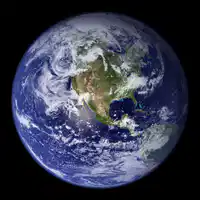
EXPERIMENTING WITH EARTH
Earth’s climate seems to be changing, and to many people this spells trouble. Satellites show melting glaciers and rising sea levels. Computer models predict warming temperatures. Many scientists blame people for producing greenhouse gases that heat up Earth’s atmosphere.
4
EXPERIMENTING WITH EARTH
According to these scientists, only drastic action will save the planet.
They believe that we must reduce the amount of greenhouse gases like the carbon dioxide produced by cars, factories, and power plants. Every person plays a part because we all contribute to these emissions. This is our carbon footprint.
Some scientists suggest that we try to cool the earth artificially. If we could just reflect some of the sun's energy away from the earth, that might cool the planet. We could place mirrors in orbit or create artificial clouds to do this. Others suggest removing the problem carbon dioxide from the air by forcing more plants to grow, or by liquefying and burying it. But will all of this actually fix the problem?

5
21 A WHAT IS CLIMATE?
What is climate, and what factors affect it?
At the heart of the climate change debate is the question of how we should treat Earth. God made this planet our home, and He wants us to take care of it. That doesn't mean that we can do anything we want with Earth's resources. It also doesn't mean that we should protect those resources at all costs. So should we use Earth or protect it from use? We should do both! Conservation is the preservation and wise use of earth's resources with a mind for the future. The work of conservation involves protecting some resources that are limited, have big effects on people, or are key parts of Earth's environment. Conservation also includes using other resources in managed ways, like creating the national parks.
6
Multiple Choice
What is the central idea regarding Earth's treatment in the climate change debate?
A) Earth should be exploited for resources without any restrictions.
B) Earth should be preserved at all costs, even if it means limiting human activities
C) Earth should be both used and protected through conservation efforts
D) Earth's treatment is irrelevant to the climate change debate.
7
8
Multiple Choice
What is the primary difference between weather and climate?
A) Weather focuses on long-term trends, while climate describes short-term atmospheric conditions.
B) Weather is the average atmospheric conditions over a long period, while climate describes short-term variations.
C) Weather is the present or near-future atmospheric conditions, while climate is the average weather for an area over a longer period.
D) Weather is studied by climatologists, while climate is studied by meteorologists
9
Christians should be the most passionate conservationists because wisely using God's world is one of the first commands God gave to mankind (Gen. 1:28). He cares about His world and wants us to use it in ways that allow the people He made in His image to flourish and grow. A growing human population is part of the Creation Mandate. Whether we recycle, adopt a highway, plant a garden, or do animal res-cue, we're taking care of God's creation for His glory.
Thinking about God's world in light of His Word brings clarity to the climate change debate. We must make decisions that best use the earth's resources, save money, and, most importantly, help people.
And to do all these things we need to understand Earth's climate and what affects it. So let's get started!
10
Multiple Choice
Which of the following statements aligns with the perspective presented regarding Christians' role in conservation efforts?
A) Christians should disregard conservation efforts as they are not mentioned in the Bible.
B) Christians should prioritize their own interests over the conservation of Earth's resources.
C) Christians should be passionate conservationists as instructed by God's command to wisely use His creation.
D) Christians should solely focus on spiritual matters and not concern themselves with environmental issues.
11
Multiple Choice
Who primarily studies climate and its long-term trends?
Meteorologists
Weather forecasters
Environmentalists
Climatologists
12
Do you ever notice the weather in places other than where you live? What do you observe? Though weather changes every day, Vermont has snowy, cold winters and Florida has mild, warmer winters. But why is that true? And why does the state of Washington get so much rainfall while parts of California don’t? After all, they’re both on the US Pacific coast. Average temperatures and precipitation define climates. But many conditions control these factors for a given region of the world. Let’s understand what these conditions are before looking at the different kinds of climate zones.
13
TEMPERATURE
Latitude. Surface air temperature depends on the amount of thermal energy in the air. The sun’s rays can warm the air directly, but most heat comes from contact with ground or water heated by the sun. The sun’s rays heat the earth’s surface most efficiently when the rays are ver- tical. Vertical rays travel the shortest path through the atmosphere, so fewer are absorbed. Also, vertical sunlight packs the most rays into a given area of the earth’s surface, so more heating can occur in a given amount of time. The angle that the sun’s rays make with the earth’s surface depends on latitude. Latitude is one of the most important conditions affecting regional temperature and climate.
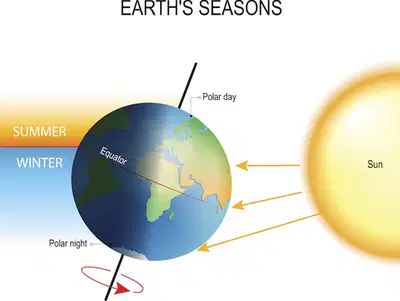
Calendar. But latitude alone doesn’t control the sun’s angle. The time of year, or season, does too. Seasons are repeated, natural changes in temperature, precipitation, and the amount of daylight. You remember from Chapter 4 that the earth’s rotational axis is tilted 23½° from a line perpendicular to the plane of its orbit. This means that the sun’s rays are vertical at 23½° latitude twice during Earth’s orbit. When the sun is directly over 23½ °N latitude, it is the summer solstice—first day of summer—in the Northern Hemisphere and the winter solstice in the Southern Hemisphere. Approximately six months later the sun’s rays are vertical at 23½ °S latitude, which marks the winter solstice—start of winter—for the Northern Hemisphere sphere and summer solstice in the Southern Hemisphere. Cartographers have given these parallels special names. The northern one is the Tropic of Cancer; the southern, the Tropic of Capricorn. The latitudes between these two parallels lie in the tropics, the warmest temperature belt on the earth’s surface.
14
Multiple Choice
What primarily determines the angle of the sun's rays on Earth's surface?
Latitude
Longitude
Altitude
Precipitation
15
Multiple Choice
How does the angle of the sun's rays affect the heating of Earth's surface?
Vertical rays cause less heating due to absorption in the atmosphere.
Vertical rays result in more heating because they travel a longer path through the atmosphere.
Vertical rays lead to more efficient heating as they pack more energy into a given area of the surface
Vertical rays cause minimal heating due to their indirect path through the atmosphere
16
Multiple Select
When are the sun's rays vertical at 23½°N latitude?
Winter solstice in the Northern Hemisphere
Summer solstice in the Northern Hemisphere
Winter solstice in the Southern Hemisphere
Summer solstice in the Southern Hemisphere
17
Multiple Choice
What are the latitudes between the Tropic of Cancer and the Tropic of Capricorn known as?
Equator
Polar regions
Temperate zones
Tropics
18
The earth’s tilt defines two other parallels that climatologists use to identify temperature belts. At the summer solstice, the sun’s rays shine across the North Pole and graze the earth at 66½ °N on the far side of the world (see Figure 21-3). This parallel is 23½° from the pole and is called the Arctic Circle. The same thing happens in the Southern Hemisphere at its summer sol- stice, which defines the Antarctic Circle. The earth’s sur- face and atmosphere between these parallels and their poles lie within the polar zones. These climates are really cold because the sun’s rays are either at a large angle from the vertical, or totally absent for nearly half the year! Lat- itudes between the tropics and the polar zones lie within the temperate zones. The temperate belts are compara- tively mild, neither too hot nor too cold on the average. Most of us live in a temperate zone. The seasonal tilt of the earth also controls the length of day. Days are longer than nights in summer so more heating takes place. In winter, the days are shorter than nights, so the earth cools for longer periods.
19
Multiple Choice
What defines the boundaries of the polar zones on Earth?
The Equator and the Tropic of Cancer
The Tropic of Cancer and the Tropic of Capricorn
The Arctic Circle and the Antarctic Circle
The Prime Meridian and the International Date Line
20
Multiple Choice
Which latitudinal zones are characterized by comparatively mild climates?
A) B) C) D)
Polar zones
Temperate zones
Tropics
Equatorial zones
21
Elevation. Recall from Chapter 18 that air temperature in the tropo- sphere usually drops with altitude (the lapse rate). This means that places near sea level at a given latitude are generally warmer, while places at a higher elevation are generally cooler. This is why you can hike in British Columbia’s mountain snow or go swimming at its ocean beaches during the month of June!
22
Water. The presence of large bodies of water, like the ocean and large lakes, directly affects climate. You learned in Chapter 14 that the major ocean currents warm lands far from the tropics and cool lands far from polar regions. Great Britain has similar average temperatures as New England because of the influence of the Gulf Stream Current, even though it lies 10 degrees latitude farther north. Similarly, the West Coast of the United States is cooler than Japan because of the influence of the cold California Current.
23
READ the Canopy Theory p. 507
24
PRECIPITATION
In summary, the climate in a particular place in the world results from annual averages of temperature and precipitation. The yearly amounts can vary from year to year, but over time, they are pretty much the same. In the next section, you will learn about the important types of climate zones and where they are located around the world.
25
PRECIPITATION
Besides temperature, precipitation is the other major factor in contributing to the climate at a given location. In previous chapters, you learned that humid and dry air masses control weather far from where they form. Marine air masses are driven by prevailing winds over land, where precipitation occurs. This is why the Pacific North- west in the United States and Canada has frequent rainy weather and why Great Britain is famously known for its rainy climate. Some seasonal winds control precipitation as wind patterns change directions through the year. A good example of these is monsoon winds in Asia. These winds blow for six months of the year from the Indian Ocean into southern and southeast Asia. The heavy rains they bring are followed by six months of very dry weather as the winds reverse and blow outward from the Gobi desert in central China. Air masses also produce precipitation as they flow over mountain ranges. This orographic precipitation on a mountain’s windward side can be quite heavy. But very dry conditions can result from a rain shadow on the leeward side of mountains as air descends and warms. These differences in precipitation can create dramatically different climates on opposite sides of the same mountain
26
21A REVIEW QUESTIONS: answer these questions with at least 1 person. Answers on next slide.
1. What good for the earth’s climate might come from injecting large quanti- ties of liquefied carbon dioxide into rock strata deep underground? What might happen if climatologists’ models are incorrect about the influence of carbon dioxide on global warming?
2. How are climate and weather different, given that they rely on the same data?
3. How do the following affect the temperature of a given location? a. latitude c. elevation b. calendar (season) d. water
4. As you go from the Equator to the poles, how does general climate change?
5. In what two ways can large bodies of water affect climate?
6. How do mountains affect climate?
7. (True or False) The climate in two places in different parts of the world will always be the same if the locations are at the same latitude.
27
21A REVIEW ANSWERS
1. This question may require students to do some outside research. If human-caused CO2 is actually causing global warming, then burying it may slow or reverse the warming trend. One adverse effect could be that climatologists could miscalculate the amount of CO2 to remove and take out too much. This could have an unintended impact on our climate. It could also deprive plants of needed CO2, resulting in widespread crop problems or deforestation. Buried CO2 could acidify groundwater aquifers and limit potable water supplies. (p. 502)
2. Weather is the current state (temperature, air pressure, humidity, and winds) of the atmosphere. Climate is the long-term conditions in the atmosphere. While they are both based on the same data, climate is based on the average of the data over a long period of time. (p. 504)
28
21A REVIEW ANSWERS
3. a. ? Temperature typically decreases with increased latitude. b. ? Temperatures are typically lower in the winter, warmer in the sum mer, and moderate during spring and autumn. c. ? Temperatures typically decrease with increased elevation. d. ? Water has a moderating effect on temperature. In the summer water will keep temperatures lower, while in the winter water will keep tem- peratures warmer. (pp. 504–6)
4. Generally, climate cools as you progress from the Equator to the poles, beginning with the hot tropical zone, then the temperate zone of moderate temperatures, and ending at the poles with frigid tempera- tures. Typically climates are drier farther from the Equator due to reduced evaporation at lower temperatures. (pp. 504–6, 508–9)
5. Warm water currents can warm nearby land, and cold water currents can cool nearby land. Bodies of water can also add humidity to air masses, producing precipitation. Students may also mention that water is able to absorb larger amounts of energy with only a small tempera- ture change. This tends to prevent large temperature swings. (pp. 80, 506)
6. Mountains force air up, producing orographic precipitation on one side of the mountains and creating dry zones on the other. Average temperature drops with increasing elevation on mountains because of the lapse rate. (pp. 506, 508)
7. False. (pp. 504–9) Many conditions can affect climate besides latitude.
29
30

Climate | National Oceanic and Atmospheric AdministrationBack to top
You can open this webpage in a new tab.
21 A "What is climate?
Be careful to follow this Quizzez. Make sure when you are supposed to read, you actually read.
Goals for today:
1. Contrast weather from climate
2. Analyze factors that may affect climate
Show answer
Auto Play
Slide 1 / 30
SLIDE
Similar Resources on Wayground

26 questions
Deposition
Presentation
•
6th Grade
23 questions
Nonrenewable Resources
Presentation
•
6th Grade
23 questions
Geologic Time Scale Introduction
Presentation
•
6th Grade
22 questions
Air Fronts
Presentation
•
6th Grade
23 questions
Molecules Needed by the Cells
Presentation
•
6th Grade
21 questions
Digestive/Excretory System
Presentation
•
6th Grade
21 questions
Layers of Earth
Presentation
•
6th Grade
21 questions
Tides
Presentation
•
6th Grade
Popular Resources on Wayground
10 questions
How much do you know about our Portrait of an Eagle?

Quiz
•
10th Grade
10 questions
Fast Food Slogans
Quiz
•
6th - 8th Grade
21 questions
Continents and Oceans
Quiz
•
6th Grade
20 questions
Parts of Speech
Quiz
•
5th Grade
16 questions
Subject & Predicate
Quiz
•
5th Grade
25 questions
Multiplication Facts
Quiz
•
5th Grade
12 questions
Map Skills
Quiz
•
3rd Grade
22 questions
Continents and Oceans
Quiz
•
5th Grade
Discover more resources for Science
10 questions
6.6D - Relative Density Review
Quiz
•
6th Grade
20 questions
Claim, Evidence and Reasoning (CER)
Quiz
•
6th - 8th Grade
20 questions
Density
Quiz
•
6th Grade
10 questions
Exploring Chemical and Physical Changes

Interactive video
•
6th - 10th Grade
20 questions
Food Chains & Food Webs
Quiz
•
5th - 7th Grade
18 questions
Interpreting Distance/Time Graphs
Quiz
•
6th Grade
10 questions
Decoding the Periodic Table of Elements
Interactive video
•
6th - 10th Grade
15 questions
Potential and Kinetic Energy
Quiz
•
6th Grade