

RW LESSON 04.11.24

Presentation
•
English
•
3rd Grade
•
Practice Problem
•
Hard

Jennifer Holmes
FREE Resource
27 Slides • 0 Questions
1


HISD 3rd Grade
Read Write
Teacher Facing
April 11, 2024
2


HISD 3rd Grade
Read Write
Informational
April 11, 2024
3

9
TEKS: 3.10A Explain the author’s purpose and message within a text.
TEKS: 3.10C Explain the author’s use of print and graphic features to achieve specific purposes.
LO: SWBAT explain the author’s purpose
and message within an informational text.
DOL: Given a text, SW correctly explain
the author’s purpose and message in at
least 4 out of 5 questions.
4

10
Do Now
5


11
All About Ants
Living Together
Under the anthill lies an ant nest, which is the name for the ants’ home. Many ants live
in a single nest in a group called a colony. Each ant in the colony has a job.
The queen ant is a very special ant in a colony. Most colonies have only one queen
ant, but some have more than one. A queen ant is born with wings, unlike most of the
other ants in the colony. The queen’s job is to lay eggs. Without the queen, there
would not be enough ants to keep the colony healthy.
What is the most likely reason the author includes the information in
paragraph 2?
A.
To describe the appearance of the queen ant.
B.
To explain the importance of the queen ant in the colony.
C.
To compare the queen ant to other ants in the colony.
D.
To discuss the behavior of ants in the nest.
6

12
Eating Together
A growing ant colony needs a lot of food! Ants eat many different things,
including sweet pieces of fruit and bugs. Another one of the worker ants’
jobs is to search for food and bring it back to the colony. As they search,
their bodies give off a scent, or smell, that makes a trail they can follow
back home. Other ants in the colony can follow the trail to get more food.
Sometimes they keep the food in rooms in the nest.
What is the most likely reason the author includes this information?
7

13
Eating Together
A growing ant colony needs a lot of food! Ants eat many different things,
including sweet pieces of fruit and bugs. Another one of the worker ants’
jobs is to search for food and bring it back to the colony. As they search,
their bodies give off a scent, or smell, that makes a trail they can follow
back home. Other ants in the colony can follow the trail to get more food.
Sometimes they keep the food in rooms in the nest.
What is the most likely reason the author includes this information?
The most likely reason the author includes this information is to
highlight the importance of worker ants in finding food.
8

14
Author’s
Purpose
Author’s
Message
vs.
After reading a text, a reader can explain the
author’s purpose for writing the text and author’s
message.
A specific
idea explored
in the writing
The reason
intended for
writing something
9


15
What is the
author’s
purpose for
writing this text?
What is the
main message
of the text?
All About
Ants
10


16
What is the
author’s
purpose for
writing this text?
What is the
main message
of the text?
The author’s
purpose for writing
this text is to
inform the reader
about the different
types of ants that
live in a colony.
Teamwork and
collaboration are
important for a
group’s success.
All About
Ants
11

17
Author’s Purpose
An author’s purpose is his or her reason for writing a text.
Persuade
Inform
Entertain
What other purposes do
authors have besides P.I.E?
12

18
Why did the author include this paragraph, section, or text?
tell/state
to provide with information
describe/illustrate
to tell or write about; create a picture using
words
show/convey
to make clear by example
explain
to make clear in writing
emphasize/highlight
to give particular attention to
compare
to describe the similarities or differences of
13

19
Apply To Text
We will examine today’s
text by identifying the
author’s purpose and
message to gain a deeper
understanding of the text.
What’s for Dinner After Dark?
14
20
What’s for Dinner After Dark?
Text
After reading this information, what
did you learn?
What is the
author’s purpose
for including this
information?
Raccoons’ front paws
have more nerves than
most animals’ paws.
The nerves make their
fingers sensitive. They
can feel crayfish hiding
in muck or acorns
tucked under leaves.
Raccoons often use
touch instead of sight
to hunt. They don’t
need daylight to find
food. (paragraph 4)
I learned…
●
15
21
What’s for Dinner After Dark?
Text
After reading this information, what
did you learn?
What is the
author’s purpose
for including this
information?
To explain how
raccoons use
their sensitive
paws to find
food in the dark
Raccoons’ front paws
have more nerves than
most animals’ paws.
The nerves make their
fingers sensitive. They
can feel crayfish hiding
in muck or acorns
tucked under leaves.
Raccoons often use
touch instead of sight
to hunt. They don’t
need daylight to find
food. (paragraph 4)
I learned…
●raccoons have sensitive front
paws
●the sensitivity allows them to
detect objects hidden in the
environment
●raccoons rely on their senses to
hunt food
16
22
A.
To describe how bats
compete with birds for
insects
B.
To explain how bats use
sound to locate their prey in
the dark
C.
To compare the hunting
abilities of bats and
raccoons
D.
To persuade readers to
appreciate bats for their
unique abilities
What is the mostly likely reason the author included paragraph
7 in the selection?
7 Bats find their prey
through echolocation. This
means they send out
high-pitched sounds, like
screams that people can’t
hear. Bat screams bounce
off bugs. When bats hear
the echoes, they know
where to find dinner. Bats
can hunt in complete
darkness.
17
23
What’s for Dinner After Dark?
Text
After reading this information, what
did you learn?
What is the
author’s purpose
for including this
information?
Opossums have
long, sensitive
noses. They can find
their food by
smelling it. One
night, an opossum
raided my trash can.
Opossum noses
sniff out smelly
things like garbage
and animals.
(Paragraph 8)
I learned that …
18

24
Read the sentence.
Opossums eat almost anything they find, including fruit, eggs, and
bugs.
What is the most likely reason the author includes this
information?
A. To explain why opossums are considered scavengers.
B. To describe the diet and eating habits of opossums.
C. To encourage readers to keep opossums as pets.
D. To illustrate the challenges faced by opossums in urban
environments.
19
25
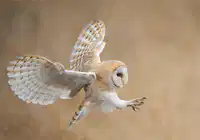
What is the most likely reason the
author includes this information?
A. To explain how owls' physical
adaptations help them hunt in
the dark
B. To describe how owls digest their
prey
C. To compare owls' hunting
abilities to those of other
nocturnal animals
D. To persuade readers to protect
owls and their habitats
Owls have great
eyesight. Their big
eyeballs are
shaped like tubes.
The long shape
lets in more light.
Read the sentences.
20

26
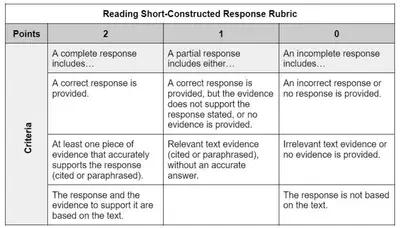
SCR: What is the author’s main purpose in writing this selection?
Use text evidence to support your answer.
The author’s main purpose in writing this
selection is…
21

27
What is the main message of the text?
A. Raccoons are the most
successful nocturnal hunters
due to their flexible fingers.
B. Many nocturnal animals
find their prey using their
sense of smell.
C. Owls are the most
skilled nighttime hunters
because of their eyesight.
D. Nocturnal animals use
their senses to hunt for
food in the dark.
22

28
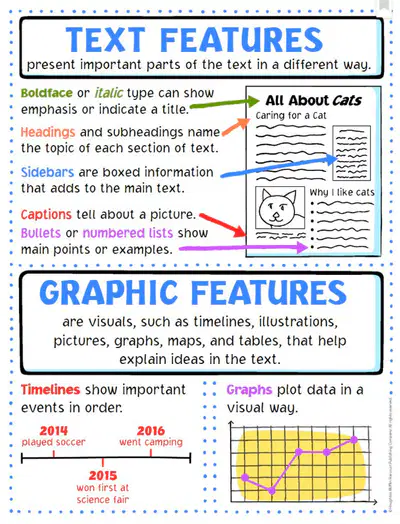
Informational text has a
different structure and
organization. Authors include
❏ Text features
❏ Graphic features
to help to reader comprehend
the information.
23
29
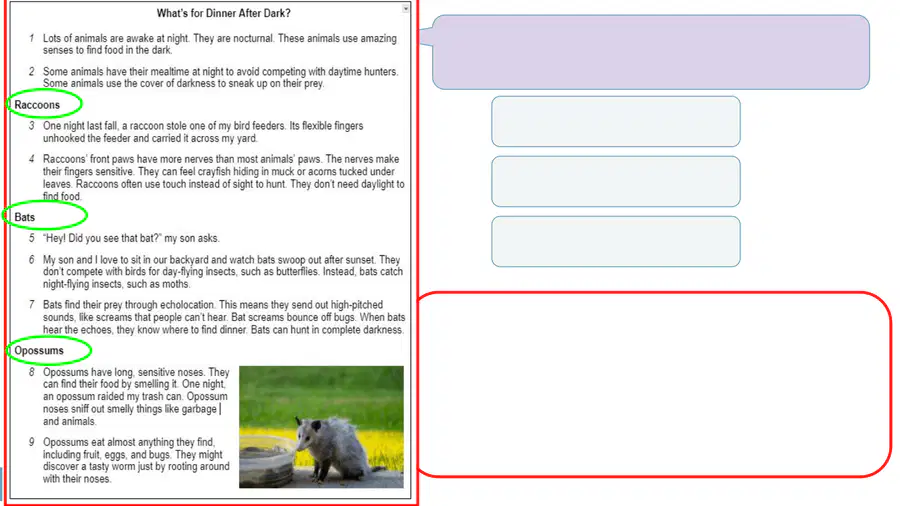
What is the highlighted feature
on the text?
Bold Word
Subheading
Caption
The author uses _____________ to
_____________________________________
24
30
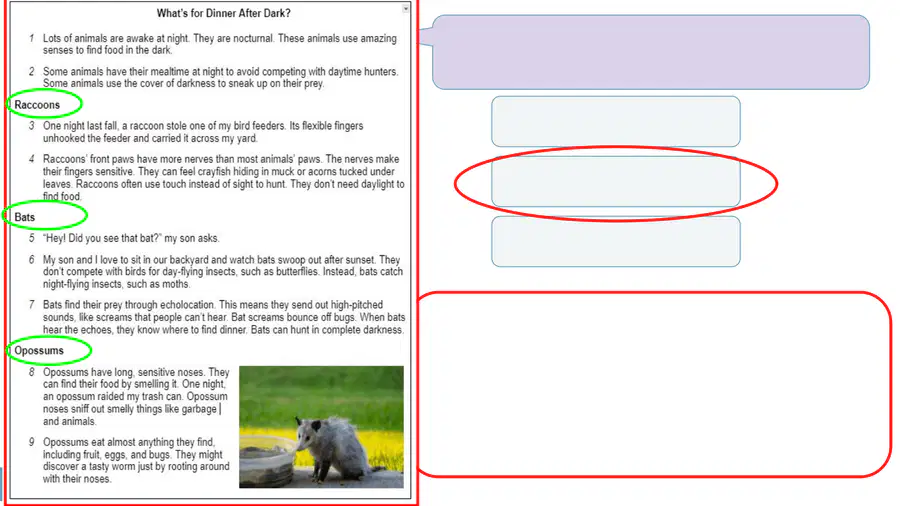
What is the highlighted feature
on the text?
Bold Word
Subheading
Caption
The author uses _____________ to
_____________________________________
subheadings
name the topic of each section of text.
25

31
The author most likely includes this photographs to…
What is the most likely reason the author includes the
photograph next to paragraph 8 and 9?
26

32
A. Owls have large eyes to help them see in the
dark.
B. Owls have sharp eyes for catching their prey.
C. Owls have soft feathers to help them fly silently.
D. Owls have long beaks for tearing apart their
food.
E. Owls have sharp talons for catching their prey.
Which idea from the selection does the author best
support by including the photograph next to
paragraph 12? Select TWO correct answers
27

34
DOL: Given a text,
SW correctly explain
the author’s purpose
and message in at
least 4 out of 5
questions.
HISD 3rd Grade
Read Write
Teacher Facing
April 11, 2024
Show answer
Auto Play
Slide 1 / 27
SLIDE
Similar Resources on Wayground

22 questions
Reading Skills Review
Presentation
•
3rd Grade
19 questions
Constructed Response Introduction
Presentation
•
3rd Grade
21 questions
Author's Purpose
Presentation
•
3rd Grade
18 questions
Verb Tenses Future
Presentation
•
3rd Grade
20 questions
Sharks
Presentation
•
3rd Grade
20 questions
Fact and Opinion
Presentation
•
3rd Grade
20 questions
fast food
Presentation
•
KG
21 questions
Contractions
Presentation
•
3rd Grade
Popular Resources on Wayground
20 questions
Math Review

Quiz
•
3rd Grade
15 questions
Fast food
Quiz
•
7th Grade
20 questions
Context Clues
Quiz
•
6th Grade
20 questions
Inferences
Quiz
•
4th Grade
19 questions
Classifying Quadrilaterals
Quiz
•
3rd Grade
20 questions
Figurative Language Review
Quiz
•
6th Grade
20 questions
Equivalent Fractions
Quiz
•
3rd Grade
10 questions
Identify Fractions, Mixed Numbers & Improper Fractions
Quiz
•
3rd - 4th Grade
Discover more resources for English
41 questions
Reading Practice - Comprehension
Quiz
•
3rd Grade
20 questions
Reading & Test Testing Strategies
Quiz
•
3rd - 5th Grade
20 questions
Prefix and Suffix Review
Quiz
•
3rd - 5th Grade
20 questions
3rd Grade Grammar Review
Quiz
•
3rd Grade
10 questions
Reading Comprehension
Quiz
•
3rd - 5th Grade
12 questions
Context Clues Vocabulary
Quiz
•
3rd Grade
20 questions
Memorial Day 3rd-5th
Quiz
•
3rd Grade
20 questions
Main Idea Quiz
Quiz
•
3rd - 4th Grade