SOL Review: Scientific Investigation
Presentation
•
Biology
•
9th - 12th Grade
•
Medium
+11
Standards-aligned
Kerry Dabbs
Used 12+ times
FREE Resource
13 Slides • 36 Questions
1
2
3
Multiple Choice
Why do we use graphs?
to help us see patterns in data sets
to make data more interesting
to make data less boring
to make data more accurate
4
5
6
7
Multiple Choice
If you wanted a graph to show how many fruit flies were found in a specific habitat area compared to the number of turtles which graph would you use?
Pie Chart
Bar Graph
8
Multiple Choice
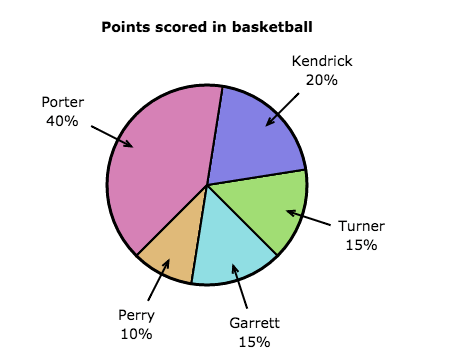
If you want to show the percent of tree species in a forest are birch, which graph would you use?
Pie Chart
Bar Graph
9
10
11
Multiple Choice
Which graph would you use if you wanted to show how a plants height changed over time?
line graph
scatter plot
12
Multiple Choice
If you want a graph that shows how test grades vary by hours spent studying
pie chart
bar graph
line graph
scatter plot
13
Multiple Choice
What type of graph should be used to show the color car that gets the highest percentage of speeding tickets?
bar graph
histogram
line
pie chart
scatterplot
14
Multiple Choice
What type of graph should be used to show the speed of a car while it slows down?
bar graph
histogram
line
pie chart
scatterplot
15
Multiple Choice
What type of graph should be used to show how many students got an A, B, C, D, or F on a unit exam?
bar graph
histogram
line
pie chart
scatterplot
16
Multiple Choice
What type of graph should be used to show the effect of time on social media on GPA?
bar graph
histogram
line
pie chart
scatterplot
17
Multiple Select
If Row (1) is correct for this graph, choose the things that are true
as deforestation increases, carbon dioxide in the atmosphere increases
increasing deforestation means increasing biodiversity
decreasing deforestation is caused by high levels of biodiversity
18
The Experimental Process
19
As late as the 17th century, some biologists thought that some simpler forms of life were generated by spontaneous generation. To test the hypothesis, Francesco Redi placed fresh meat in open containers. The rotting meat attracted flies, and the meat was soon swarming with maggots, which hatched into flies. When the jars were tightly covered so that flies could not get in, no maggots were produced. To answer the suggestion that the cover cut off fresh air necessary for spontaneous generation, Redi covered the jars with several layers of porous gauze instead of an air-tight cover. Flies were attracted to the smell of the rotting meat, clustered on the gauze, which was soon swarming with maggots, but the meat itself remained free of maggots.
20
Multiple Choice
Redi's experiment effectively demonstrates that:
flies reproduce by larvae called maggots
gauze is porous
maggots like meat
life is necessary to produce life.
21
Multiple Choice
Which PART OF THE CELL THEORY does this experiment support?
All living things are made of cells
All cells come from existing cells
Cells are the smallest unit of life
Maggots are made of cells
22
Louis Pasteurs Experiment
23
Multiple Choice
Why did Pasteur boil the broth at the start?
to bring out the flavor
to dissolve any solid particles
to remove any possible microbes
24
Analyzing Experimental Design
Two groups of people were assessed in an experiment designed to evaluate reaction time:
Use this design plan to help you answer the questions that follow.
25
Open Ended
If the outcomes for each group are as follows, propose an appropriate CONCLUSION:
Group A Reaction time: 0.968 seconds
Group B Reaction time: 0.688 seconds
26
Open Ended
Propose an appropriate HYPOTHESIS for this experimental design.
27
Match
Match the following:
controlled variable
(constant)
source of error
independent variable
dependent variable
number of students in each group
Group A not controlled for age/gender...
amount of sleep
reaction time
number of students in each group
Group A not controlled for age/gender...
amount of sleep
reaction time
28
Multiple Choice
Where is the dependent variable placed on a graph?
x-axis
y-axis
either the x-axis or the y-axis
neither the x-axis nor the y-axis
29
Labelling
Label where the IV and DV would be placed on this graph
IV
DV
30
Interpreting Graphs
31
Multiple Choice
Doubling the amount of sunlight from 3 to 6 hours always doubles the plant growth
TRUE
FALSE
32
Multiple Choice
According to this graph, the trend shows
an increase in cases every year
a higher overall population every year
a cyclic change from year to year
33
Multiple Choice
According to this graph, the general trend in drink consumption is
people consume more as they get older
soft drinks are the most popular drinks for teenagers
people never drink energy drinks
nobody drinks water
34
Multiple Choice
When graphing average temperatures in Fort Collins over the past year, what should go on the y-axis?
average temperature
temperature
time
location
35
Multiple Choice
When graphing average temperatures in Fort Collins over the past year, what should go on the x-axis?
average temperature
temperature
time
location
36
Multiple Choice
37
Multiple Choice
38
Multiple Choice
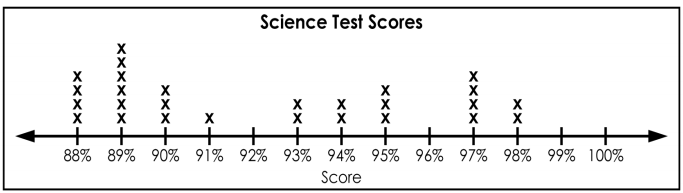
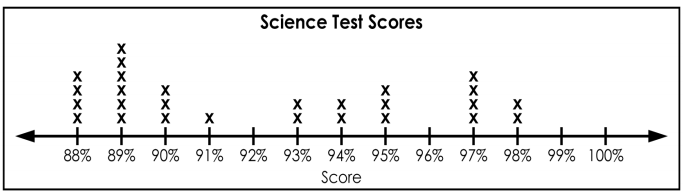
How many students received a score of 94%?
94
4
1
2
39
Multiple Choice
What is the difference between the shortest and the longest distance of the baseball thrown?
1,005 feet
85 feet
82 feet
80 feet
40
Multiple Choice
41
Multiple Choice
Choose the graph that matches the following scenario:
A student walked to his locker, stopped for a few seconds and then continued on the same path to class.
42
Read the problems and identify the independent, dependent variable in each as well as constants.
43
Multiple Choice
The higher the temperature of the water, the faster the egg will boil. What is the dependent variable (the effect)
The egg
The temperature of water
The type of water
The time it takes the egg to boil
44
Multiple Choice
Students of different age groups were asked to put the same jigsaw puzzle together, they were timed to see how long it took. What is the dependent variable?
Age of students
The jigsaw puzzle size
The time to complete puzzle
The music they listened to
45
Multiple Choice
Students of different age groups were asked to put the same jigsaw puzzle together, they were timed to see how long it took. What is the independent variable?
The age of the student
The jigsaw puzzle
The time to complete puzzle
The music they listened to
46
Open Ended
Do tomatoes grow fastest under fluorescent, incandescent, or natural light? What is the independent variable?
47
Open Ended
Do tomatoes grow fastest under fluorescent, incandescent, or natural light?
List as many constants that you can think of.
48
Open Ended
David selected four different CD’s to find out which type helped him to finish his homework the fastest. The first CD was rock, the second rap/hip-hop, the third classical, and the fourth was country. He chose a math assignment that required concentration. David used a stopwatch with an alarm to make sure that he only listened to each CD for 5 minutes. Each time the alarm went off, he recorded how many problems he was able to finish. Identify the:
Independent Variable (IV)
Dependent Variable (DV)
Constants (list two)
49
Categorize
fur color
height in centimeters
weight in kilograms
age in years
temperature in degrees Celsius
distance in meters
time in seconds
price in dollars
eye color
hair texture
favorite color
music genre
marital status
education level
employment status
hobby
Organize these options into the right categories
Show answer
Auto Play
Slide 1 / 49
SLIDE

Similar Resources on Wayground
44 questions
Nonmendelian Genetics
Lesson
•
9th - 12th Grade
46 questions
Homeostasis & Feedback
Lesson
•
9th Grade
46 questions
Trigonometric Ratios
Lesson
•
9th - 12th Grade
42 questions
Review - 1st 6wks
Lesson
•
9th - 12th Grade
44 questions
Unit 3: Cell Division
Lesson
•
9th - 12th Grade
44 questions
Cellular Respiration Lesson
Lesson
•
9th - 12th Grade
48 questions
Mendel Experimental Design
Lesson
•
9th - 12th Grade
44 questions
Non-Mendelian Genetics Lesson
Lesson
•
9th - 12th Grade
Popular Resources on Wayground
10 questions
5.P.1.3 Distance/Time Graphs
Quiz
•
5th Grade
10 questions
Fire Drill
Quiz
•
2nd - 5th Grade
20 questions
Equivalent Fractions
Quiz
•
3rd Grade
15 questions
Hargrett House Quiz: Community & Service
Quiz
•
5th Grade
20 questions
Main Idea and Details
Quiz
•
5th Grade
20 questions
Context Clues
Quiz
•
6th Grade
20 questions
Inferences
Quiz
•
4th Grade
15 questions
Equivalent Fractions
Quiz
•
4th Grade
Discover more resources for Biology
14 questions
Ecological Succession: Primary and Secondary
Quiz
•
9th Grade
20 questions
Cladogram Practice
Quiz
•
10th Grade
20 questions
Evolution and Natural Selection
Quiz
•
9th Grade
21 questions
Cell Cycle and mitosis
Quiz
•
9th - 10th Grade
45 questions
Unit 9 Review: Biosphere
Quiz
•
9th Grade
20 questions
Food Chains and Food Webs
Quiz
•
7th - 12th Grade
20 questions
Sex-Linked Traits
Quiz
•
9th - 12th Grade
22 questions
AP Biology: Unit 7 Review (CED)
Quiz
•
9th - 12th Grade