
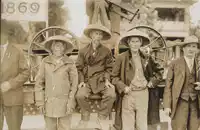
Immigratinon to California

Presentation
•
Social Studies
•
1st - 5th Grade
•
Medium

Carmie Rehor
Used 4+ times
FREE Resource
10 Slides • 33 Questions
1

2
Multiple Choice
What is the term used to describe people who come to another country to live?
Emigrants
Migrants
Immigrants
Natives
3
Multiple Choice
Why might people immigrate to a new country?
To find good jobs or schools
To escape from war or natural disasters
Both A and B
To visit as tourists
4
Multiple Choice
What can immigrants bring to their new community?
Food
Traditions and cultures
Technology
Books
5
Multiple Choice
What is an important aspect for newcomers and locals in a community?
Competing with each other
Avoiding each other
Being sensitive to one another
Ignoring each other
6
Multiple Choice
Which state's history is defined by the thousands of immigrants who have arrived over the years?
Texas
New York
Florida
California
7


8
Multiple Choice
For how many years have people been living in California according to research?
More than 1,000 years
More than 5,000 years
More than 10,000 years
More than 15,000 years
9
Multiple Choice
When did Spanish explorers begin to arrive in California?
In the 1400s
In the 1500s
In the 1600s
In the 1700s
10
Multiple Choice
What was the purpose of the missions in California?
To promote trade with Indigenous peoples
To make Indigenous peoples adopt Christianity and a Spanish way of life
To serve as military outposts
To establish schools for Indigenous peoples
11

12
Multiple Choice
When was gold discovered in California, leading to the California Gold Rush?
1847
1848
1849
1850
13

14
Multiple Choice
How long did it initially take to get to California before the transcontinental railroad was built?
Up to six weeks
Up to six months
Up to one year
Up to three months
15
Multiple Choice
What did Chinese workers do when they arrived in California in the 1850s?
They only worked on the transcontinental railroad
They looked for gold, worked on farms, or started their own businesses
They exclusively started their own businesses
They were only hired for gold mining
16
Multiple Choice
Why were many Chinese immigrants hired to work on the transcontinental railroad in the 1860s?
Because they were the only workers available
Because they were paid more than other workers
Because their jobs were less dangerous than other workers
Because they were not paid as much as other workers
17
Multiple Choice
Why did many Chinese immigrants send money back to their families in China?
They could not spend money in California
They could earn more in China than in California
They could earn more in California than in China
They were planning to return to China soon
18


19
Multiple Choice
What was one of the laws that hurt Chinese people in California between 1850 and the 1880s?
Chinese immigrants could become U.S. citizens.
Chinese workers were allowed to join ceremonies.
A Chinese immigrant could not testify in court against a white person.
Chinese people were encouraged to enter the country.
20
Multiple Choice
What was the Chinese Exclusion Act?
An act that allowed Chinese people to become U.S. citizens.
An act that encouraged Chinese immigration.
An act that stopped almost all Chinese people from entering the U.S.
An act that celebrated Chinese contributions to the U.S.
21
Multiple Choice
When was the Chinese Exclusion Act repealed?
1869
1882
1943
It was not repealed.
22


23
Multiple Choice
Why did many Japanese people move to Hawaii and the Pacific Coast of the United States in the mid-1800s?
To escape political unrest in Japan
To modernize along with the changes in Japan
To attend educational institutions
To establish diplomatic relations
24
Multiple Choice
What industries did Japanese immigrants work in when they moved to California?
Farming, mining, and business
Technology and education
Textile manufacturing
Fishing and shipbuilding
25
Multiple Choice
What was the purpose of the laws passed in the decades following the initial Japanese immigration to the United States?
To encourage more Japanese immigration
To stop Japanese immigration
To provide financial aid to Japanese immigrants
To establish trade agreements with Japan
26
Multiple Choice
In what year did California pass a law against Japanese immigrants owning land?
1907
1913
1922
1956
27
Multiple Choice
What was the significant immigration law change that occurred in 1924?
Japanese people could become U.S. citizens.
California overturned the 1913 land law.
The Immigration Act of 1924 blocked all Asian immigration.
No more Japanese men could immigrate.
28


29
Multiple Choice
What event prompted the United States to enter World War II and subsequently intern Japanese Americans in War Relocation Authority (WRA) camps?
The bombing of a U.S. naval base at Pearl Harbor by Germany
The bombing of a U.S. naval base at Pearl Harbor by Japan
The invasion of the United States by Japan
The signing of a treaty with Japan
30
Multiple Choice
Approximately how many Japanese Americans were forced to move to WRA camps during World War II?
About 50,000
About 120,000
About 200,000
About 300,000
31
Multiple Choice
What was the main reason given for relocating Japanese Americans to WRA camps?
It was a standard procedure for all immigrants
They volunteered to move for their safety
It was feared they would help Japan
They were looking for work opportunities
32
Multiple Choice
In what year did the U.S. government formally apologize to the Japanese Americans who had been interned in WRA camps?
1978
1988
1998
2008
33
Multiple Choice
Despite many of their relatives being interned in WRA camps, what did many Japanese American men do during World War II?
They moved to Japan to fight
They protested against the U.S. government
They fought in Europe in the U.S. armed forces
They refused to participate in the war
34
Multiple Choice
Which President ordered that all Americans of Japanese heritage be moved to WRA camps?
President Harry S. Truman
President Dwight D. Eisenhower
President Franklin D. Roosevelt
President John F. Kennedy
35


36
Multiple Choice
What was one of the reasons for South Korean women moving to the United States after the Korean War?
They were seeking employment.
They were pursuing higher education.
They married U.S. soldiers.
They were part of cultural exchange programs.
37
Multiple Choice
What did U.S. families do in relation to Korean orphans after the Korean War?
They sent them to schools in the United States.
They provided them with financial aid.
They adopted them.
They organized cultural events for them.
38
Multiple Choice
Why did some Koreans move to the United States after the Korean War?
To find work in the technology sector.
To study.
To join the U.S. military.
To start businesses.
39


40
Multiple Choice
What makes the United States very diverse according to the text?
The political system
The technology industry
The landscape and climate
Newcomers
41

42
Multiple Choice
Which state is mentioned as having a long and rich history of immigration?
New York
Florida
California
Texas
43
Multiple Choice
What is one of the most diverse states in the country?
Nevada
California
Michigan
Arizona
Show answer
Auto Play
Slide 1 / 43
SLIDE
Similar Resources on Wayground

37 questions
English 26/04
Presentation
•
KG
39 questions
stand up
Presentation
•
1st - 5th Grade
38 questions
new year - Vika
Presentation
•
KG
38 questions
Extremophiles Lesson
Presentation
•
1st - 5th Grade
38 questions
Presentación sin título
Presentation
•
KG
39 questions
Lesson 2 - BG Business - Chị Laura
Presentation
•
KG
35 questions
HOMOPHONES, HOMONYMS & HOMOGRAPHS
Presentation
•
1st - 6th Grade
33 questions
Holidays Around the World
Presentation
•
1st - 5th Grade
Popular Resources on Wayground
10 questions
Safety Day 2026 – Student Review

Quiz
•
9th Grade
21 questions
Continents and Oceans
Quiz
•
6th Grade
20 questions
Parts of Speech
Quiz
•
5th Grade
16 questions
Subject & Predicate
Quiz
•
5th Grade
25 questions
Multiplication Facts
Quiz
•
5th Grade
12 questions
Map Skills
Quiz
•
3rd Grade
22 questions
Continents and Oceans
Quiz
•
5th Grade
15 questions
Rounding Decimals
Quiz
•
5th Grade
Discover more resources for Social Studies
22 questions
Continents and Oceans
Quiz
•
5th Grade
14 questions
Age of Exploration
Quiz
•
4th Grade
15 questions
Local History
Quiz
•
2nd Grade
20 questions
Continents and Oceans
Quiz
•
3rd Grade
40 questions
Mapping Our World Test Review
Quiz
•
3rd Grade
50 questions
United States Map
Quiz
•
5th Grade
13 questions
AL State & National Parks, Landmarks, Symbols, and Monument
Quiz
•
3rd Grade
22 questions
Northeast states and capitals
Quiz
•
4th Grade