Evidence of Evolution & Phylogeny
Presentation
•
Biology
•
9th - 12th Grade
•
Practice Problem
•
Easy
+7
Standards-aligned
Sherwana Stewart
Used 2+ times
FREE Resource
5 Slides • 31 Questions
1
Multiple Choice
According to this image, which two domains of life are most related?
Bacteria & Archaea
Archaea & Eukarya
Eukarya & Bacteria
2
Multiple Choice
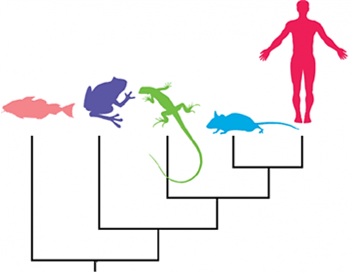
According to this phylogenetic tree, which creature is the least related out of all pictured?
Fish
Frog
Salamander
Human
3
Multiple Choice
Which group of animals on this tree are most closely related to birds?
Saurischian dinosaurs
Ornithischian dinosaurs
Crocodiles
None of these are related to birds
4
Multiple Choice
What number is the common ancestor of C and D
1
2
3
4
5
Multiple Choice
From the picture above, What do the species all have in common?
Back bone
Same father
Common ancestor
Feathers
6
Multiple Choice
7
Multiple Choice
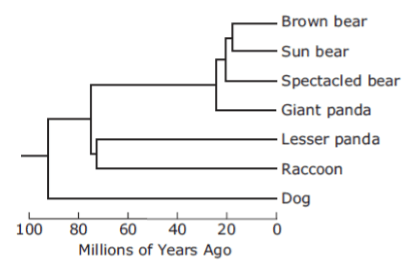
Who is the closest relative to the brown bear?
Giant panda
Dog
Lesser panda
Sun bear
8
Multiple Choice
9
Multiple Choice
Who is the ancestral group of this phylogenetic tree.?
Carnivore
Felidae
Mustelidae
Canidae
10
Multiple Choice
Which trait (adaptation) was developed most recently?
tetrapod limbs
feathers
amnion
They developed at the same time
11
12
13
14
15
16
Multiple Choice
This diagram shows a phylogenetic tree of six species based on amino acid similarities.
Which two species are the least closely related?
V and VI
III and IV
I and VI
II and III
17
Multiple Choice
A scientist sees the organism shown to the right in an aquarium and uses a key to help classify the species.Based on the key what species did the scientist observe?
Aulostomus
Gymnothorax
Bothus
Aetobatus
18
Multiple Choice
What is the purpose of using a dichotomous key?
to identify organism
to determine the evolutionary relationship between two organisms
to locate the environment for each species
to create a new kingdom
19
Multiple Choice
20
Multiple Choice
21
Multiple Choice
22
Multiple Choice
Which of the following can be determined by observing the embryos shown in the diagram
23
Multiple Choice
Vestigial structures
structures that perform a similar function but are not similar in origin
remnants of once-important structures that have slowly lost all or most of their function
features found in different organisms that share structural similarities but may have very different functions
preserved remains of an organism
24
Multiple Choice
25
Multiple Choice
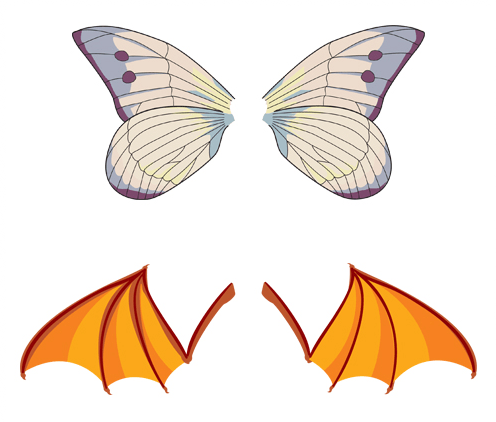
The picture shows a/an ___________
homologous structure
vestigial structure
26
Multiple Choice
What is this an example of?
Homologous structure
Analogous structure
Vestigial organs
Functional adaption
27
Multiple Choice
28
Multiple Choice
Scientists are studying a particular protein found in blood cells. Based on this, which animals are most closely related?
Dog: ARG - LYS - HIS - TYR
Rabbit: ARG - LYS - TYR - TYR
Elk: ARG - PRO - TYR - ARG
Dog & Rabbit
Rabbit & Elk
Dog & Elk
29
Multiple Choice
Which genetic material is pictured?
DNA
RNA
30
Multiple Choice
Which genetic material is pictured?
DNA
RNA
31
Multiple Choice
Mutations are important because they bring about
death of the organism in which they develop
genetic variation needed for a population to evolve
benefits for the individual, not for the population
Hardey-Weinberg equilibrium within a population
32
Multiple Choice
In 1861 paleontologists announced that they had found a fossil with feathers, now known as,
Archaeopteryx, which lived approximately 150 million years ago. When comparing
Archaeopteryx to other small dinosaurs and modern-day birds, the paleontologists learned that
Archaeopteryx had more in common with dinosaurs. The Archaeopteryx were small and had
broad wings which likely gave them the ability to fly or glide. How can the Archaeopteryx fossils
be used to support the theory of evolution?
They can demonstrate that animals from long ago are still alive today.
They show how organisms today share characteristics with fossilized species.
They give evidence to support the idea that organisms inherit the best traits from their
parents.
They indicate that evolution is a theory because scientists do not completely understand
the fossil record.
33
Multiple Choice
Which scientist visited the Galapagos Islands, observed traits in finches, and came up with the theory of natural selection?
Alfred Russell Wallace
Jean-Baptiste Lamarck
Carolus Linnaeus
Charles Darwin
34
Fill in the Blanks
Type answer...
35
Multiple Choice
The hypothesis that evolution of a species occurs gradually over time as a slow and constant process is known as --
gradualism.
speciation.
punctuated equilibrium.
microevolution.
36
Multiple Choice
The formation of a new species is a process known as ___________________, which is typically the result of divergence.
microevolution
gradualism
punctuated equilibrium
speciation
According to this image, which two domains of life are most related?
Bacteria & Archaea
Archaea & Eukarya
Eukarya & Bacteria
Show answer
Auto Play
Slide 1 / 36
MULTIPLE CHOICE

Similar Resources on Wayground
32 questions
Intro to Cell Membrane
Presentation
•
9th - 12th Grade
26 questions
Biogeochemical Cycles
Presentation
•
8th - 12th Grade
31 questions
Verbos SER y ESTAR
Presentation
•
9th - 12th Grade
32 questions
El subjuntivo
Presentation
•
9th - 12th Grade
30 questions
Unit 2.6: Fossil Fuels
Presentation
•
9th - 12th Grade
35 questions
Regulating the Cell Cycle + Cancer (part 3)
Presentation
•
9th - 12th Grade
Popular Resources on Wayground
19 questions
Naming Polygons
Quiz
•
3rd Grade
10 questions
Prime Factorization
Quiz
•
6th Grade
20 questions
Math Review
Quiz
•
3rd Grade
15 questions
Fast food
Quiz
•
7th Grade
20 questions
Main Idea and Details
Quiz
•
5th Grade
20 questions
Context Clues
Quiz
•
6th Grade
20 questions
Inferences
Quiz
•
4th Grade
19 questions
Classifying Quadrilaterals
Quiz
•
3rd Grade
Discover more resources for Biology
50 questions
Biology Final Review
Quiz
•
10th Grade
50 questions
Biology EOC Review
Quiz
•
9th Grade
15 questions
Biology EOC Review P2
Quiz
•
10th Grade
20 questions
Food Chains and Food Webs
Quiz
•
7th - 12th Grade
20 questions
Biology EOC Review 1
Quiz
•
10th Grade
50 questions
NC EOC Biology Review part 1
Quiz
•
9th - 12th Grade
15 questions
Evolution and Natural Selection Review
Quiz
•
10th Grade
10 questions
Exploring Food Webs and Energy Pyramids
Interactive video
•
6th - 10th Grade