
Applications of Electric Fields Lesson 4

Presentation
•
Physics
•
12th Grade
•
Practice Problem
•
Medium

Calvin Huck
Used 2+ times
FREE Resource
19 Slides • 9 Questions
1

Applications of
Electric Fields
Lesson 4
2

Focus Question
What is a capacitor and how does it work?
3

New Vocabulary
electric potential difference
volt
equipotential
capacitor
capacitance
4

Review Vocabulary
work: the transfer of energy that occurs when a
force is applied through a distance; equal to the
product of the system’s displacement and the
force applied to the system in the direction of
displacement
5


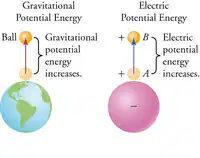
Energy and Electric Potential
• The electric potential difference (ΔV), which often
is called potential difference, is the work (Won q’)
needed to move a positive test charge from one
point to another, divided by the magnitude of the
test charge.
Electric Potential Difference
6
Multiple Choice
What is the electric potential difference?
The transfer of energy that occurs when a force is applied through a distance
The work needed to move a positive test charge from one point to another, divided by the magnitude of the test charge
The change in electric potential energy per unit charge
The product of the system's displacement and the force applied to the system in the direction of displacement
7


Energy and Electric Potential
8


Energy and Electric Potential
You also can think of electric potential difference as the
change in electric potential energy (ΔPE) per unit
charge.
9

Energy and Electric Potential
• ΔV is measured in joules per coulomb (J/C). One (J/C)
is called a volt (V).
• Whenever the electric potential difference between
two or more positions is zero, those positions are
said to be at equipotential.
10
Multiple Choice
What does it mean when two positions have an electric potential difference of zero?
They have the same electric potential energy
They have the same electric field strength
They are at equipotential
They have the same charge
11
Multiple Choice
Which unit is used to measure electric potential difference?
Joules per coulomb
Newtons per meter
Farads
Volts
12

Electric Potential in a Uniform Field
• You can produce a uniform electric field by placing
two large, flat conducting plates parallel to each
other.
• One plate is charged positively, and the other plate is
charged negatively.
• The magnitude and the direction of the electric field
are the same at all points between the plates, except
at the edges of the plates, and the electric field
points from the positive plate to the negative plate.
13
Multiple Choice
How can a uniform electric field be produced?
By placing two large, flat conducting plates parallel to each other
By connecting a power supply to a capacitor
By charging a conductor with excess electrons
By using a magnetic field
14


Electric Potential in a Uniform Field
• The electric potential is higher near the positively
charged plate and lower near the negatively
charged plate.
• You can represent the electric potential difference
(ΔV) between two points a distance (d) apart in a
uniform field (E) with the following equation.
Electric Potential Difference
in a Uniform Field
15

Millikan’s Oil-Drop Experiment
• Robert Millikan performed an experiment to test
whether charge exists in discrete amounts.
• Millikan was able to measure the magnitude of
the elementary charge with his experiment.
• His results showed why the net charge on an
object must be some integer multiple of the
elementary charge.
16


Millikan’s Oil-Drop Experiment
Millikan used two parallel plates to produce a
uniform electric field in his apparatus.
17

Millikan’s Oil-Drop Experiment
• Millikan sprayed fine oil drops from an atomizer.
The drops were charged by friction.
• Earth’s gravitational force pulled the drops
downward. A few drops entered the hole in the
top plate.
• Millikan adjusted the electric field between the
plates until the downward force from Earth’s
gravitational field and the upward force from the
electric field were equal in magnitude.
18
Multiple Choice
What did Robert Millikan's oil-drop experiment demonstrate?
The existence of discrete amounts of charge
The relationship between electric potential and charge
The behavior of electric fields near conductors
The storage of electrical energy in capacitors
19


Electric Fields Near Conductors
• Because electrons have like
charges, they repel each other. In a
conductor they are free to move,
so they spread far apart in a way
that minimizes their potential
energy.
• The charges come to rest on the
surface of the conductor. It does
not matter if the conducting
sphere is solid or hollow.
20


Electric Fields Near Conductors
• The electric field is zero
everywhere inside a closed,
charged metal container.
• The electric field at the surface
depends on the shape of the
conductor; free charges are
closer together at the sharp
points of a conductor.
21

Capacitors
• Energy can be stored in an electric field. A device
for storing electrical energy is called a capacitor.
• If you connect a 1-V power supply across a
capacitor, the potential difference between the
two plates would be 1 V.
• This would result in a net positive charge (+q) on
one plate and a net negative charge of equal
magnitude (-q) on the other plate.
22
Multiple Choice
What is the purpose of a capacitor?
To produce a uniform electric field
To store electrical energy
To measure electric potential difference
To create an equipotential surface
23


Capacitors
• The graph of q v. ΔV
is a straight line.
• The slope of the line
in a net charge
versus potential
difference graph is a
constant and is called
the capacitance
(C) of the capacitor.
24
Multiple Choice
What is the relationship between net charge and potential difference in a capacitor?
They are directly proportional
They are inversely proportional
They have no relationship
It depends on the shape of the capacitor
25


Capacitors
• Capacitance is measured in farads (F),
where 1 F = 1 C/V.
Capacitance
26
Multiple Choice
What is the unit of capacitance?
Joules per coulomb
Newtons per meter
Farads
Volts
27

28
Multiple Choice
What is the typical range of capacitance for capacitors used in modern electronics?
1 F to 10 F
10 pF to 500 μF
1 μF to 10 μF
1 nF to 100 nF
Applications of
Electric Fields
Lesson 4
Show answer
Auto Play
Slide 1 / 28
SLIDE
Similar Resources on Wayground

23 questions
Lesson 1.3
Presentation
•
12th Grade
20 questions
3.1C - Circular Motion (12 Physics)
Presentation
•
12th Grade
22 questions
7.1 Stages of pregnancy
Presentation
•
12th Grade
20 questions
The Federal Bureaucracy
Presentation
•
12th Grade
20 questions
Negative Exponents
Presentation
•
12th Grade
20 questions
States of Matter Review
Presentation
•
3rd Grade
22 questions
ECONOMICS TOPIC 3 LESSON 2
Presentation
•
12th Grade
22 questions
Tone and Mood
Presentation
•
KG
Popular Resources on Wayground
10 questions
Safety Day 2026 – Student Review

Quiz
•
9th Grade
21 questions
Continents and Oceans
Quiz
•
6th Grade
20 questions
Parts of Speech
Quiz
•
5th Grade
16 questions
Subject & Predicate
Quiz
•
5th Grade
25 questions
Multiplication Facts
Quiz
•
5th Grade
12 questions
Map Skills
Quiz
•
3rd Grade
22 questions
Continents and Oceans
Quiz
•
5th Grade
15 questions
Rounding Decimals
Quiz
•
5th Grade
