

Intro to Biodiversity

Presentation
•
Science
•
9th - 12th Grade
•
Easy
+15
Standards-aligned

Jequetta Rogers
Used 2+ times
FREE Resource
47 Slides • 8 Questions
1

Biology
Introduction to Ecology
Unit 6, Part 1 Basic Organization
2


Ecology includes the study of living organisms
and their nonliving environment.
3
4
Multiple Choice
5
Multiple Choice
6
Match
Biotic
Abiotic
Ecosystem
living things
Nonliving things
the relationship between living and nonliving parts of the environment
living things
Nonliving things
the relationship between living and nonliving parts of the environment
7


Turn and
Talk:
Identify 3
biotic
factors and
3 abiotic
factors in
this picture.
8
Open Ended
Based on the Previous slide, Name the three Biotic Species and Three abiotic species
9


What is ECOLOGY?
Ecology is the study of how organisms interact with
each other and with their environments.
We study ecology at different levels.
10


Levels of Ecology: ORGANISM
ORGANISM
ORGANISM
ORGANISM
11


Levels of Ecology: POPULATION
Species- a group of
organisms of the same type
of individuals capable of
reproducing and whose
offspring can reproduce
12


Levels of Ecology: COMMUNITY
Communitiesconsist of
more than one
population interacting
in the same habitat.
13


Levels of Ecology: ECOSYSTEM
Biotic + Abiotic Factors
14


Levels of Ecology: BIOSPHERE
The BIOSPHERE
includes every
part of the
planet where
life can exist
and all of the
organisms that
live on Earth.
15


Biogeography of
Kangaroos
Biogeography is the study of the patterns
of geographic distribution of organisms and
the factors that determine those patterns.
16


Native species came to be in an area
without the influence of humans.
17


Transplants - Non-native species can create
ecological disasters. Ex. 1 Zebra Mussels
18


Transplants - Non-native species can create
ecological disasters. Ex. 2 Kudzu
Kudzu - the vine that
is eating the South!
19


Transplants - Non-native species can create
ecological disasters. Ex. 3 Fire Ants
Fire ant were first
reported in Arkansas in
1958.
Fire ants bite the skin and hold
on until the ant's stinger injects
the venom.
20


Transplants - Non-native species can create
ecological disasters. Ex. 4 Snakehead Fish
Don’t confuse the
native bowfin with
the invasive
snakehead.
21


Add examples of invasive species to
your notes as you watch this video.
22
23
Multiple Choice
What is an invasive species?
An organism that is new to an environment that has positive effects on the environment.
An organism that is native to an environment that has negative effects on the environment.
An organism that is new to an environment that has negative effects on the environment.
An organism that is native to an environment that has positive effects on the environment.
24
Multiple Choice
Invasive species can have a major impact on the ecosystem.
TRUE
FALSE
25
Multiple Choice
26
Multiple Choice
27

Biology (ABI or BI)
Introduction to Ecology
Unit 12.1, Part 2 Water and Climate
28



Review Water Properties.
29


Hadley Cell Model - Shows the movement
of water vapor around the globe.
Hadley Cells are responsible for the general pattern of
rainforests, grasslands, and deserts across the globe. Moist,
warm air rising at the equator causes considerable rainfall.
The same air, drier and cooler when it falls, contributes to arid
(dry) conditions near 30° north and south.
30

Geographic features create local effects.
Oceans act as “heat banks,”absorbing a huge
amounts of solar radiation.
31


Ocean currentsact as conveyer belts of warm
and cold water, sending heat toward the polar
regions and helping tropical areas cool off.
32


Geographic features create local
effects, for example the Rain Shadow
Effect.
33


Ponds and lakes undergo seasonal changes in
temperature - thermoclines and “turn over”.
Turn over is
vital to
recycling
nutrients.
34


Think-Write-Share: Watch this video, then choose
one of the questions on the next slide to answer.
35

Biology (ABI or BI)
Introduction to Ecology
Unit 12.1, Part 3 Biomes
36


Think-Pair-Share
The graph shows a
comparison between
amount of phosphorus,
amount of chlorophyll a
(needed for
photosynthesis) and the
depth in various types of
lakes over time during
the summer. Looking at
just the red and green
lines which show the
measurement averages,
which claim can be
inferred (assumed to be
true) from the data?
1.
Make a claim about the relationship between the
average amount of phosphorus, a limiting
nutrient (red line) and the average amount of
chlorophyll a, needed for photosynthesis (green
line).
2.
Describe the evidence you used from the diagram
that supports your claim.
37

Communities can live in
• Classified by climate
(temperature,
precipitation) and soil
type.
• Shaped by availability
of resources in region
(location)
or
• Classified by salt
concentration: ocean,
brackish, freshwater
• Shaped by water
depth (sunlight),
salinity, temperature,
nutrients, currents
38


Aquatic Biomes
39


Coastal and
Ocean
Terms
40


Coral Reefs of the World (purple areas)
“Rainforests of the Oceans”
There are different types of aquatic biomes. The
type of biome depends on:
● salinity
● amount of light
● depth
● dissolved oxygen
● temperature
● pH levels
● flow rate
41


Freshwater Terms
● amount of
light
● depth
● dissolved
oxygen
● temperature
● pH levels
● flow rate
42


Oligiotrophic Lakes - nutrient poor, deep
and cold; few nutrients at cold bottom, clear
43


Eutrophic Lakes - nutrient rich;
shallow and warm; appear
murky because of the presence
of phytoplankton, algae,
dissolved solids
44


Eutrophication - all lakes and ponds move
toward being dry land.
45


Streams and Rivers
46


Stream Headwaters - Waters are cold, clear,
fast, narrow, nutrient poor, high dissolved
Oxygen.
47


Midstream - Waters are warm, slow, wide,
nutrient rich and murky due to erosion,
lower dissolved O2.
48


Estuary - This is
where fresh water
meets salt water -
nutrient rich;
biodiversity rich.
Because salt water has a greater density than fresh water, it
moves upstream in the form of a wedge.
49

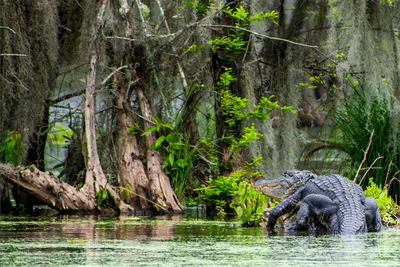
Wetlands - Swamp - These are lands
possessing water and above water plants
with TREES.
50


Wetlands - Marsh - These are lands
possessing water and above water plants,
no trees; reeds and grasses
51


Biome Portal from Arizona State University
52

Fundamental Concepts
● The many dynamic and delicate feedbacks between the
biosphere and other Earth systems cause a continual
co-evolution of Earth’s surface and the life that exists on it.
(BI-ESS2-7‡)
● The foundation for Earth’s global climate systems is the
electromagnetic radiation from the sun, as well as its
reflection, absorption, storage, and redistribution among
the atmosphere, ocean, and land systems, and this
energy’s re-radiation into space. (BI-ESS2-2, BI-ESS2-4)
Biodiversity is increased by the formation of new species
(speciation) and decreased by the loss of species
(extinction). (BI-LS2-7*‡)
53

Fundamental Concepts
● Ecosystems have carrying capacities, which are limits to
the numbers of organisms and populations they can
support. These limits result from such factors as the
availability of living and nonliving resources and from such
challenges such as predation, competition, and disease.
Organisms would have the capacity to produce populations
of great size were it not for the fact that environments and
resources are limited. This limitation affects the abundance
(number of individuals) of species in any given ecosystem.
(BI-LS2-1, BI-LS2-2)
54

Fundamental Concepts
● A complex set of interactions within an ecosystem can
keep its numbers and types of organisms relatively
constant over long periods of time under stable conditions.
If a modest biological or physical disturbance to an
ecosystem occurs, it may return to its more or less original
status (i.e., the ecosystem is resilient), as opposed to
becoming a very different ecosystem. Extreme fluctuations
in conditions or the size of any population, however, can
challenge the functioning of ecosystems in terms of
resources and habitat availability. (BI-LS2-2, BI-LS2-6)
55

Fundamental Concepts
● Moreover, anthropogenic changes (induced by human
activity) in the environment—including habitat destruction,
pollution, introduction of invasive species,
overexploitation, and climate change—can disrupt an
ecosystem and threaten the survival of some species.
(BI-LS2-7*)
Biology
Introduction to Ecology
Unit 6, Part 1 Basic Organization
Show answer
Auto Play
Slide 1 / 55
SLIDE
Similar Resources on Wayground

49 questions
Protein Synthesis and Codon Chart Notes
Presentation
•
9th - 12th Grade
50 questions
Unit 6 Latin America Physical and Cultural Geography
Presentation
•
9th - 12th Grade
51 questions
Muscular System
Presentation
•
9th - 12th Grade
50 questions
Electricity, Current, Voltage
Presentation
•
8th - 11th Grade
49 questions
Bacteria, Virus, and Protist Review
Presentation
•
9th - 12th Grade
48 questions
Domain 1 Lesson 1
Presentation
•
9th - 12th Grade
49 questions
AP Psychology Sensation & Perception Unit 3 (AP) 4 (Myers)
Presentation
•
9th - 12th Grade
49 questions
Frog Dissection Lab
Presentation
•
9th - 12th Grade
Popular Resources on Wayground
10 questions
Safety Day 2026 – Student Review

Quiz
•
9th Grade
21 questions
Continents and Oceans
Quiz
•
6th Grade
20 questions
Parts of Speech
Quiz
•
5th Grade
16 questions
Subject & Predicate
Quiz
•
5th Grade
25 questions
Multiplication Facts
Quiz
•
5th Grade
12 questions
Map Skills
Quiz
•
3rd Grade
22 questions
Continents and Oceans
Quiz
•
5th Grade
15 questions
Rounding Decimals
Quiz
•
5th Grade
Discover more resources for Science
10 questions
Exploring Chemical and Physical Changes

Interactive video
•
6th - 10th Grade
20 questions
Atomic Structure
Quiz
•
9th Grade
10 questions
Exploring the Electromagnetic Spectrum for Middle School Science
Interactive video
•
6th - 10th Grade
10 questions
Exploring Force and Motion Concepts
Interactive video
•
6th - 10th Grade
10 questions
Exploring Air Masses and Weather Fronts
Interactive video
•
6th - 10th Grade
14 questions
Periodic Trends
Interactive video
•
11th Grade
10 questions
Exploring the States of Matter
Interactive video
•
6th - 10th Grade
10 questions
Exploring Forces: Net Force, Normal Force, Gravity, and Friction
Interactive video
•
6th - 10th Grade