

Unit 4.10: Economic Growth and Development Strategies (Part 1)

Presentation
•
Other
•
12th Grade
•
Easy

Moganes S
Used 7+ times
FREE Resource
69 Slides • 14 Questions
1

4.10 ECONOMIC GROWTH
AND/OR ECONOMIC
DEVELOPMENT STRATEGIES
2

STRATEGIES TO PROMOTE ECONOMIC
GROWTH AND/OR ECONOMIC DEVT
3

CONCEPTUAL UNDERSTANDING
• Perceptions of the meanings of devt and equity change over time and vary
across cultures.
• Govts and other economic agents may intervene in an attempt to promote
economic wellbeing and equity in societies.
• The pursuit of sustainability is subject to various constraints.
• Effective strategies should take account of the relevant social, economic,
and political context.
4
5
To recap measures and policies that government can use to achieve EG and devt
Appropriateness of policies - Developing vs Developed countries
6

A. IMPORT SUBSTITUTION
Import substitution refers to a growth and trade strategy where a country
begins to manufacture simple consumer goods for the domestic market
to promote its domestic industry. It depends on protective measures
(tariffs, quotas, etc.) preventing the entry of imports that compete with
domestic producers.
•Promote consumption of import substitutes (i.e. goods produced
by domestic industry)
•E.g. shoes, textile, electrical appliances
7
Also known as import -substitution industralization
Growth and trade strategy where a country begins to manufacture simple consumer goods for domestic market to promote domestic industry.
Dependents on protective measures
8

IMPORT SUBSTITUTION
POLICIES AND CHARACTERISTICS
High levels of protection of domestic firms, inefficiency & resource misallocation
(from tariffs, quotas and import licenses etc)
Breeds inefficiency in resource allocation & resource misallocation → encourages
high-cost producers to continue production + lack of competition in the mkt →
consumers have to pay a higher price for the gds
Overvalued exchange rate
•To lower price of imported capital goods in domestic currency to facilitate setting
up of domestic industry but at the expense of export competitiveness & Nt
•Made agricultural X more expensive → worsen rural poverty
•Led to capital-intensive production methods (inappropriate tech) → unNt and
growth of the informal sector
9

IMPORT SUBSTITUTION
POLICIES AND CHARACTERISTICS
Limited growth in the LT
•Higher growth in the ST but slow growth in the LT as domestic industry that
produces import substitutes remains an ‘infant’
Too much govt intervention
•Relied heavily on industrial policies (interventionist SS-side policy) -->misallocation of resources & inefficiencies in production
•Govt failure whereby govt fails to allocate resources efficiently due to
bureaucracy & red-tape
10

IMPORT SUBSTITUTION
POLICIES AND CHARACTERISTICS
Deterioration in the BOP and debt position
•Increased importation of K goods
•Need to import food due to neglect of agricultural sector
•Outward flow of financial capital due to profit repatriation of foreign MNCs, or by
domestic wealthy grp seeking higher returns
Encouragement of capital intensive production methods
•Inappropriate technologies
•Workers do not have the necessary skills
•Increase unNt, widening Y gap & rise in poverty
Negative impacts on Nt & Y distribution
•Capital-intensive tech + neglect of small producers in agricultural & urban sector →
rise in unNt & growth in informal sector → worsening Y distribution & rise in poverty
11
Open Ended
Explain a reason why import-substitution is not a good strategy for growth and development of a country.
12

B. EXPORT PROMOTION
Export promotion refers to a growth and trade strategy where a country
attempts to achieve economic growth by expanding its exports.
•Develops a manufacturing sector that produces goods to be exported
•Generates export revenue
•Promotes economic growth
13

EXPERIENCE OF EXPORT
PROMOTION
• Extension of import substitution → industries become the strongest exporters
(i.e. import substitution was successful as a temporary industrialisation
strategy)
• China, HK, Indonesia, Japan, Malaysia, Singapore, South Korea, Taiwan and
Thailand are the newly industrialising economics known as the Asian Tigers
14

B. EXPORT PROMOTION
COMMON POLICIES ADOPTED
Provide incentives for
pvt sector to engage
in R&D on high-tech
gds
- Encourages devt of
domestic skill lvls &
technological devts
appropriate to local
conditions
Impose requirements
on MNCs
- e.g. use local inputs,
training of domestic
workers, transfer of
technical know-how
Target specific
industries for exports
- e.g. high-tech gds/
higher value-added
production activities
15

B. EXPORT PROMOTION
COMMON POLICIES ADOPTED
Industrial policies to support
export industries
- Investment grants, production
subsidies to X industries, special
benefits granted to MNCs that
were export oriented etc
Some protection of
domestic industries
- e.g. selective import
substitution for some
domestic industries
Large public spending in key
areas
- On education & training to
ensure workers have the
necessary skills / modernization of
the transport & communication
infrastructure
State ownership & control of
financial institutions to
ensure easy credit for export
industries
- Subsidised credit & other
favourable borrowing terms
16

B. EXPORT PROMOTION
FACTORS BEHIND THE SUCCESS OF EXPORT
PROMOTION OVER IMPORT SUBSTITUTION
Export promotion
allows firms to tap on
foreign mkt ➔ Reap
EOS
Economic
diversification:
labour-intensive
production to K-
intensive production
Investment in
human capital
Govt support for
R&D of appropriate
tech to raise level of
tech ➔ Moves up
value-added chain
Increased Nt
TRX➔(X-M) ➔
favourable current
account
17
Multiple Choice
Which of the following is not the disadvantage of export promotion?
vulnerable to changes in the economic conditions of trading partners
liable to protectionist measures
need to maintain low wages to maintain export competitiveness
Increase in human capital
18

C. ECONOMIC INTEGRATION
Recall :
Preferential trade agreement (PTA) is an agreement between two or more
countries to lower trade barriers on particular products.
Trade barriers may remain for the rest of the products, and on imports from
non-member countries.
Types of PTA:
• Bilateral
• Regional
• Multi-lateral
19
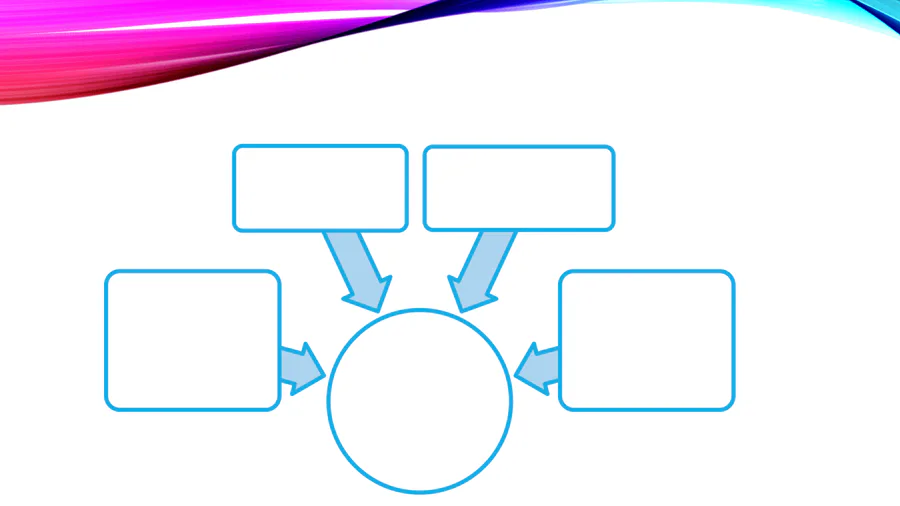
C. ECONOMIC INTEGRATION
THE GROWTH OF PTA
Rise in no.
of
preferential
trade
agreements
Slow progress
of WTO in
promoting free
trade
Benefits of free
trade
Bypass protection
by developed
c’tries
Retain some
trade
protection
20

REGIONAL FTA:
POTENTIAL BENEFITS FOR GROWTH & DEVT
Success factors in FTAs:
▪ regional agreements;
▪ geographical closeness;
▪ similar level of devt & technological capabilities;
▪ similar market sizes;
▪ shared commitment to co-operation
21

REGIONAL FTA:
POTENTIAL BENEFITS FOR GROWTH & DEVT
Regional FTA
▪ Expansion of mkt & achieve EOS
▪ Diversify production & exports
▪ Higher TRX & attract more investment → Economic growth
Countries with similar lvl of devt, technological capabilities mkt sizes
▪ Competition btwn c’tries is more ‘fair’
Shared commitment to co-operation
▪ Joint effort in pursue of policies
▪ E.g. infrastructural devt (transport infrastructure), collaboration on
R&D → raise economic devt for all
22

REGIONAL FTA:
POTENTIAL BENEFITS FOR GROWTH & DEVT
• Neighbouring c’tries forming regional blocs
• Examples:
MERCOSUR
ASEAN
COMESA
CEMAC
(Latin America) (Southeast Asia) (Eastern & Southern Africa) (Central Africa)
23

BILATERAL FTA:
RISKS FOR GROWTH & DEVT
Developed
c’try
Developing
c’try
Bilateral FTA
that gives
developing
c’try access
to developed
c’try’s mkt
24

BILATERAL FTA:
RISKS FOR GROWTH & DEVT
Risks faced by developing c’tries
Make equal and
matching cuts in tariffs ➔
at a competitive disadv
→ Forced to compete
with lower-cost
developed c’try’s firms ➔
--> Leading to Shut down of domestic firms
Many developing
countries form FTAs with
same developed c’try ➔
Compete with each other
& developed c’try’s firms
➔ Limited rise in TRX
Weaker bargaining
power of developing c’try
➔ Better for it to
negotiate multilateral
trade agreements under
WTO rather than enter
into bilateral trade
agreement with
developed c’try
25

BILATERAL FTA:
RISKS FOR GROWTH & DEVT
Risks faced by developing c’tries
Forced to agree to
other requirements not
usually in its best
interests, e.g. stricter IP
rights ➔ higher cost of
adopting high tech ➔
Slows down econ devt
Limited rise in TRX &
greater rise in TEM➔(X-
M) falls ➔ Current a/c
worsens & econ growth
falls, higher unNt,
worsening Y
distribution, increased
poverty
Divide developing c’tries
by creating different
interests + weaken regional
trade agreements when a
member c’try makes a
bilateral agreement with a
third c’try
26
Open Ended
Explain one potential disadvantage of bilateral trade agreement to promote growth and development in a developing country.
27

DIVERSIFICATION
Diversification is a strategy to reduce relianceon the export of a narrow
range of goods and services to reduce the risks of over-specialisation.
• Reallocate resources into new activities that broaden the range of
g&s produced
• Egs from S’pore: Petroleum refined products, semi-conductors,
financial services
28

DIVERSIFICATION
Objectives of diversification
Sustained increase in exports
•Diversify into products for which there’s sustained increase in global DD
•E.g. entry into higher value-added mkts for manufactured goods
•Sustained rise in TRX
Development of technological capabilities and skills
•Diversification encourages technological & skills developments to
facilitate pdtion of different types of g&s
•Rise in quality of labour → rise in c’try productive capacity
•Rise in LRAS → potential econ growth
29

DIVERSIFICATION
Objectives of diversification
Use of domestic primary commodities
•Vertical diversification → make use of domestic raw materials to fuel
growth of manufacturing industry
Reduced vulnerability to ST price volatility & LT price declines
•Diversification → manufactured goods produced alongside with
primary pdts
•Reduce reliance on primary pdts
•Less susceptible to price fluctuations of primary pdts
30
Open Ended
Explain two benefits of diversification to a developing country.
31

SOCIAL ENTERPRISE
Social enterprises are organisations that have specific social objectives as
their primary goal.
• May be for-profit or non-profit organization → profit is a secondary
goal
• Principal objective & purpose: to overcome or alleviate a global
or local issue (e.g. poverty)
32
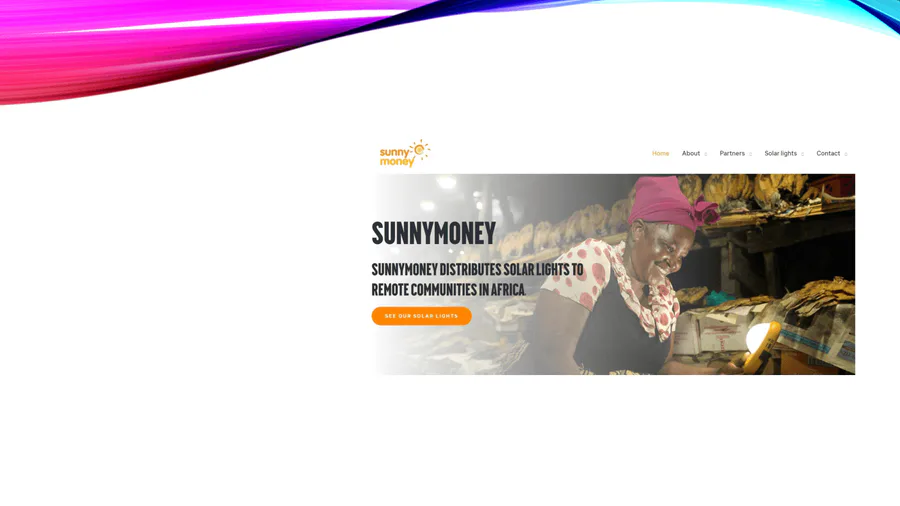
SOCIAL ENTERPRISE
E.g. Sunny Money
• Provide solar-powered
products to rural and
off-grid communities in
Africa
• Create Nt in the areas
where they sell
33

SOCIAL ENTERPRISE
E.g. Bambike
• Produce hand-made bicycles made of bamboo
• Create Nt in the areas where they produce
34
35

MARKET-BASED POLICIES
Market-based policies are policies that support the allocation of resources by
SS and DD (or the price mechanism) rather than through govt intervention in
the mkt.
Market-based SS policies
-Deregulation of labour mkt : ↓
labour union power & unNt
benefits, ↓ or eliminate min. wage
-Deregulation of product mkt:
removing BTEs
-Privatisation of state enterprise:
e..g transport
Trade liberalisation
-Elimination of trade barriers to
achieve free trade
-Limited govt intervention
36

STRENGTHS OF MARKET-BASED
POLICIES
Under competitive conditions, mkt mechanism can affect efficiency in
resource allocation. This is because producers & consumers are rational (i.e. pursuit of self-interest)
•Prices act as incentives and signals for resources to be allocated to
address the resource allocation questions of what and how much to
produce, and how to produce
•Improves allocation of resources
•Incentives for hard work, risk-taking, innovation & investment → Higher level
of output and hence SOL
37

Policies encouraging competition (e.g. deregulation, privatization)
•Freeing mkt forces and make mkts more competitive
•Greater efficiency in production, lower prices, improved quality & a more
efficient allocation of resources
•Increased level of output (economic growth)
STRENGTHS OF MARKET-BASED
POLICIES
Trade liberalization (Free or freer trade)
•Elimination of trade barriers → increase competition, efficiency in
production, lower prices, improved qly & increase consumer choice
•Improve allocation of resources
•Greater economic growth
38
Open Ended
Explain the effects of liberalizing policies on export growth.
39

A. Cannot tackle mkt failures
-ve environmental externalities
& problems of common access
resources
Public gds (complete mkt
failure)
merit goods (partial mkt failure)
WEAKNESSES OF MARKET-BASED
POLICIES
40

B. Weak or missing market institutions
•Missing in developing c’tries:
- enforcement of property rights,
- enforcement of legal contracts,
-well-developed banking,
- effective road system, etc.
•Markets are highly imperfect in their functions & fail to function
effectively
WEAKNESSES OF MARKET-BASED
POLICIES
41

C. Insufficient credit for poor people
Free mkt
•No loans given to poor people with no collateral
•Low investment in human, phy & natural K
•Low productivity → low econ growth → low income
•Perpetuates poverty cycle
WEAKNESSES OF MARKET-BASED
POLICIES
42

D. Questionable effects on economic growth & development
•Firms in low-Y c’tries not able to withstand competition from bigger firms
from developed economies → cannot generate export revenue for
developing c’tries
Capital liberalization is undertaken before country develops necessary institutions --> capital flight -->reduced ability to use MP
•Market liberalization → withdrawal of govt from provision of merit goods
→ -ve impact on econ devt
WEAKNESSES OF MARKET-BASED
POLICIES
43

E. Limited benefits for export growth and diversification
•Developing c’tries could not diversify their production into increased
manufacturing for X due to trade protection used by developed c’tries
on developing c’try Xs
•Growing reliance on free mkt policies → With less govt support, many
developing c;tries were not able to perform well.
WEAKNESSES OF MARKET-BASED
POLICIES
44

F. Increasing income inequalities and poverty within developing c’tries
•Greater Y inequalities & poverty
•Economic & trade liberalisation creates both ‘winners’ & ‘losers’
•E.g. of ‘winners’: the employed in X sectors / the employed in
growing formal sector / people with relevant skills & education
•E.g. of ‘losers’: less educated or illiterate people / poor who lack
collateral and has no access to credit / those working in income
sector
WEAKNESSES OF MARKET-BASED
POLICIES
45
Open Ended
Explain one negative effects of market liberalization policies.
46

THE NEW DEVELOPMENT
CONSENSUS
• Trade liberalisation continues to be important, but in developing countries
there should also be some government intervention to help create the
conditions needed for markets to work without resulting in the negative
effects described above. E.g. of conditions
• Human capital (health & education)
• Infrastructure
• Effective institutions
• Industrial policies
• Trading system that encourages developing country X
47

INTERVENTIONIST POLICIES
Interventionist policies are based on govt intervention in mkts intended to
correct market deficiencies and create an environment in which mkts can
work more effectively.
Redistribution policies such as:
-Tax policies
-Transfer payments
-Minimum wages
Objective of redistribution policies
SDG 10 – Reduce inequality within & among countries
48

INTERVENTIONIST POLICIES:
TAX POLICIES
SDG 17.1 (goal 17, target 1) states ‘strengthen domestic resource mobilisation . . .
to improve domestic capacity for tax and other revenue collection’.
-↑ progressivity of the tax system
-Expand coverage of personal Y taxes
-Expand the use of indirect taxes on luxury gds & gds that
create (-)ve ext
-↑ taxation from capital income
-Impose / ↑ taxes on real estate & land
-Reduce tax evasion
49

INTERVENTIONIST POLICIES:
TRANSFER PAYMENTS
SDG 1.3 (goal 1, target 3) states ‘Implement nationally appropriate social
protection systems and measures for all, including floors, and by 2030 achieve
substantial coverage of the poor and the vulnerable.
-Improve Y distribution & ↓ poverty
-World Bank & International Labour Org (ILO) →universal social
protection:include child benefits, pensions for older persons,
benefits for maternity, disability, work injury or unNt → mainly in
the form of transfer payments
50

INTERVENTIONIST POLICIES:
TRANSFER PAYMENTS
SDG 1.3 (goal 1, target 3) states ‘Implement nationally appropriate social
protection systems and measures for all, including floors, and by 2030 achieve
substantial coverage of the poor and the vulnerable.
• In 2019, four billion people or more than half of the world’s
population had no access to even one social protection benefit.
• 45% of the global population had access to one benefit, one-
third of children had a family and child benefit.
• Only 28% of people with disabilities had a benefit.
• Old age pensions were the most prevalent, with 68% of older
persons receiving pensions.
51
Open Ended
Explain the significance of transfer payments to achieve the economic growth and development.
52

INTERVENTIONIST POLICIES:
TRANSFER PAYMENTS
Special policy: conditional cash transfers (CCTs)
-Money paid on condition that the households receiving the
money undertake activities related to education and health
care, often for children
Example: Bolsa Familia in Brazil
- Social welfare programme that provides cash to the low income
- conditioned upon (a) children attend school regularly
(b) children must receive regular checkups and
vaccinations
Non-conditional cash transfers (CCTs)
-Do not impose restrictions
-Provides flexibility to households to manage their expenditure freely in accordance with their needs.
53

INTERVENTIONIST POLICIES:
TRANSFER PAYMENTS [EVALUATION]
Universal social protection systems are costly
•Beyond the means of many developing c’tries
•Cannot be fully implemented over the ST
Effectiveness depends on govt policies
•w/o appropriate infrastructure (e.g. schools, hospitals, roads) and human
capital (e.g. trained doctors & nurses), these policies are limited in
effectiveness
Difficulties in the design & implementation to reach those that are most in need
54
Open Ended
Explain how government policies may affect the effectiveness of transfer payments.
55

INTERVENTIONIST POLICIES:
MINIMUM WAGES
To best design a minimum wage system to reduce inequality, the
International Policy Centre for Inclusive Growth notes guidelines:
-Set by govts after taking all relevant pts of view into account
-Consider needs of workers & families + monitor & evaluate effects
to make necessary adjustments
-Establish measures to ensure compliance and enforcement
56

INTERVENTIONIST POLICIES:
MINIMUM WAGES
Standard theory: designed to support Ys of unskilled workers but
give rise to unNt
However, studies have shown that in practice such job losses do not
occur unless minimum wages are set at very high levels.
57
Draw
Draw the minimum wage graph. Identify the unemployment.
58
Open Ended
What are the positive externalities of education?
59

POSITIVE EXTERNALITIES (EXTERNAL
BENEFITS) OF EDUCATION
Promotes economic growth
Education ➔ labour
productivity
Education ➔
unNt ➔ Investor
optimism
Education ➔
Political stability ➔
Investor optimism
Education ➔
qly of phy
capital
Education ➔
crime rate ➔
Investor optimism
60

Education of women
labour force participation rate by women ➔
SS of labour
maternal mortality ➔non-material SOL
Healthier children ➔child mortality ➔non-
material SOL
Children taught basic principles of hygiene &
sanitation →non-material SOL
Spillover
benefits
into health
POSITIVE EXTERNALITIES (EXTERNAL
BENEFITS) OF EDUCATION
61
Draw
Draw the market failure diagram for merit goods.
62
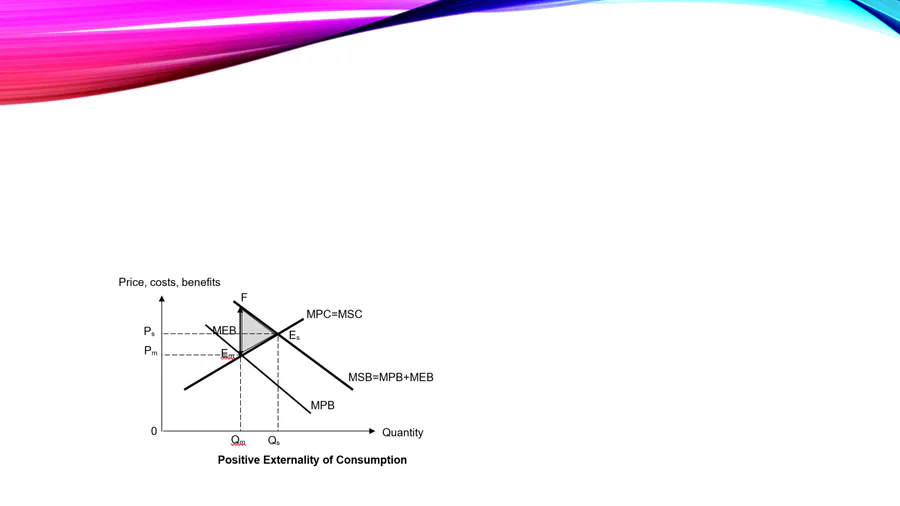
INTERVENTIONIST POLICIES:
PROVISION OF MERIT GOODS
• Recall that both education & healthcare svcs are merit goods with (+)ve
consumption externalities
• If left to free market → underconsumed/underprovided
• 5-step analysis
(Explain how market failure arises.)
63

According to World Bank,
• Countries at a relatively low level of development should invest in
primary (elementary) school education
• However, they are often found investing too heavily in higher
(secondary and university) education
One of the most impt investment in education:
Achieving universal literacy rates
IMPORTANCE OF ELEMENTARY
EDUCATION & UNIVERSAL LITERACY
64
Brain Drain
Developing c’tries
that focus > on sec
& tertiary education
Misallocation of resources
Internal
UnderNt as
highly educated
individuals
cannot find Nt in
their field of
specialisation
Medical
personnel
work in pvt
hospitals,
instead of
govt ones
Work in
R&D
projects
that benefit
developed
c’tries
International
From
developing
to
developed
c’tries
IMPORTANCE OF ELEMENTARY
EDUCATION & UNIVERSAL LITERACY
65

2 main external benefits of consuming
healthcare svcs:
Healthy people do
not spread illnesses ➔
Community becomes
healthier
Healthy workforce ➔
labour productivity
➔productive
capacity of economy
➔ potential
economic growth
POSITIVE EXTERNALITIES (EXTERNAL
BENEFITS) OF HEALTHCARE
66

Spill over external
benefits
Healthy students ➔ Improve school
attendance & performance ➔
level of education
Healthy individuals ➔ make better
use of knowledge and skills they
possess
POSITIVE EXTERNALITIES (EXTERNAL
BENEFITS) OF HEALTHCARE
67

GOVT POLICIES IN EDUCATION &
HEALTHCARE
How to increase consumption to
socially optimal level
Mkt-based
policy:
Subsidies
Non-mkt-based
policy: Govt
provision
Non-mkt-based
policy:
Advertising &
persuasion
68
Open Ended
Explain one policy that will increase consumption of healthcare to the socially optimal level of output.
69

Subsidies on education/ healthcare
MKT-BASED SOLUTION:
output
Benefit, cost
MSB =MPB +MEB
MPB
0
Qs
Es
MPC = MSC
Qm
E
MPC - subsidy
subsidy
Mkt eqm E:
MPC=MPB
Social eqm: Es
which is =
marginal external
benefit generated
X
GOVT POLICIES IN EDUCATION &
HEALTHCARE
70
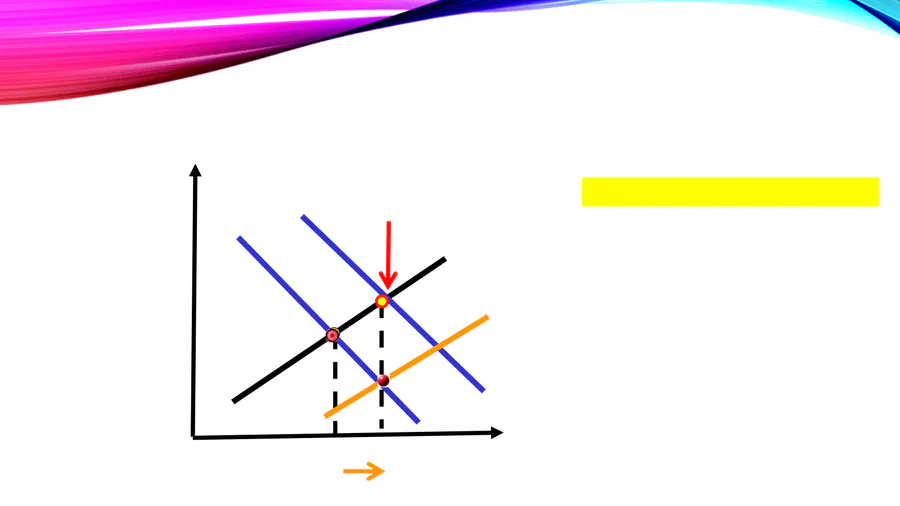
Direct Provision/Govt Provision
output
Benefit, cost
MSB =MPB +MEB
MPB
0
Qs
Es
MPC = MSC
Qm
E
S+ govt provision
Mkt eqm E:
MPC=MPB
Social eqm: Es
X
GOVT POLICIES IN EDUCATION &
HEALTHCARE
71
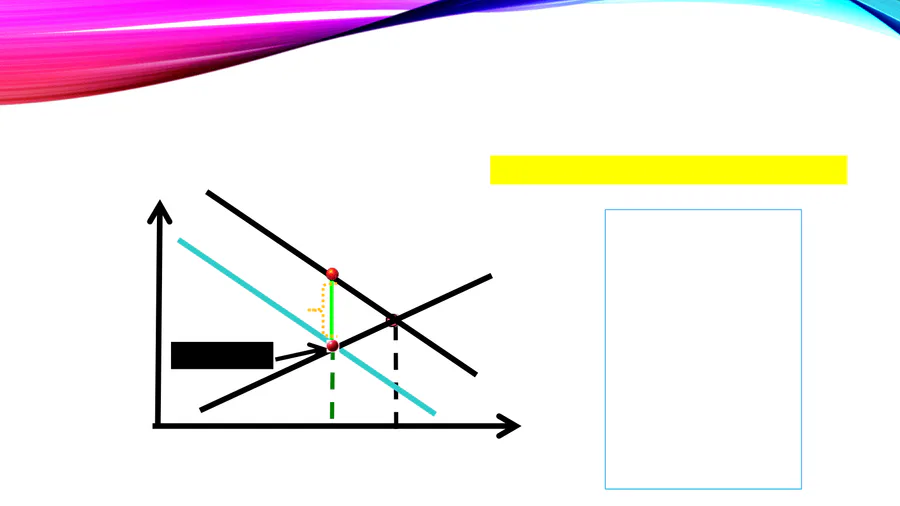
Legislation, advertising & persuasion
Es
Qs
MPB
Quantity
0
Cost/Benefit ($)
MPC = MSC
MSB
E
Qm
F
Assume no ext cost
MEB
MPB=MPC
• Legislation,
advertising &
persuasion would
be entirely
useless in a
situation where
there’re no
schools or health
clinics.
• Govt need to
provide these
svcs
GOVT POLICIES IN EDUCATION &
HEALTHCARE
72
INFRASTRUCTURE
Infrastructure boosts economic growth/
economic devt
↑ productivity & ↓ COP
→ economic activities
are carried out more
efficiently
Irrigation → ↑ yields →
↑ Y and ↓ poverty
Facilitates
modernisation &
diversification → ↑
worker productivity
with availability of
electricity
73
INFRASTRUCTURE
Infrastructure boosts economic growth/
economic devt
↑ country’s
international
competitiveness → ↑
FDI
Provision of svs
essential for
maintaining basic SOL
→ ↓ avoidable illnesses
& premature deaths →
↑ qty of labour
Easier access to
healthcare svcs and
education for rural
areas + ↑ Nt opp + ↑
access to mkts →
alleviate poverty
74
INFRASTRUCTURE
Infrastructure boosts economic growth/ economic devt
Availability of water &
energy supplies improves
gender equity → ↑ sch
enrolment among girls as
less time needed to do
chores → ↑ Nt & ↓ poverty
↓ indoor air pollution with
safe energy sources →
(+)ve effects on health of
women & children
↑ Nt opp on construction
→ ↑ Ys
75
Open Ended
Explain one benefit of infrastructure on economic growth/economic development.
76
STRENGTHS OF INTERVENTIONIST
POLICIES
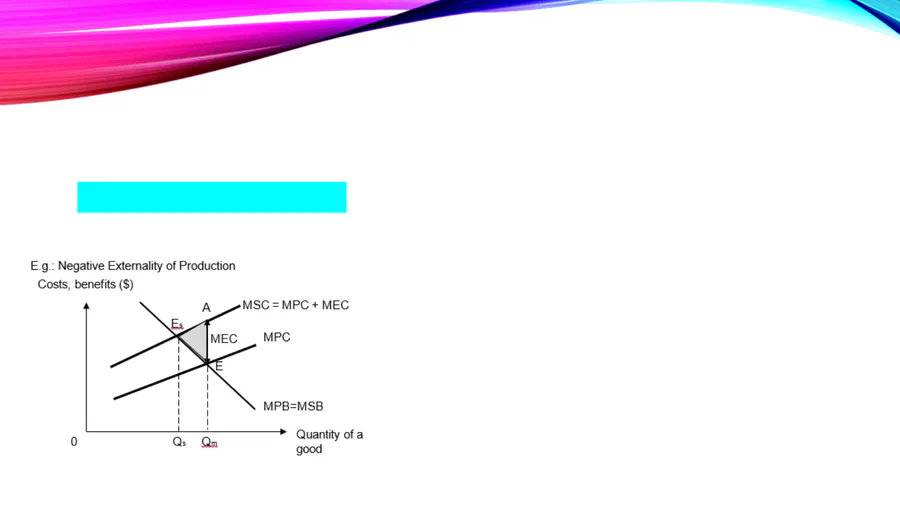
A. Correcting mkt failures
1.
Correct –ve environmental ext of
production & consumption & overuse of
common access resources
2.
Provide public goods (e.g. national
defence) & merit goods (e.g. health &
education)
3.
Assist in correction of co-ordination
failures
4.
Contribute to devt of mkt institutions that
enable mkts to operate more effectively
77

STRENGTHS OF INTERVENTIONIST
POLICIES
B. Investment in human capital
•
Govt correct underconsumption of education & training → increase
labour productivity & productive capacity of the economy
C. Provision of infrastructure
•
Infrastructure has significant positive externalities
•
Govt corrects underprovision of roads & sanitation
•
Encourage economic growth and results in economic & human devt
→ ↑ productivity → ↑ SOL
78

STRENGTHS OF INTERVENTIONIST
POLICIES
D. Provision of stable macro environment
•Stable macroeconomic environment:
•Price stability
•Full Nt
•Reasonable budget deficit
•Reasonable BOT
•Govt implements policies to achieve macro-objectives. --> Econ stability -->Investor confidence-->Rise in investment-->formation of physical &
human capital
79

STRENGTHS OF INTERVENTIONIST
POLICIES
E. Provision of a social safety net
•
Social safety net is a system of govt transfers of cash or goods to
vulnerable groups, undertaken to ensure that these groups do not fall
below a socially acceptable minimum SOL
F. Redistribute Y
•E.g. progressive income tax & transfer payments
G. Industrial policies
•Govt supports SMEs & infant industry through tech transfer from developed
countries, establishment of R&D capability, as well as investments in human
capital (through preferential tax cuts, subsidies, subsidized loans)
80

WEAKNESSES OF INTERVENTIONIST
POLICIES
A. Excessive bureaucracy
•Too many rules governing procedures-->red tape-->inefficiency &
high cost-->Hence, should reduce size of govt sector by privatisation of
SOEs, sub-contracting of govt projects to private sector, etc
B. Poor planning
•Govt may run into difficulties in planning as they lack the technical
knowledge & expertise as well as imperfect info
81

WEAKNESSES OF INTERVENTIONIST
POLICIES
C. Corruption
•Corruption-->lower growth & poorer development
•Corruption in the form of a payment for something: Works like a tax
that makes private investments more costly-->Reduce overall level of
investment
•Corruption as bribes to receive basic services like education or health
care: Works like a regressive tax as bribe is a higher fraction of the Y of
lower income earners
82

WEAKNESSES OF INTERVENTIONIST
POLICIES
C. Corruption
•Bribes for tax evasion-->reduce govt revenues
•Govt officials accept bribes to pursue uneconomic projects (e.g. dams
& power plants) instead of socially necessary services (e.g. education,
sanitation) -->results in misallocation of resources
•Weaken sustainable development if bribes are used to bypass
environmental regulation
•Reduction of people’s trust towards the state
83
Open Ended
State one strength and one weakness of interventionist policies.
4.10 ECONOMIC GROWTH
AND/OR ECONOMIC
DEVELOPMENT STRATEGIES
Show answer
Auto Play
Slide 1 / 83
SLIDE
Similar Resources on Wayground

77 questions
Extra lesson G11_EASE 1 Preparation
Presentation
•
11th Grade
76 questions
Spine Stuff
Presentation
•
10th - 12th Grade
78 questions
Skeletal System and Joint Identification
Presentation
•
11th Grade - University
81 questions
hydraulic Presentation
Presentation
•
KG - University
81 questions
Past Simple + Past Continuous (R&C. FPC&S)
Presentation
•
University
80 questions
Env. Sci = Air Pollution and Global Warming
Presentation
•
12th Grade
76 questions
Price Floor
Presentation
•
12th Grade
80 questions
Media and Culture
Presentation
•
KG - University
Popular Resources on Wayground
10 questions
Safety Day 2026 – Student Review

Quiz
•
9th Grade
21 questions
Continents and Oceans
Quiz
•
6th Grade
20 questions
Parts of Speech
Quiz
•
5th Grade
16 questions
Subject & Predicate
Quiz
•
5th Grade
25 questions
Multiplication Facts
Quiz
•
5th Grade
12 questions
Map Skills
Quiz
•
3rd Grade
22 questions
Continents and Oceans
Quiz
•
5th Grade
15 questions
Rounding Decimals
Quiz
•
5th Grade
Discover more resources for Other
26 questions
SLIME!!!!!
Quiz
•
KG - 12th Grade
21 questions
Los paises hispanohablantes y sus capitales
Quiz
•
12th Grade
20 questions
Cell Transport
Quiz
•
9th - 12th Grade
20 questions
Budgeting
Quiz
•
9th - 12th Grade
20 questions
Investing
Quiz
•
9th - 12th Grade
8 questions
DNA vs. RNA
Presentation
•
9th - 12th Grade
12 questions
Identify Rigid Transformations
Quiz
•
8th - 12th Grade
10 questions
Complementary, Supplementary, Vertical, and Linear Pairs
Quiz
•
9th - 12th Grade