Search Header Logo
Joints and Articulations

Joints and Articulations

Assessment

Presentation

•

Science

•

11th Grade - University

•

Practice Problem

•

Easy

•
NGSS
MS-PS2-2, MS-PS2-1

Standards-aligned

Created by

Teresa Schlueter

Used 160+ times

FREE Resource

34 Slides • 44 Questions

1

Joints and Articulations

Slide image

2

Slide image

3

Multiple Choice

Ways that articulations are classified
1
Structurally
2
Functionally
3
Both Structurally & Functionally
4
Neither

4

Multiple Choice

What is a joint or articulation?

1

The junction between two bones.

2

A bone that sticks out.

3

A point where calcium is stored and released.

4

None of these answers is correct.

5

Slide image

6

Slide image

7

Multiple Choice

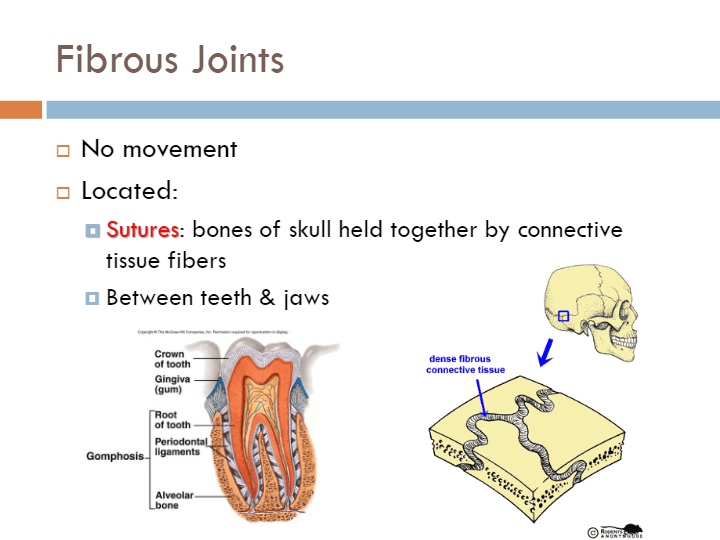
Types of fibrous joints include  
1
synarthrotic, amphiarthrotic, and diarthrotic 
2
syndesmosis, suture, and gomphosis 
3
synchondrosis, symphysis, and synovial
4
pivot, condylar, and ellipsoidal

8

Multiple Choice

A fibrous joint in which an interosseous ligament binds bones is a  
1
suture
2
syndesmosis
3
gomphosis
4
symphysis

9

Multiple Choice

A fibrous joint that is also known as a "peg in socket"

1

suture

2

syndesmosis

3

gomphosis

4

symphysis

10

Multiple Choice

A fibrous joint between cranial bones

1

suture

2

syndesmosis

3

gomphosis

4

symphysis

11

Slide image

12

Slide image

13

Multiple Choice

Synchondroses (along epiphyseal growth plate) and Symphyses (midline of hip bones) are examples of...
1
fibrous joints
2
cartilaginous joints
3
synovial joints
4
diarthroses

14

Slide image

15

Slide image

16

Slide image

17

Slide image

18

Multiple Choice

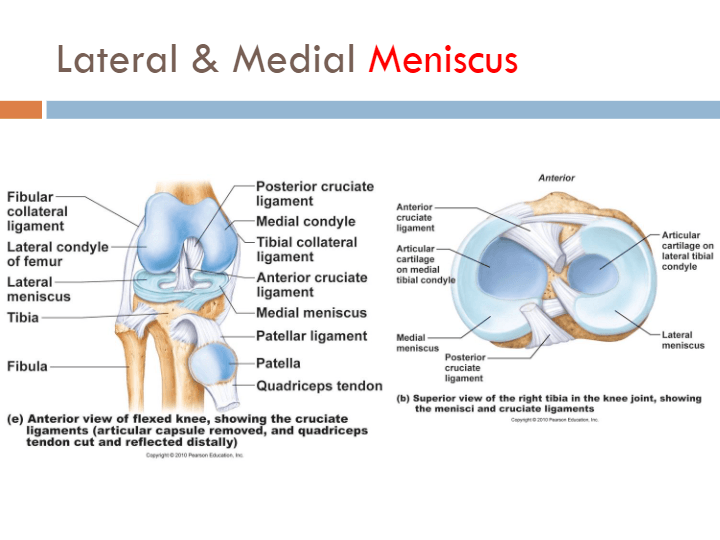
Fluid-filled sacs containing synovial fluid are called  
1
bursae
2
menisci
3
ligaments
4
tendons

19

Multiple Choice

Fibrocartilage discs that divide the joint into two compartments are called  
1
menisci
2
bursae
3
tendons
4
ligaments

20

Multiple Choice

A synovial membrane  
1
is very thick with many layers of cells
2
secretes serous fluid
3
 secretes mucus
4
secretes synovial fluid

21

Slide image

22

Slide image

23

Slide image

24

Slide image

25

Slide image

26

Slide image

27

Slide image

28

Slide image

29

Multiple Choice

slightly movable joint
1
synarthrosis
2
diarthrosis
3
amphiarthrosis

30

Multiple Choice

Immovable joint
1
synarthrosis
2
diarthrosis
3
amphiarthrosis

31

Multiple Choice

Freely movable joint
1
diarthrosis
2
amphiarthrosis
3
synarthosis

32

Multiple Choice

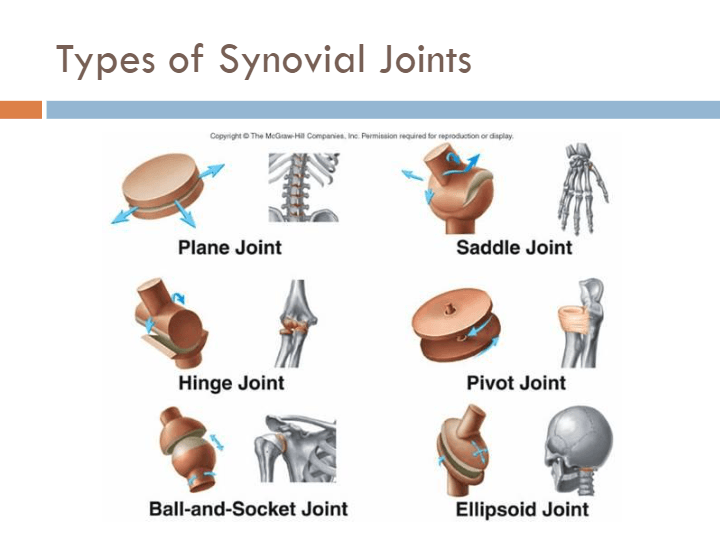
The elbows, knees and phalanges are examples of this type of joint
1
ball and socket
2
condyloid
3
gliding
4
hinge

33

Multiple Choice

This type of joint allows the your first two vertebrate to rotate as in shaking your head no
1
condyloid
2
gliding
3
pivot
4
saddle

34

Multiple Choice

Carpals and tarsals (flat bones) are examples of this type of joint
1
condyloid
2
gliding
3
hinge
4
saddle

35

Multiple Choice

The joint that allows for a wider range of motion (flexion, extension, abduction, adduction, rotation).

1

gliding

2

saddle

3

ball and socket

4

fibrous

36

Multiple Choice

The most movable joints in the body are:

1

symphyses

2

synovial joints

3

syndesmoses

4

gomphoses

37

Multiple Choice

In terms of function, which is considered an immovable?

1

a synarthrosis

2

an amphiarthrosis

3

a diathrosis

4

all joints are movable

38

Multiple Choice

In terms of structure, which type of articulation has a joint capsule?

1

fibrous

2

cartilaginous

3

synovial

4

amphiarthrotic

39

Slide image

40

Slide image

41

Slide image

42

Slide image

43

Slide image

44

Slide image

45

Slide image

46

Slide image

47

Slide image

48

Slide image

49

Slide image

50

Slide image

51

Slide image

52

Slide image

53

Slide image

54

Multiple Choice

Question image
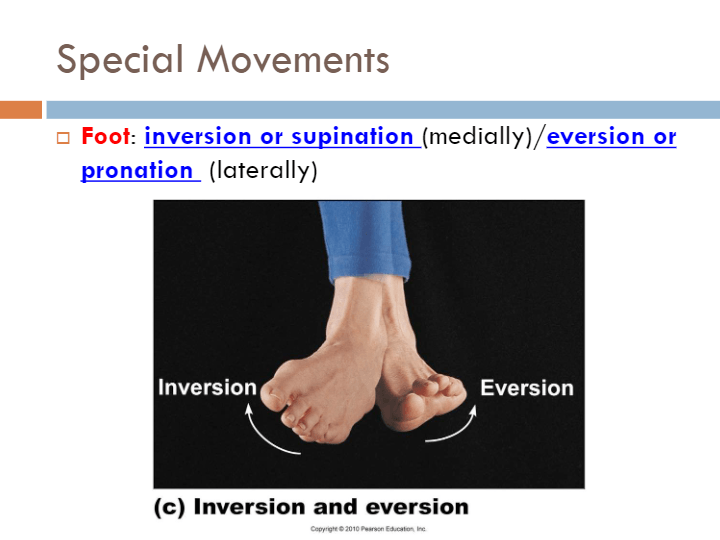
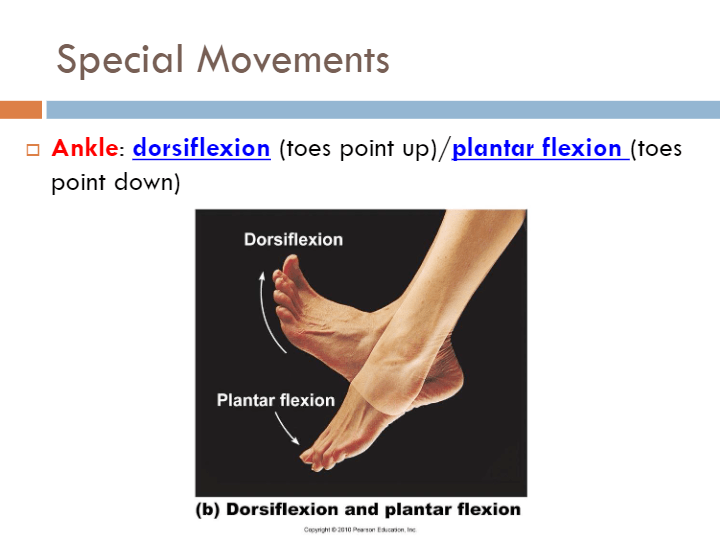
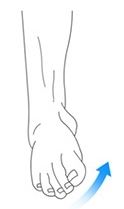
Turning the foot so the plantar surfaces faces medially.
1
plantar flexion
2
eversion
3
inversion
4
dorsiflexion

55

Multiple Choice

Question image
Moving a part so that its end follows a circular path (moving a finger in a circular motion without the the hand).
1
circumduction
2
rotation
3
opposition
4
retraction

56

Multiple Choice

Question image
Movement away from the mid-line is called _____________.
1
abduction
2
adduction
3
internal rotation
4
external rotation

57

Multiple Choice

Question image
Moving a part forward (thrusting the head forward).
1
protraction
2
retraction
3
elevation
4
supination

58

Multiple Choice

Flexing your foot; toes towards the ceiling
1
dorsiflexion
2
plantar flexion
3
opposition
4
elevation

59

Multiple Choice

Circular motions about a joint
1
circumduction
2
rotation
3
opposition
4
retraction

60

Multiple Choice

Pointing your toe
1
dorsiflexion
2
plantar flexion
3
flexion
4
extension

61

Multiple Choice

Straightening beyond the anatomical position
1
extension
2
hyperextension
3
flexion
4
hyperflexion

62

Multiple Choice

Question image
Tissue that connects bone to bone
1
Ligament
2
Tendon
3
Cartilage
4
Muscle

63

Multiple Choice

Question image
Rotation of the forearm until the palm faces anterioriorly is called _________.
1
Supination
2
external rotation
3
plantar flexion
4
pronation

64

Multiple Choice

Question image
Rotation of the forearm until the palm faces posteriorly is called __________.
1
supination
2
pronation
3
flexion
4
dorsiflexion

65

Multiple Choice

Question image
Movement away from the mid-line is called _____________.
1
abduction
2
adduction
3
internal rotation
4
external rotation

66

Multiple Choice

Question image
The lateral motion TOWARDS the midline is called ______.
1
adduction
2
abduction
3
internal rotation
4
external rotation

67

Multiple Choice

Question image

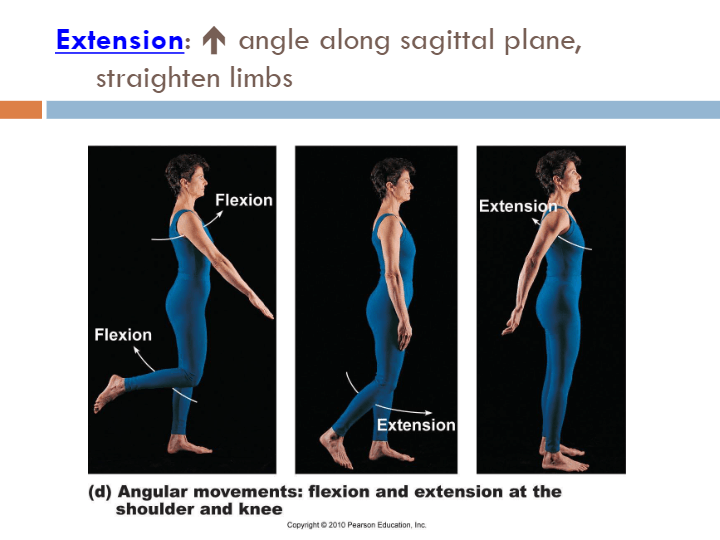
Which of the following best describes extension?

1

The straightening of a joint where the angle of movement increases

2

The bending of a joint where bones get closer together

3

The rotation of a joint or spinning of one bone on another

4

The lateral movement away from the midline

68

Slide image

69

Multiple Choice

Commonly known as a chronic autoimmune disorder in which the joints and some organs are attacked, joints become swollen, painful and immobile.
1
Osteoarthritis
2
Osteoporosis
3
Gouty Arthritis
4
Rheumatoid Arthritis

70

Multiple Choice

Deposits of uric acid in the joints which forms crystals in the joints. 
1
Osteoarthritis
2
Osteoporosis
3
Gouty Arthritis
4
Rheumatoid Arthritis

71

Multiple Choice

Wear and tear arthritis, most commonly associated with aging
1
Gouty Arthritis
2
Osteoarthritis
3
Rheumatica
4
Osteoporosis

72

Multiple Choice

The partial displacement of a bone from its joint
1
Fracture
2
Sprain
3
Sublaxation
4
Dislocation

73

Multiple Choice

The total displacement of a bone from its joint.
1
Sublaxation
2
Fracture
3
Sprain
4
Dislocation

74

Multiple Choice

A stiffness of joints, especially in the elderly.
1
Polymyslgia
2
Synovitis
3
Bursitis
4
Arthrosclerosis

75

Multiple Choice

An inflammation of the bursa around joint.
1
Bursitis
2
Arthrosclerosis
3
Chondroma
4
Synovitis

76

Multiple Choice

Abnormal softening of the cartilage.
1
Chondroma
2
Chondromalacia
3
Bursitis
4
Sprain

77

Multiple Choice

a slow growing benign tumor derived from cartilage cells. 
1
Chondroma
2
Costochondritis
3
Sprain
4
Polymyalgia

78

Multiple Choice

When a ligament that connects bones to a bone is wrenched or torn.
1
Chondrom
2
Hallux vagus
3
Rheumatica
4
Sprain

Joints and Articulations

Slide image

Show answer

Auto Play

Slide 1 / 78

SLIDE