Search Header Logo
  1. Resource Library
  2. Science
  3. Biology
  4. Aquatic Ecosystems
  5. 23_24| Eoc Review |energy In Ecosystems | Aquatic Ecosystems
23_24| EOC Review |Energy in Ecosystems | Aquatic Ecosystems

23_24| EOC Review |Energy in Ecosystems | Aquatic Ecosystems

Assessment

Presentation

Science

9th - 12th Grade

Medium

NGSS
MS-ESS1-1, MS-LS2-3, MS-ESS2-5

+19

Standards-aligned

Created by

Anissa Rodriguez

Used 14+ times

FREE Resource

15 Slides • 20 Questions

1

media

2

Must complete
6 Quizizz this week for extra credit A's

REMEMBER YOU MUST GET 100% ON EACH QUIZIZZ TO RECIEVE EXTRA CREDIT

3 Classes left

media

3

media

4

media

5

Multiple Choice

Question image

The diagram shows the relationships among organisms living in an Atlantic coast estuary. Use the diagram to answer the following.


Which of these is an abiotic factor that affects the organisms in the estuary ecosystem?

1

the amount of bacteria in the water

2

the number of copepods

3

the amount of salt in the water

4

the number of scavengers

6

Multiple Choice

Question image

Scientists have recently discovered hydrothermal vent communities on the ocean floor. A diagram of a hydrothermal vent community is shown in the figure below.

The organisms in this community live near heated vents. Inorganic compounds such as sulfides mix with extremely hot water when they are released from the vents. Bacteria use the sulfides to make food for themselves and other animals. Many of these bacteria live in the bodies of the giant tubeworms and the giant white clams that live in this community.

Which of these is an abiotic factor that influences this ecosystem?

1

food

2

bacteria

3

water temperature

4

giant tubeworms

7

media

8

Multiple Choice

The pH of the water in several lakes in Norway and Sweden had decreased to below 5.0 due to an increase in acid rain. Which of the following is most likely to happen in these lakes?

1

the decline of several fish populations

2

an increase in numbers of fish

3

an increase in the amount of primary producers

4

increased predator-prey relationships

9

Multiple Choice

Question image

Mullet are local estuarine fish that move in schools and feed on plankton and plant matter. Natural predators of the mullet include spotted sea trout, sharks, pelicans and dolphins. The graph below shows how the number of mullet in an area has changed over time. 

Based on the data, one student concludes that a new predator was introduced into the area during this time period. Which of the following is a likely alternate explanation for the change in the mullet population?


1

mullet prey increased in the area

2

mullet parasites decreased in the area

3

the temperature of the area increased

4

the amount of aquatic plants in the area increased

10

media

11

Multiple Choice

Question image

In the coastal waters off western North America, there is a starfish species that feeds primarily on mussels, another marine organism. In an experimental area, the starfish were removed from the waters. The effect of this removal is shown in the graph below. What conclusion can be made regarding the role of the starfish in this ecosystem?

1

The biodiversity of this ecosystem increased within ten years as organisms adjusted to the loss of the starfish.

2

The starfish is important in maintaining the biodiversity of this ecosystem.

3

When the starfish were removed, the ecosystem decreased in stability and increased in biodiversity.

4

Biodiversity in this ecosystem is not dependent on the presence of starfish.

12

media

13

media

14

media

15

media

16

Categorize

Options (10)
Question image
Question image
Question image
Question image
Question image
Question image
Question image
Question image
Question image
Question image

Organize these options into the right categories

Producers
Consumers
Decomposers

17

Labelling

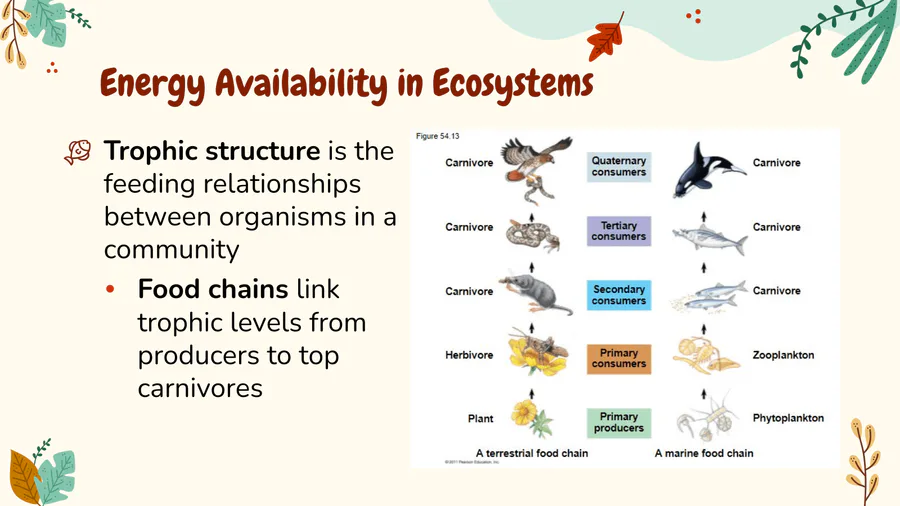
Label this food chain

Drag labels to their correct position on the image

primary consumer

tertiary consumer

secondary consumer

producer

quaternary consumer

decomposer

18

Open Ended

What does the arrow in a food chain represent?

19

media

20

Multiple Choice

Question image

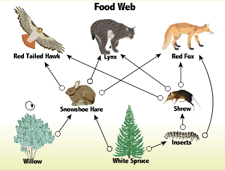
Which organism in figure 1 contains the most available energy?

1

plants

2

hawks and owls

3

spiders

4

foxes

21

Multiple Choice

Question image
What may happen if the snowshoe hare was removed from the food web pictured?
1
The insects in the habitat would increase.
2
The shrew population would decrease due to being only hawk food source.
3
The willow tree population would decrease.
4
Foxes would dies due to no food source. 

22

Multiple Choice

What might happen if you remove a primary consumer from the ecosystem?
1
There would be more food for secondary consumers.
2
The number of primary consumers would increase.
3
The number of plants would increase.
4
The number of secondary consumers would increase.

23

Drag and Drop

A(n) ​
is an organism that can make its own food and a(n) ​
is an organism that has to consume other organisms to gain nutrients and energy.
Drag these tiles and drop them in the correct blank above
autotroph
heterotroph
primary consumer
secondary consumer

24

media

25

Multiple Choice

If only 10% of an organism's energy is available for the next trophic level, what happens with the other 90% of the energy?

1

It is destroyed after it is used up.

2

It is used for life processes or lost as body heat.

3

It remains for the next trophic level IF the predator consumes ALL of the organism.

4

It is lost completely as body heat.

26

Multiple Choice

Question image

The diagram represents a model of a food pyramid. Which statement best describes what happens in this food pyramid?

1

More organisms die at higher levels than at lower levels, resulting in less mass at higher levels.

2

When organisms die at higher levels, their remains sink to lower levels, increasing the mass of lower levels.

3

Energy is lost to the environment at each level, so less mass can be supported at each higher level.

4

Organisms decay at each level, and thus less mass can be supported at higher levels

27

media

28

media

29

Multiple Choice

Question image

This diagram shows the flow of carbon in a terrestrial ecosystem. What will most likely happen if the decomposers are removed from the carbon cycle?

1

The amount of carbon dioxide in the atmosphere will decrease.

2

The amount of carbon dioxide in the atmosphere will increase.

3

The amount of carbon dioxide used by producers will increase.

4

The amount of carbon dioxide needed by consumers will decrease.

30

Multiple Choice

The framework of organic molecules essential to all organisms is composed mainly of carbon atoms. Which processes are involved in the cycling of carbon within an environment?

1

photosynthesis and respiration

2

evaporation and condensation

3

transcription and translation

4

diffusion and transpiration

31

Multiple Choice

All organisms contain carbon and oxygen. Both of these elements are also found in Earth’s atmosphere. Which of the following processes does not return carbon to the atmosphere?

1

Combustion

2

Decomposition

3

Photosynthesis

4

Cellular respiration

32

media

33

Match

Match the following

Changes Liquid to gas in the water cycle?

Where water is stored underground?

Rain,Hail, Snow and Sleet are?

When water leaves leafs is?

Evaporation

Aquifers

Precipitation

Evapotranspiration

34

Match

Match the following

occurs when the sun heats water up and it becomes vapor in the air.

the opposite of evaporation; it occurs when air cools and the vapor collects into liquid form.

condensation falling onto land in the form of rain, sleet, hail, snow, and mist. Only 10% of water evaporated falls as precipitation.

the downward movement of water from the land surface into the soil or porous rock. Ground water begins as precipitation. Once water infiltrates the soil it can move vertically and horizontally through the soil.

is the water that exists for long periods below the Earth’s surface.

Evaporation

Condensation

Precipitation

Infiltration

Groundwater storage

35

Multiple Choice

Question image

According to this simplified water cycle, what is the function of the process of transpiration?

1

releases water vapor from plants

2

decreases the rate of the water cycle

causes

3

photosynthesis in plants

4

speeds the evaporation of water

media

Show answer

Auto Play

Slide 1 / 35

SLIDE