Search Header Logo
  1. Resource Library
  2. Science
  3. Biology
  4. Animal Habitat
  5. Animal Habitat And Adaptation With Research
Animal Habitat and Adaptation with Research

Animal Habitat and Adaptation with Research

Assessment

Presentation

Science

3rd Grade

Easy

NGSS
MS-ESS1-1, MS-LS2-3, MS-LS1-5

+20

Standards-aligned

Created by

LORI LINDLEY

Used 6+ times

FREE Resource

39 Slides • 14 Questions

1

Animal Habitats

2

3

media

4

Multiple Choice

What is a habitat?

1

A habit that an animal has

2

An environment that an animal lives

3

a behavior of an animal

5

media

A forest

6

media

Desert

7

media

Ocean

8

media

Grassland

9

media

Tundra

(Arctic)

10

media

Rainforest

11

Multiple Choice

Pond, garden, a rotting log or a desert is an example of:

1

Habitat

2

Trees

3

Animals

12

Multiple Choice

Cactus is found in the following habitat:

1
2
3

13

media

It lives in the forest.

Where does the monkey live?

14

media

It lives in the desert.

Where does the camel live?

15

media

They live in the ocean.

Where do sharks live?

16

media

They live in grasslands.

Where do lions live?

17

media

They live in the arctic.

Where do arctic foxes live?

18

Match

Match the following

Forest

Desert

Ocean

Arctic

Grassland

19

media

20

21

media

22

media

23

media

24

media

Pouch

A kangaroo has a pouch.

Because the baby grows in the pouch.

25

media

Tongue

Giraffes have long tongues.

Because they need their tongues to eat leaves.

26

media

Fur

Dogs have thick fur.

Because the fur keeps them warm.

27

media

Horns

Bulls have horns.

Because they need their horns to fight.

28

media


Claws

Bears have claws.

Because they need their claws to hunt.

29

media

Fins

Sharks have fins.

Because they need fins to swim.

30

media

Wings

Eagles have wings.

Because they need their wings to fly.

31

Dropdown

Question image
Why do bears have ​
Because they need to hunt for food.

32

Match

Match the following

pouch

long tongue

thick fur

horns

claws

33

media

34

media

35

media

36

media

37

38

Multiple Choice

Question image

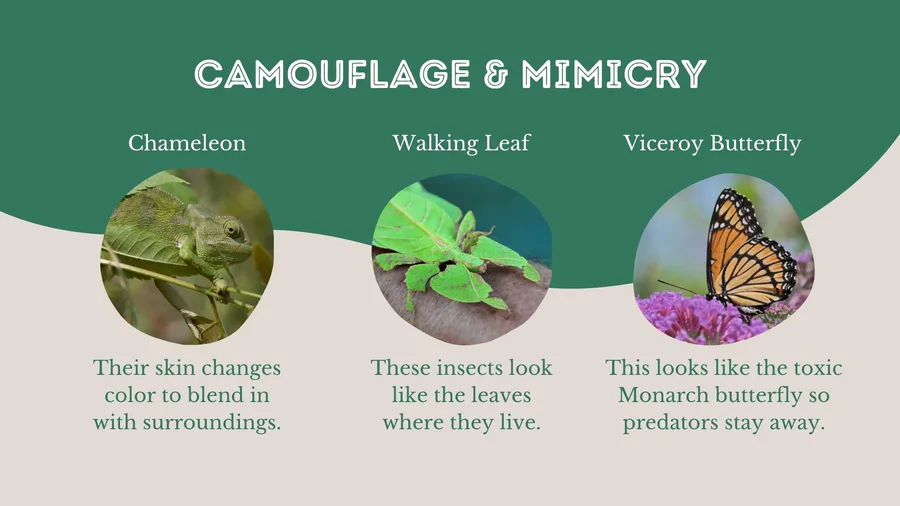
What does it mean to CAMOUFLAGE?

1

when a weak animal copies a stronger animal to warn of predators

2

when an animal is able to change colors to survive in an enviornment

3

when an animal hibernates during the winter.

39

Multiple Choice

Select that animal that is using camouflage

1
2
3

40

Multiple Choice

Select the animal that is uses mimicry to survive

1
2
3

41

media

42

media

43

Multiple Choice

What is a behavioral adaptation?

1

Something an animal does to survive

2

How an animal looks

3

A structure that an animal has

4

A bear's thick fur

44

media

45

Multiple Choice

Question image

Birds flying south 800 miles to find food and to escape cold winters is an example of

1

Hibernating

2

Migrating

3

Camouflage

46

media

47

media

48

media

49

Multiple Choice

Which is NOT a physical adaptation?

1

a bear hibernating in the winter

2

a bird with a sharp beak

3

a fish with scales on its body

50

Multiple Choice

Question image

According tho the graph, which animal travels the longest distance?

1

Hummingbirds

2

Snow Geese

3

Seals

4

Monarch Butterflies

51

Multiple Choice

An animal has blubber and thick fur to keep warm. What habitat is this animal most likely from?

1

Tundra

2

Rainforest

3

Grasslands

4

Desert

52

Select and investigate!

Select any animal and find out about its adaptation by clicking on the links provided on the next slide! Fill out the information on the Animal Research slide in your Google Classroom. Enjoy!


Some examples are armadillo, chameleon, hummingbird, platypus, cheetah, camel, narwhal, gecko, archerfish, woodpecker, sloth, seahorse, praying mantis, crocodile, or lion.


Animal Habitats

Show answer

Auto Play

Slide 1 / 53

SLIDE