

Civics Final Review

Presentation
•
Social Studies
•
6th - 8th Grade
•
Easy

Brian York
Used 8+ times
FREE Resource
194 Slides • 271 Questions
1
2
3

Darker shading is more populated
Lighter shading is less populated
Symbols can be used to represent the populations of cities
Always look at the key when you are reading a map!
Population Density Maps
4
AN URBAN SETTLEMENT- OBSERVE

5
NOTICE THE CHANGES IN A RURAL SETTLEMENT.

6

7

8

9
10
Get a green card and then file a declaration of intention to become a citizen. You must have the green card for at least 5 years
Learn English if you are not from an English speaking country. You will have to prove you can speak and write it
Pass a Civics test
Pass an Interview
Take an Oath of Allegiance

11
Multiple Choice

Use the map below to answer the question. What data does the map show?
population density
immigration status
naturalization status
ethnic diversity
12
Multiple Choice

Use the table below to answer the question. Why is paying taxes listed as an obligation?
Taxes are not mentioned in the Constitution.
Obligations are actions that are helpful to other citizens.
Obligations are actions citizens are required to do by law.
Paying taxes is considered a right and not a responsibility.
13
Multiple Choice
The quote below is from President Woodrow Wilson. "There is no higher religion than human service. To work for the common good is the greatest creed." What is Wilson referring to in the passage?
civil rights
naturalization
religious diversity
civic responsibility
14
Multiple Choice

Use the photo below to answer the question. Which American value does the statue represent?
equality
justice
liberty
patriotism
15
Multiple Choice
16
Multiple Choice

17
Multiple Choice

18
Multiple Choice
The great variety of human characteristics is known as..
diversity
segregation
assimilation
categoration
19
Multiple Choice

How does the Fourteenth Amendment define citizenship?
All persons born or naturalized in the U.S., are citizens of the U.S.
All persons born in the U.S., are citizens of the U.S.
All persons naturalized in the U.S., are citizens of the U.S.
All persons who apply for citizenship, are citizens of the U.S.
20
Multiple Select
Who is considered a natural-born U.S. citizen?
Naturalized
Law of Blood
Permanent resident alien
Law of Soil
21
Multiple Choice
2. Demonstrate the ability to read, speak, and write words in English.
Which title would best fit these two statements?
22
Multiple Choice

23
Multiple Choice
24
Multiple Choice
25
Multiple Choice
26
Multiple Choice
27
Multiple Choice
28
Multiple Choice
Why would someone want to be a citizen instead of just having a greencard forever?
A greencard will expire after awhile
Citizenship is easier to get than a greencard
Citizenship means you will have the full rights provided by the country
29
Multiple Select
Which of the following are 2 requirements to go through naturalization?
Have a good paying job
Have family members in the U.S.
Have good character
Be at least 18 years old
Be at least 30 years old
30
Multiple Select
Which of the following must be done to go through naturalization *select 3*
Pass a civics test
Pass a geography test
Get a U.S. drivers license
Take an Oath of Allegiance
Pass an interview
31
Essential Question: Why is community important?
32
Multiple Choice
What do people swear to do when they take the naturalization oath?
to learn English
to work in the United States
to be loyal to the U.S.
to follow all naturalization steps
33
The Political Process
34
Influence of Individuals
35
The Power of Interest Groups
Interest groups play a significant role in shaping politics.
They represent specific interests and advocate for their policy preferences.
Interest groups use various strategies such as lobbying, campaign contributions, and grassroots mobilization to influence the political process.
They can impact legislation, regulations, and public opinion.
Their power lies in their ability to organize and influence decision-makers.
36
The Impact of Media
Media plays a crucial role in shaping public opinion and influencing political processes.
It provides information to citizens, helping them make informed decisions.
Media can set the agenda by highlighting certain issues and influencing public discourse.
It can also shape public perception of political parties, individuals, and interest groups.
However, media bias and misinformation can distort the political process and undermine democracy.
37
Multiple Choice
Which of the following plays a vital role in informing the public and shaping public opinion?
Political parties
Individuals
Interest groups
Media
38
Multiple Choice
Which individuals play a crucial role in the political process?
Voters
Journalists
Teachers
Scientists
39
Multiple Choice
What role does media play in shaping public opinion and influencing political processes?
It has no role in shaping public opinion and influencing political processes
It provides information to citizens, helping them make informed decisions
It only highlights certain issues but does not influence public discourse
It has a negative impact on democracy
40
Multiple Choice
Where can we find out about the qualifications for national office ?
US Constitution
The Magna Carta
Declaration of Independence
The Articles of Confederation
41
Multiple Choice

In its role as watchdog, the media keeps watch on the government and others in power.
True
False
42
Multiple Choice
A local news station refuses to publish a story about one of its reporters getting arrested wanting to keep it under wraps. Which role of media does this NOT fall under?
Media as a watchdog
Media as an agenda-setter
Media as a gate keeper
Biased media
43
Multiple Choice
Why do you think they included this freedom?
"In the Bill of Rights the founding fathers included freedom for the media to say and print what they want, this is called freedom of the press."
to limit public opinion
to monitor the citizens
to limit citizens' knowledge
to monitor the government
44
Multiple Choice
How do interest groups influence the government?
by running for state and federal political office
by lobbying government officials for a particular issue
by recruiting foreign leaders to vote in favor of certain laws
by holding public officials accountable for their actions in a court of law
45
Multiple Choice
What does a "watchdog" do?
raise money to donate to political campaigns.
create biased political ads to influence public opinion.
question and expose government officials of wrongdoing.
volunteer at phone banks to help a candidate get elected.
46
Essential Question: How can you participate in your community?
47
What do we notice about the office of the President ?

48
Congress is divided into two chambers or houses, or bicameral.

49

Studio
You can open this webpage in a new tab.
50
Multiple Choice
51
Multiple Select
The formal qualifications for the presidency according to the Constitution:
Native-born U.S. Citizen
must be a male
35 Years Old
Must be one of the two main political parties
14 year resident minimum in the U.S.A.
52
Multiple Select
Which must a person be in order to become President of the United States?
natural born citizen
permanent resident
US citizen
naturalized citizen
53
Multiple Choice
54
Multiple Select
True or False: Each state's requirements for office are the same?
true
false
55
Multiple Choice
Ethan lives in Florida and wants to be in the State Senate. He is 20 years old and LOVES politics. He moved to Florida when he was 2. Is he eligible to run for State Senate?
No, he has to be 21.
No, he has to be 30
No, he is not native to Florida.
Yes, he meets all the requirements.
56
57
levy (assess) and collect taxes
make war
regulate interstate trade
58
A way to understand this idea is to think about the expressed power of Congress to create a military. The Constitution doesn't say that Congress can pay the soldiers, design uniforms, or purchase tanks. But we assume Congress has those powers because they are necessary to create a military.
59
taxation
transportation
establishing courts
making laws
60
The powers not given to the national government by the Constitution of the United States are reserved to the states or people (10th Amendment).
61
Neither national nor state governments can pass ex post facto ("after the fact") laws. These laws make something a crime that was not a crime when the action occurred. This seems strange to us, but it was a policy of the British government to the colonies.
Neither national nor state governments can tax US exports. The reason for that is it would punish US businesses by adding an unnecessary tax.
62

63
State Government
The governor serves as the executive head of the state government.
64
State Government
State governments have a legislative (law-making body) consisting of a state House of Representatives & Senate.
65
Local Governments: City, Towns, or Villages
66
Municipality
A city, town, or village, that usually has its own local government.
67
Charter
A legal document that establishes a municipality and serves as its constitution.
68
The mayor Serves as The executive head or leader of city government.
City Council is a group that serves as the local legislative body to pass laws, or ordinances
69
County, city, town, village, etc...
State can regulate municipal powers
Basic executive/legislative power:
County commisioner, Town Council, Mayor, etc...
Limited powers to regulate government
Federal government uses $$ to influence
States depend on federal money so may be forced to follow federal guidelines
Grants, federal mandates, tax breaks, etc...
Municipal government
Legislative - Senate and House of Representatives
Executive - Governor and Lt. Governor
Judicial - cases move UP through system
State Supreme Court (7 justices)
DIstrict Court of Appeals
Circuit Court
County Court
State government
Some text here about the topic of discussion
70
71

72
Multiple Choice
Concurrent powers
The federal government has supremacy over state governments.
The federal government follows the lead of state governments.
The federal government shares powers with the state governments.
The federal government sets standards that state governments must follow.
73
Multiple Choice
Which power is delegated to the federal government?
conducting elections
establishing courts
taxing citizens
coining money
74
Multiple Choice
Example of Reserved powers
establishing and funding a system of public education
raising and maintaining a navy
declaring war and governing combat
setting and fixing the standards of weights and measures
75
Multiple Choice
Which of the following is a shared obligation of the federal, state, and local governments?
coining money
constructing roads and highways
issuing passports
making treaties with foreign nations
76
Multiple Choice
Which service is performed by local government?
Minting coins
Delivering mail
Providing fire protection
Granting teacher certificates
77
Multiple Choice
Maria is a member of the mayor's council. She is preparing to present these charts of information to her fellow council members at the next meeting. These charts compare the public and private trash collection services in their area.
Which level of government would be involved in making decisions about trash pick-up services?
International
State
Federal
Local
78
Multiple Choice
If a State Tax Amendment is rejected by Florida voters....
What conclusion can be drawn from that?
Citizens can be directly involved in policy making
Only elected officials may change constitutions
Citizens can be involved in policy making through their representatives.
Only elected officials make policy
79
Multiple Choice
(Who) is the Legislative Branch in the Local Government?
Senator
City Council
Chief Justice
Representative
80
Multiple Choice
What is a local law called?
Statute
Act
Ordinance
Amendment
81
Multiple Choice
82
Multiple Choice
Which level of government regulates drivers’ licenses?
County
Federal
Municipal
State
83
Multiple Choice
Which is a responsibility of state government?
regulating public transportation
public education
providing clean drinking water
providing fire protection
84
Multiple Choice
Which level of government provides the most services to citizens?
Federal
Local
National
State
85
Multiple Choice
What is the highest level of courts within a state?
The appellate courts
District courts
The state Supreme Court
The federal Supreme Court
86
Multiple Choice
What level of government officials do citizens vote for?
local and national
state and local
state and national
local, state, and national
87
Multiple Choice
88
Multiple Choice

The _________________ manages/runs K-12 school systems.
Parents
School Committee
Governor
School Board
89
Multiple Choice
Clerk of the Court
Mayor
Commissioner of Revenue
Which of the following terms apply to all of these positions?
90
Multiple Choice
91
Attending a city council meeting is an example of civic engagement in a local community. It allows individuals to participate in decision-making processes and voice their concerns directly to local government officials.
92
Multiple Choice
Ava, Aria, and Luna are discussing ways to get involved in their local community. Which action discussed by them is the best example of civic engagement in their local community?
Donating to an international charity
Attending a city council meeting
Watching a documentary on global issues
Reading a book on political theory
93
Multiple Choice
Engaged citizens are involved in their government. Which level of government should you contact if you are unhappy with what is being taught at our schools and universities?
municipal
county
state
federal
94
Multiple Choice
Engaged citizens are involved in their government. Which level of government should you contact if you want a sidewalk to get added to your neighborhood?
municipal
county
state
federal
95
Multiple Select
What are two things tribal governments do?
To build houses for their citizens
Create and enforce laws
to make sure citizens buy milk and bread when it snows
To tax their citizens and non-citizens
96
Multiple Choice
Why do tribes have their own constitution?
to outline how their governments work and how they work with the federal government
To boss their citizens around
to outline how their government can work without federal government cooperation
97
Multiple Choice
All of the federally recognized tribes have exactly the same tribal governments.
True
False
98
Multiple Choice

How would you describe the structure of the Yavapai-Apache Nation’s government?
Three branches: legislative, executive, judicial
One body of government called a Tribal Council
99
Multiple Choice
Local Government power
minting coins
Delivering mail
providing fire protection
teacher certificates
100
Multiple Choice

101
102
Essential Question: How can you solve problems in your community?
103
104
105

106

107

108

109

110

111

112
Multiple Select
What are the natural rights according to Locke?
Liberty
Property
Money
Life
113
Multiple Choice
Which document established self-government? ("guess we should make some laws now." ~ something a pilgrim could have said)
Magna Carta
Common Sense
English Bill of Rights
Mayflower Compact
114
Multiple Choice
To divide the government into three branches is which BIG idea?
Social contract
Separation of powers
Natural Rights
State of Nature
115
Multiple Choice
To give up some of your rights in order to be governed (and protected by and from the government), is which BIG idea?
Social contract
Separation of powers
Natural Rights
State of Nature
116
Multiple Choice
What was the purpose of Thomas Paine's Common Sense?
To encourage colonists to seek independence from Great Britain
To encourage colonists to establish rule of law in Texas
To enrage colonists to swim to Great Britain
To enrage colonists to pay more taxes to the British
117
Multiple Choice
No one is above the law:
Separation of Powers
Natural rights
Rule of Law
Montesquieu
118
Multiple Choice
119
Multiple Choice
The Mayflower Compact was unique because it..
was the first example of colonial European self-government in northeastern North America.
gave freedom to Black colonists
provided a foundation for the Declaration of Independence
allowed women to vote
120
Multiple Choice
How does “Rule of Law” affect U.S. government officials and institutions? (1.9)
It prevents government officials and institutions from making their work public.
It requires government officials and institutions to create new laws.
It holds government officials and institutions accountable to the law.
It ensures government officials and institutions are exempt from laws.
121
Multiple Choice

Which of these documents was signed 800+ years ago by King John of England. HINT: It is the oldest example of Rule of Law and limited the powers of a king or queen.
The U.S. Constitution (in 1787)
The English Bill of Rights (in 1689)
The Magna Carta (in 1215)
The Mayflower Compact (in 1620)
122
Multiple Choice
A time period, mostly in the 1700's, where philosophers and thinkers thought science and reason could improve all humanity.
Enlightenment
Great Awakening
American Revolution
French Revolution
123
Multiple Choice
With ideas like the Separation of Powers, Baron de Montesquieu influenced this American document.
The Declaration of Independence
The Bill of Rights
The Magna Carta
The Constitution
124
Multiple Choice
John Locke believed that all people had:
Natural Rights
No rights
Some rights
Animal rights
125
Multiple Choice
What was the purpose of government according to Locke?
To share the riches of the kingdom
To keep power in the hands of the King
Protect people and their rights
To allow power to be taken by force
126
Multiple Choice
According to John Locke, if the government didn't protect the people's natural rights, what could the people do?
Overthrow (change) the government
Petition the government for their rights
Nothing, the people don't have rights
127
Multiple Choice
Which American Founding Father did John Locke influence the most?
Ben Franklin
George Washington
John Adams
Thomas Jefferson
128
July 4, 1776

129

130
DECLARATION OF RIGHTS
That whenever any Form of Government becomes destructive of these ends, it is the Right of the People to alter or abolish it, and to institute new Government, laying its foundation on such principles, and organizing its powers in such form, as to them shall seem most likely to effect their Safety and Happiness.
...it is their right, it is their duty, to throw off such Government, and to provide new Guards for their future security.
131
GRIEVANCES AGAINST THE CROWN
Quartering of Soldiers
Standing Armies in the Colonies
Taxation without Representation
Forbidding the Colonial Legislatures from passing laws
Failure to enforce laws
No Trial by Jury
Making it hard for Colonists to participate in Government
132
STATEMENT OF INDEPENDENCE
We, therefore, the Representatives of the united States of America, in General Congress, Assembled, appealing to the Supreme Judge of the world for the rectitude of our intentions, do, in the Name, and by Authority of the good People of these Colonies, solemnly publish and declare, That these United Colonies are, and of Right ought to be Free and Independent States; that they are Absolved from all Allegiance to the British Crown, and that all political connection between them and the State of Great Britain, is and ought to be totally dissolved; and that as Free and Independent States, they have full Power to levy War, conclude Peace, contract Alliances, establish Commerce, and to do all other Acts and Things which Independent States may of right do. And for the support of this Declaration, with a firm reliance on the protection of divine Providence, we mutually pledge to each other our Lives, our Fortunes and our sacred Honor.
133
Multiple Choice
Which country did the colonists declare independence from?
France
Spain
Great Britain
United States
134
Multiple Choice
What are unalienable rights?
rights that can't be taken away
rights that can be denied
rights that are temporary
rights that can be removed at any time
135
Multiple Choice
Why did the colonists write the Declaration of Independence?
To officially break away from Britain
As a final attempt at peace with Britain
To form the U.S. military
To get France on their side
136
Multiple Choice

137
Multiple Choice

138
Multiple Choice

139
Multiple Choice
140
Multiple Choice
The List of Grievances was the part of the Declaration that
detailed the colonists' complaints with King George III.
141
Multiple Choice
142
143
144
145
Multiple Choice
146
Multiple Choice
147
Multiple Choice

148
Multiple Choice

149
Multiple Choice

150
Multiple Choice
151
Multiple Choice

152
Multiple Choice
153
Multiple Choice
154
Multiple Choice
155
Multiple Choice
156
Multiple Choice
157
Multiple Choice
158
Multiple Choice
Why did the Anti-Federalists demand a Bill of Rights?
they wanted to keep the government small
they wanted a provision for Taco Tuesday
they wanted to keep the government big and strong
they wanted to make sure individual states rights were protected
159
Multiple Choice
How did Federalists and Anti-Federalists "compromise" to ratify (approve) the U.S. Constitution?
they added the Bill of Rights (first 10 amendments)
ensured due process of law
they outlawed cruel and unusual punishment
the Federalists threatened the Anti-Federalists with war
160
Multiple Choice
Who would say: The President created by the Constitution is really just a king.
federalist
antifederalist
161
Multiple Choice
Who would say: I believe that laws should come from a strong national government.
Federalist
Anti-Federalist
162
Essential Question: Why is it important to listen to different ideas and viewpoints?
163
164
In the United States, the people come first
The government gets its power from the people, as they are the ones writing this Constitution
This idea is called Popular Sovereignty
165
To unite the people of the country under one government, not like the Articles of Confederation.

166
To establish a court or justice system.

167
To keep the peace WITHIN the country/your home.

168
Government should have the power to collect taxes to fund the military.

169
To ensure the wellbeing of all the People.

170
To insure freedom in the country to current citizens and all future generations

171
Means: we write and approve this paper so that these things will happen.
172
Multiple Choice
The Preamble to the United States Constitution
"We the People of the United States, in Order to form a more perfect Union, establish Justice, insure domestic Tranquility, provide for the common defense, promote the general Welfare, and secure the Blessings of Liberty to ourselves and our Posterity, do ordain and establish this Constitution for the United States of America."
What Enlightenment idea is reflected in the Preamble to the U.S. Constitution?
All men and women are created equal.
The government's power comes from the people.
A system of checks and balances is necessary.
Power should be divided among three branches.
173
Multiple Choice
"We the People of the United States, in Order to form a more perfect Union, ____________, insure domestic Tranquility, provide for the common defence
Which phrase fills in the blank?
establish justice
ensure sovereignty
guarantee rights
extend freedom
174
Multiple Choice
According to the Preamble to the United States Constitution, our nation needed to form a "more perfect union." Which document had been the "law of the land" since 1781 and now needed to be replaced in 1787?
The Virginia Plan
The Bill of Rights
The New Jersey Plan
The Articles of Confederation
175
Multiple Choice
What event might have been an example of why the framers of the Constitution included the phrase "insure domestic tranquility?"
Shays Rebellion
Intolerable Acts
French Revolution
Stamp Act
176
Multiple Choice
The Preamble to the U.S. Constitution called for a new system of government that could "provide for the common defence." Which of these is the BEST example of that role of our government?
America's declaration of war against Great Britain in 1812
The creation of the Environmental Protection Agency in 1970.
The preservation of all citizen's rights to free speech and religion.
The establishment of a court system that offers due process rights to all citizens.
177
Multiple Choice
The Department of War was established in 1789 and later became known as the Department of Defense.
178
Multiple Choice
The Department of Justice was created in 1870 to help interpret our nation’s laws.
179
Introduction to the US Constitution
The US Constitution is the supreme law of the United States.
It was adopted on September 17, 1787.
The Constitution establishes the framework of the federal government and outlines the rights and freedoms of the American people.
It consists of a Preamble and Seven articles.
The Constitution has been amended 27 times, with the first ten amendments known as the Bill of Rights.
180

Divided into Three Major Sections:
The Preamble
Seven Articles and
The Amendments
The Constitution has been amended 27 times, with the first ten amendments known as the Bill of Rights.
How the US Constitution
181

182

183
Article I- Legislative
Creates the legislative branch of the U.S. government, which includes the House of Representatives and the Senate. Together, they are called the Congress.
184
Article II-Executive
Creates the executive branch of government and gives the executive power to the president.
185
Article III-Judicial
Creates the judicial branch of government, consisting of the Supreme Court and any inferior courts Congress creates.
186
Article IV-State Relations
Sets rules for the relationship among the states and for admitting new states, and guarantees each state will be a republic.
187
Article V-Amendments
Enables the Constitution to be amended and sets rules for how to amend it.
188
Article VI-Supreme Law of the Land
Establishes the Constitution and other U.S. laws as the supreme law of the land, superior to state laws.
189
Article VII-Ratification
Explains that the Constitution would be ratified when nine states approved it.
190
Multiple Choice
Article VII
Enables the Constitution to be amended and sets rules for how to amend it.
Sets rules for the relationship among the states and for admitting new states, and guarantees each state will be a republic.
Explains that the Constitution would be ratified when nine states approved it.
Establishes the Constitution and other U.S. laws as the supreme law of the land, superior to state laws.
191
Multiple Choice
Article V
Enables the Constitution to be amended and sets rules for how to amend it.
Sets rules for the relationship among the states and for admitting new states, and guarantees each state will be a republic.
Explains that the Constitution would be ratified when nine states approved it.
Establishes the Constitution and other U.S. laws as the supreme law of the land, superior to state laws.
192
Multiple Choice
Article III
Creates the executive branch of government and gives the executive power to the president.
Creates the judicial branch of government, consisting of the Supreme Court and any inferior courts Congress creates.
Creates the legislative branch of the U.S. government, which includes the House of Representatives and the Senate. Together, they are called the Congress.
Enables the Constitution to be amended and sets rules for how to amend it.
193
Multiple Choice
Article I
Creates the executive branch of government and gives the executive power to the president.
Creates the judicial branch of government, consisting of the Supreme Court and any inferior courts Congress creates.
Creates the legislative branch of the U.S. government, which includes the House of Representatives and the Senate. Together, they are called the Congress.
Enables the Constitution to be amended and sets rules for how to amend it.
194
Multiple Choice
Article II
Creates the executive branch of government and gives the executive power to the president.
Creates the judicial branch of government, consisting of the Supreme Court and any inferior courts Congress creates.
Creates the legislative branch of the U.S. government, which includes the House of Representatives and the Senate. Together, they are called the Congress.
Enables the Constitution to be amended and sets rules for how to amend it.
195
Multiple Choice
Article IV
Enables the Constitution to be amended and sets rules for how to amend it.
Sets rules for the relationship among the states and for admitting new states, and guarantees each state will be a republic.
Explains that the Constitution would be ratified when nine states approved it.
Establishes the Constitution and other U.S. laws as the supreme law of the land, superior to state laws.
196
Multiple Choice
Article VI
Enables the Constitution to be amended and sets rules for how to amend it.
Sets rules for the relationship among the states and for admitting new states, and guarantees each state will be a republic.
Explains that the Constitution would be ratified when nine states approved it.
Establishes the Constitution and other U.S. laws as the supreme law of the land, superior to state laws.
197
Essential Question: How is our constitutional government structured?
198

199

200

201
One power in government is to write bills that can become laws.
The Legislative Branch has this power, as explained in Article I of the Constitution
It consists of Congress: The House of Representatives and the Senate.

202
Another power is to enforce the laws that have been passed.
The Executive branch has this power, as explained in Article II of the Constitution.
It includes the president and vice president as well as the different Cabinet departments that overseas many issues.

203
The last power that is the ability to interpret laws or explain what they mean.
The Judicial Branch has this power, as explained in Article III of the Constitution
It is composed of the Supreme Court.

204
Multiple Choice
What is the supreme law of the land?
Words of the president
Referendum passed by the people
The US Constitution
Laws passed by Congress
205
Multiple Choice
Can a law, executive order or court ruling disagree with the Constitution?
Yes
No
206
Multiple Choice
Who has the power to make laws?
The president
The House and the Senate
The Supreme Court
The People
207
Multiple Choice
Who is NOT part of the Executive Branch?
President
Vice President
Cabinet secretaries
Supreme Court Justice
208
Multiple Choice
Who has the power to review and interpret laws?
The Supreme Court
The House of Representatives
The President
The Senate
209
Multiple Choice
When the president vetoes a bill instead of signing it, it is an example of the __________ branch checking the _________ branch?
executive, judicial
legislative, executive
judicial, legislative
executive, legislative
210

211

212

213

214

215

216

217

218

219

220

221
Copy these into your notebook
Civil War Amendments:
13th Amendment: abolished slavery
14th Amendment: defined U.S. citizenship, which gave citizenship to former slaves
15th Amendment: gave all men the right to vote, including former slaves
222

19th Amendment: gave women the right to vote
24th Amendment: eliminated the poll tax when voting
26th Amendment: set the national voting age at 18
Copy this into your notebook:
223
Multiple Choice
How old do you have to be to vote?
224
Multiple Choice
What is a poll tax?
A tax that people had to pay in order to vote, meant to block African-Americans from voting
A tax you must pay on property ownership.
A tax you must pay on goods purchased.
A tax that businesses must pay.
225
Multiple Choice
Which amendment gave women the right to vote?
226
Multiple Choice
The 14th Amendment
227
Multiple Choice
Abolish means
228
Multiple Choice

How did the passage of the Voting Rights of 1965 impact political participation?
All persons who passed a literacy test could now vote.
All children of foreign citizens could now vote.
All African-Americans could now vote.
All women could now vote.
229
Multiple Choice
Neither slavery nor involuntary servitude, except as a punishment for crime whereof the party shall have been duly convicted, shall exist within the United States, or any place subject to their jurisdiction. Which amendment is this?
13th Amendment
10th Amendment
14th Amendment
15th Amendment
230
Multiple Choice
231
Match
Abolishes slavery
Protects citizenship, requires states to provide due process, and ensures equal protection of laws
Eliminates race as a barrier to voting
Provides women with the right to vote
Requires term limits for presidents
13th Amendment
14th Amendment
15th Amendment
19th Amendment
22nd Amendment
13th Amendment
14th Amendment
15th Amendment
19th Amendment
22nd Amendment
232
Multiple Choice
All persons born or naturalized in the United States are citizens of the United States and of the state in which they live. This is the ____ amendment.
11
12
13
14
233
Multiple Choice
Suffrage is ___________________
the left to vote
pain caused by injury
the right to vote
234
Multiple Choice
The Civil Rights Act of 1964 stopped this type of discrimination...
Housing
School
Employment
235
Multiple Choice
What does the American Disability Act (ADA) ensure for students with disabilities?
Non-discrimination in educational settings
Promotion of accessibility and inclusivity in schools
Guarantee of reasonable accommodations
All of the above
236
Multiple Choice
6th Amendment
No self-incrimination
No double jeopardy
Due process
The right to a jury trial in civil cases involving more than $20
No cruel and unusual punishment
No excessive bail
The right to a fair, speedy and public trial in criminal cases.
The right to a lawyer.
237
Multiple Choice
7th Amendment
No self-incrimination
No double jeopardy
Due process
The right to a jury trial in civil cases involving more than $20
No cruel and unusual punishment
No excessive bail
The right to a fair, speedy and public trial in criminal cases.
The right to a lawyer.
238
Multiple Choice
239
Multiple Choice
240
Multiple Choice
241
Multiple Choice
242
Multiple Choice
5th Amendment
No self-incrimination
No double jeopardy
Due process
The right to a jury trial in civil cases involving more than $20
No cruel and unusual punishment
No excessive bail
The right to a fair, speedy and public trial in criminal cases.
The right to a lawyer.
243
Multiple Choice
244
Multiple Choice
8th Amendment
No self-incrimination
No double jeopardy
Due process
The right to a jury trial in civil cases involving more than $20
No cruel and unusual punishment
No excessive bail
The right to a fair, speedy and public trial in criminal cases.
The right to a lawyer.
245
Multiple Choice
246
Multiple Choice
A court case that is settling a dispute, it often involves money as a settlement
Libel
Slander
Criminal Cases
Civil Cases
247
Multiple Choice
A court case that involves someone breaking a law and/or committing a crime
Libel
Slander
Criminal Cases
Civil Cases
248
Multiple Choice
fair treatment through the normal judicial system that is owed to you
Self Incrimination
Due Process
Criminal Cases
Civil Cases
249
Multiple Choice
giving testimony that can be used against you to show your guilt
Self Incrimination
Due Process
Criminal Cases
Civil Cases
250
Composed of the Supreme Court, a nine member court who serve life terms , and all of the lower (inferior) courts
The Supreme Court is the highest court in the land or the court of last appeal. Their rulings are final.
The Judicial Branch is organized in Article III of the Constitution.

251
Multiple Choice
How many Supreme Court justices are there?
Five
Twelve
Nine
Three
252
John Marshall - Supreme Court Chief Judge
Gave the Supreme Court their super power -JUDICIAL REVIEW!
Judicial Review = Supreme Court decides if a law or government action is constitutional or unconstitutional
253
Dred Scott sued for his freedom because he had lived for years in free territory and his master died.
Supreme Court decided that:
African Americans were NOT citizens and therefore had no legal rights.
slaves were property
Missouri Compromise Line unconstitutional
254
This case makes it so that school newspapers can be censored by staff if a major part of the funding is provided by the school.
Hazelwood v Kuhlmeier
This case protects symbolic speech (wearing clothes that makes a statement) so long as it does not cause a substantial disruptioin; a standard called the Tinker Test.
Tinker v Des Moines
Some text here about the topic of discussion
255
The case that permitted racial segregation as a non-violation of the 14th Amendment if the facilities were "separate but equal".
Plessy v Ferguson
The case that ended racial segregation in public schools illegal, as it violates the 14th Amendment.
Brown v Board
Some text here about the topic of discussion
256
Decided the winner of the 2000 Presidential Election, denying a Florida court recount order as the 14th Amendment protection for all ballots couldn't be certain
Bush v Gore
Limits Executive Privilege, the ability for the President to have secret communications to do his work, so that court orders overrule this power.
US v Nixon
Some text here about the topic of discussion
257
This case makes it so that everyone gets access to legal counsel (a lawyer), even if they cannot afford one. Expands the 6th Amendment.
Gideon Decision
Some text here about the topic of discussion
Requires law enforcement to Mirandize (read out the rights) of arrested people. Protects your 5th Amendment.
Miranda Decision
Miranda Decision
Includes minors in the protections of due process of the 5th and 6th Amendments.
258
Multiple Choice
Which landmark case said the Supreme Court had the power to declare laws by Congress "Unconstitutional."
Marbury v. Madison
McCollock v. Maryland
Dred Scott v. Sanford
Brown v. Board of Education
Plessy v. Ferguson
259
Multiple Choice
Which landmark case said that all African Americans were not legal citizens of the United States?
Marbury v. Madison
McCollock v. Maryland
Dred Scott v. Sanford
Brown v. Board of Education
Plessy v. Ferguson
260
Multiple Choice
Which landmark case made segregation in public school illegal
Marbury v. Madison
McCollock v. Maryland
Dred Scott v. Sanford
Brown v. Board of Education
Plessy v. Ferguson
261
Multiple Choice
Which landmark case said suspects had to be read their rights before they were questioned?
Miranda v. Arizona
McCollock v. Maryland
Dred Scott v. Sanford
Brown v. Board of Education
Plessy v. Ferguson
262
Multiple Choice
Which landmark case involved the Watergate Scandal and the President of the United States?
Miranda v. Arizona
United States v. Nixon
Dred Scott v. Sanford
Brown v. Board of Education
Plessy v. Ferguson
263
Multiple Choice
Which landmark case said that segregation Based on race was legal?
Miranda v. Arizona
United States v. Nixon
Dred Scott v. Sanford
Brown v. Board of Education
Plessy v. Ferguson
264
Multiple Choice
This landmark case of the Supreme Court happened when a Slave sued for his freedom. It is considered one of the worst decisions in Supreme Court History.
Marbury v. Madison
McCollock v. Maryland
Dred Scott v. Sanford
Brown v. Board of Education
Plessy v. Ferguson
265
Multiple Choice
"You have the right to remain silent, anything you say can and will be used against you in a court of Law......." This quote is part of what are called:
Bill of Rights
Ferguson Rights
Pax Shuttupa u' Pieholis-
Rights of the Silent but deadly
Miranda Rights
266
Multiple Choice

Which court case allowed students to wear black arm bands to protest the Vietnam War under the Free Speech portion of the 1st Amendment?
Gideon v. Wainwright
Engle v. Vitale
Tinker v. Des Moines
Miranda v. Arizona
267
Multiple Choice

Which court case established that states must provide a lawyer to those who are too poor to afford one.
Gideon v. Wainwright
Mapp v. Ohio
Engel v. Vitale
Miranda v. Arizona
268
Multiple Choice

Which court case struck down the separate but equal ruling?
Plessy v Ferguson
Brown v. Board of Ed
Regents of the University of California v. Bakke
Loving v. Virginia
269
Multiple Choice
What was the Constitutional Principle established in Marbury v. Madison?
The Equal Protection Clause
The Judiciary Act of 1789
Judicial Review
Marbury becoming a Judge
270
Match
Match the Supreme Court Case to each outcome/scenario of each case.
Dred Scott v. Sandford
Miranda v. Arizona
Gideon v. Wainwright
Brown v. Board
Plessy v. Ferguson
Ruled that enslaved people had no Constitutional rights.
Granted more protections under the 5th and 6th Amendments.
The ruling stated the government must provide a citizen an attorney if they cannot afford one.
This said segregation of colored and white people was not allowed.
Involved an arrest of a citizen for illegally boarding a train.
Ruled that enslaved people had no Constitutional rights.
Granted more protections under the 5th and 6th Amendments.
The ruling stated the government must provide a citizen an attorney if they cannot afford one.
This said segregation of colored and white people was not allowed.
Involved an arrest of a citizen for illegally boarding a train.
271
Multiple Choice
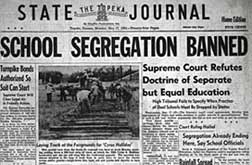
Ruled that “Separate but Equal” was Unconstitutional.
Hazelwood v Kuhlmeier
Marbury v Madison
Plessy v Ferguson
Brown v Board of Education
272
Multiple Choice
273
Multiple Choice
This case decided that Executive Privilege is not limitless. (the President does not have unlimited power)
Bush v. Gore
U.S. v. Nixon
U.S. V. Miller
D.C. v. Heller
274
Multiple Choice
275
Essential Question: How do we defend rights?
276
Two houses of Congress
House of Representatives
The Senate
277

Serve two-year terms
Must be 25+ years old and a citizen for 7+ years
Each state's number of representatives is based on the state's population (1 rep / 30,000 people)
Reps choose their speaker and officers and may impeach
Article 1 Section 2: House of Representatives
278

2 senators per state
Must be 30+ years old and a citizen for 9+ years
Vice President serves as President of the Senate
Senate choses their officers and a president when VP is absent
May impeach (needs a 2/3 vote)
Article 1 Section 3: The Senate
279
We have a bicameral legislature (meaning 2 parts)
House of Representatives + Senate = Congress

280
Representation is based on a states' population (census data)
Each state is guaranteed AT LEAST one representative
Reps. are elected every 2 years and must be at least 25 years old
There are no term limits for Representatives

281
Number of senators from each state is ALWAYS two (no matter what the population is)
Senators must be at least 30 years old
Senators are elected every 6 years
There are no term limits for senators

282
Congress also has many other jobs. Congress is very powerful because it is made up of many people and they all debate before they decide on anything. Therefore they handle many important decisions such as....
MONEY powers: collecting TAXES, regulating TRADE & borrowing MONEY
WAR: Congress can declare war NOT the President (thats too much power for 1 person!)

283
The President commands the ARMED FORCES so he can send off troops to other countries. However, the President cannot declare war
The President conducts FOREIGN POLICY which means he interacts with leaders of other countries to make decisions including making TREATIES

284
The Judicial Branch interprets the law. This means that they examine the law carefully and make decisions based on their understanding of the law
The Supreme Court interprets the U.S. Constitution and makes decisions based on their interpretation
The Federal Courts can also resolve disputes between states
285

286

287

288
289
Multiple Choice
Which part of the Constitution describes the judicial branch?
Article I
Article II
Article III
290
Multiple Choice
All federal courts below the Supreme Court are created by
Congress.
the President.
the Supreme Court.
291
Multiple Choice
Courts with original jurisdiction hold proceedings called
appeals.
trials.
292
Multiple Choice
Which type of court proceeding has multiple judges and no jury?
appeal
trial
293
Multiple Choice
How many federal district courts are there?
13
94
294
Multiple Choice
How many Courts of Appeals are there?
13
94
295
Multiple Choice
a judgment decided by a trial court without that case going to trial; an attempt to stop a case from going to trial
writ of certiorari
summary judgement
statute
niomon
296
Multiple Choice
the procedure to see if the U.S. Supreme Court will hear a case;is issued when a higher level court agrees to hear an appeal of an inferior court's decision
writ of certiorari
summary judgement
judicial review
court order
297
Multiple Choice
the power of the U.S. courts to examine the laws or actions of the legislative and executive branches of the government and to determine whether such actions are consistent with the U.S. Constitution
judicial review
jurisdiction
statute
summary judgement
298
Multiple Choice
the head justice
Supreme Chief
Judge Judy
Chief Justice
Supreme Justicer
299
Multiple Choice

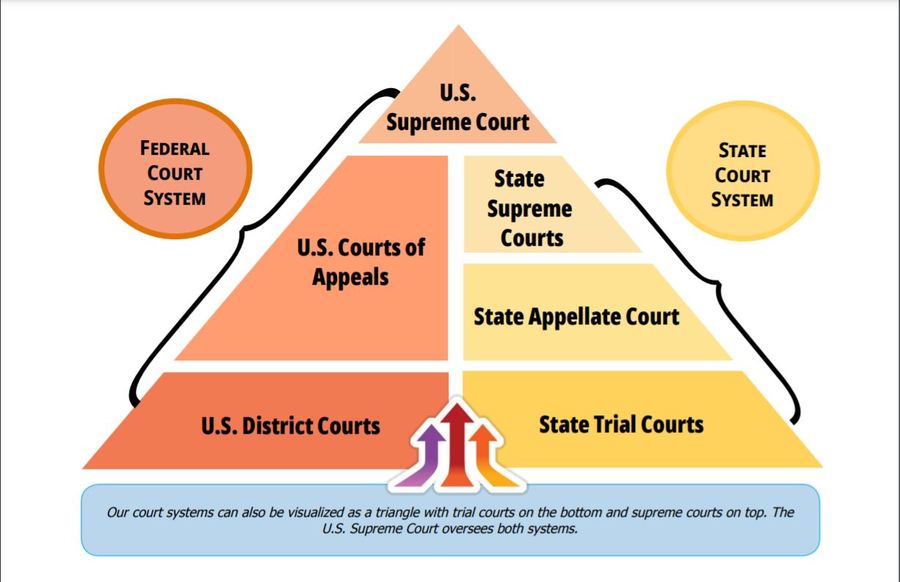
Which court completes the diagram?
U.S. Supreme Court
Florida District Court
Court of Veteran Appeals
Florida Supreme Court
300
Multiple Choice
What step can a party immediately take once it loses its case in the US District Court?
It can appeal to the US Supreme Court
It can appeal to the Florida Supreme Court
It can appeal to the US Circuit Court of Appeals
It can appeal to the Florida District Court of Appeals
301
Multiple Choice
How does an appellate court differ from a trial court?
Appellate has a jury
Appellate court decides issues of fact
Appellate court examines more witnessess
Appellate court reviews another court's decision
302
Multiple Choice
Article III of the Constitution established the U.S. Supreme Court. Why does this article refer to this court as "supreme"?
It hears more cases than any other court
It has authority over all other courts of the US
It's officers are appointed by the President of the US
It has authority over both the executive and legislative branches
303
Multiple Choice
How does the Supreme Court decide which cases to review each year?
. It grants writs of certiorari to all cases that come before it on appeal.
It grants writs of certiorari to all cases recommended to it by the President of the United States.
It grants writs of certiorari to most of those cases on which the U.S. Circuit Courts are already in general agreement.
It grants writs of certiorari to some of the cases it believes to be of national importance.
304
Multiple Choice
What do the highest courts of Florida and the United States have in common?
Both have the same number of justices
Both have chief justices
Justices serve for life with good behavior.
Justices serve for set terms of office.
305
Multiple Choice
Which show the the three levels of the Federal Court System, from lowest to highest?
City, County, State
District, Appeal, Supreme
Supreme, Appeal, District
County, State, Federal
306
Multiple Choice

How many justices are on the Supreme Court
Seven
Eight
Nine
Ten
307
Multiple Choice
District Courts are the lowest level federal courts.
True
False
308
Multiple Choice
What is the meaning of original jurisdiction? (When you are sure write the definition in your notebook.)
the power to hear appeals
the power to overrule a judgement
the power to hear a case for the first time
the power to stop other courts from hearing a case
309
Multiple Choice
Which Florida Court has seven judges, that must be reelected by the voters?
Supreme Court
District Courts of Appeal
Circuit Courts
County Courts
310
Multiple Choice
From lowest to highest which is the correct order of courts in the Florida state court system?
Florida county Court, Florida circuit court, Florida District Court of Appeals, Florida Supreme Court
Florida County Court, Florida District Court of Appeals, Florida Circuit Court, Florida Supreme Court
Florida Supreme Court, Florida District Court of Appeals Florida Circuit Court, Florida County Court
Florida Circuit Court, Florida County Court, Florida District Court of Appeals, Florida Supreme Court
311
Multiple Choice
What order would a case go through in the Florida court system? Starting at the bottom to the top:
Circuit Court
County Court
District Court of Appeals
Supreme Court
County Court
Circuit Court
District Court of Appeals
Supreme Court
Supreme Court
County Court
Circuit Court
District Court of Appeals
District Court of Appeals
County Court
Circuit Court
Supreme Court
312
Multiple Choice
What is the correct court process of the Federal Court system? Starting at the bottom to the top:
US District Court
US Supreme Court
US Court of Appeals
US Court of Appeals
US District Court
US Supreme Court
US District Court
US Court of Appeals
US Supreme Court
US Supreme Court
US District Court
US Court of Appeals
313

314

315

316

317

318

319
One of the most important protections, found in Article I
a prisoner has the right to ask for a writ of habeas corpus.
A prison official must bring the prisoner before a judge. The judge will then decide whether the accused was lawfully imprisoned
Habeas corpus safeguards individuals against being kept in jail unlawfully.

320
Write of Habeas Corpus is found here
Forbids the government from issuing bills of attainder and ex post facto laws.
A bill of attainder is a law that punishes a person accused of a crime without a trial or a fair hearing in court.
An ex post facto law is a law that would allow a person to be punished for an action that was not against the law when it was committed. It means "after the fact"
321
police must now issue what is known as a Miranda Warning.
they have the right to remain silent anything they say may be used against them as evidence
they have the right to an attorney; if they cannot afford one, the court will provide one
322
Multiple Choice

Law that comes from judges’ decisions that rely on common sense and previous cases.
Constitutional law
Military law
Civil law
Common law
323
Multiple Choice
In criminal law, what is the person who is accused called
prosecution
plaintiff
defendant
324
Multiple Choice
Which of these is NOT a civil law case?
A husband and wife applying for a divorce.
A landlord breaking a lease.
A man shooting his brother.
325

326

327

328

329
Multiple Choice
Once a president (or governor) vetoes a bill, nothing more can be done on the issue.
True
False
330
Multiple Select
Who has the power to debate a bill in the law-making process?
the Senate
the House
the President
331
Multiple Select
The job of the committees as it pertains to a bill is to...(check all that apply)
analyze it
revise it
approve or decline it for a vote
332
Multiple Select
In order for a bill to become a law, it must be approved by...(check all that apply)
the Senate
the House
the president
333

334

335

336

337

338

339

340
Multiple Choice
Which branch can veto a bill?
Legislative Branch
Executive Branch
Judicial Branch
Federalism
341
Multiple Choice
The purpose of the system of checks and balances is to prevent
any branch from becoming too powerful
people from losing their rights
states from losing more power
the government from changing the Constitution
342
Multiple Choice
Which branch can override a veto?
Legislative Branch
Executive Branch
Judicial Branch
Federalism
343
Multiple Choice
Which branch can declare laws unconstitutional?
Legislative Branch
Executive Branch
Judicial Branch
Federalism
344
Essential Question: How do our branches operate and cooperate?
345


Platform: Big-government, government-funded healthcare, increased taxes and spending on social programs, decrease oil production to protect the environment
Democratic Party
Platform: Small government, private healthcare, lower taxes and spending, less regulation, increase oil production, increase military spending
Republican Party
Platform: the only purpose of the federal government is to protect individual rights.
Libertarian Party
Third-party Option
346
Be 21 years of age, be a citizen, and live in the district you wish to represent
Florida House Representative
Be 35 years of age, be a natural-born citizen, reside in the United States for 14 years
US President
Us Senate: 30 years old; Representatives: 25 years old
347


Vote
Petition the government
communicate with politicians
Individuals
Hire Lobbyists to work with Legislators to get their policy passed
Interest Groups
provide money for interests groups and candidates
PACS
informs the individuals of wrongdoings of the government
Media (watch dog)
348

Political communication intended to persuade people towards an organizations goal or mission
The Uncle Sam poster was release to increase the number of men that enlisted in WWII
Propaganda
349


The Supreme Court ruled that the President was held accountable under the law
This legal precedent upheld "rule of law"
US vs. Nixon
The Supreme Court agreed with Bush's argument that a recount in Florida would violate the equal protection right of Floridians under the 14th Amendment.
States cannot violate citizens equal right to vote
Bush vs. Gore
350
What sets candidates apart?
Level of Education
Political Experience
Character and Integrity
351

Primary Election - registered voters can VOTE for their candidate
V.
Caucus - Group meeting of party members, then the group discuss and choose candidate
352
A person's beliefs on a topic
Platform

353
Primary and General Elections
In most states, the first step in the election process is called a primary election. These elections are usually held in the spring or summer. The purpose of the primary election is to choose one candidate from each party to run in the general election. The person who receives the most votes in each party becomes the party’s candidate for an office.
Sometimes no person wins a majority of the votes in a primary. In some states when this happens, a runoff election is held. The person who wins the runoff moves on to the general election
Subject | Subject
Some text here about the topic of discussion
354
Election Day
The general election is held throughout the country on the same day. These elections always take place on the first Tuesday after the first Monday in November. National elections are held in even-numbered years. All seats in the U.S. House of Representatives and about one-third of the seats in the Senate are up for election every two years. Presidential elections are held every four years. Usually state and local officials, such as state legislators, mayors, and city council members, are also elected at this time.
Subject | Subject
Some text here about the topic of discussion
355
Understanding the Electoral College
When voters cast their ballots in a presidential race, they are actually electing special representatives called electors. These electors have pledged to vote for a particular candidate. Electors represent their state in the group known as the Electoral College. A person voting for a Republican presidential candidate, for example, is really voting for a Republican to represent his or her state in the Electoral College.
Each state has the same number of electors as it has members of Congress. In addition, the District of Columbia has three electors. As a result, there are 538 electors in all.
After a presidential election, in December, the winning electors meet in their state capitals. They cast their electoral votes for president and vice president. They send their votes to the Senate. In January, the House and Senate meet to count these votes. The candidate who wins a majority of the electoral votes—at least 270—is the winner of the election. The electoral vote determines the president. The purpose of the popular vote, the votes cast directly by the people, is to choose the electors.
Subject | Subject
popular vote - the votes cast by individual voters in a presidential election, as opposed to the electoral vote
356
Multiple Choice
A presidential candidate who wins the popular vote always becomes the president.
TRUE
FALSE
357
Special Elections
Some states allow recall elections. In a recall, people vote on whether to remove an official from office. Like an initiative, the process begins with people signing a petition. If enough citizens ask for a recall, a special election will be held. If the majority votes to remove the official in that election, he or she must give up the office.
Sometimes an official dies in office or resigns before the term of office has ended. In those cases, a special election might be held. These elections are staged to fill a vacant office. They are called “special” because they do not take place at a regularly scheduled time.
Subject | Subject
358
Multiple Choice
In some states, if enough citizens sign a petition, a special election will be held to remove a candidate from office.
TRUE
FALSE
359
Multiple Choice
Election Day is the ____________________.
first Monday in November
first Tuesday in November
first Tuesday after the first Monday in November
first Monday after the first Tuesday in November
360
Multiple Choice
The winner of a primary election becomes ______________ in the general election.
president
vice president
a governor
a candidate
361
Multiple Choice
A person running for a government job
Vote
Candidate
Political Party
362
Multiple Choice
A group of government people from each state who vote on the president of the US
Political Party
Election
Electoral College
363
Multiple Choice
A person’s beliefs or thoughts on something
Platform
Vote
Election
364
Multiple Choice
How many days before an election must citizens register to vote?
20
21
22
10
365
Multiple Select
What must a qualified citien do before they can vote in an election?
pay taxes
vote in a local election first
live in the US for 10 years
registar to vote
366

367
Essential Question: Why is it important to be a responsible voter?
368

369

370
Multiple Choice
CHOOSE THE CORRECT RESPONSE:
What two domains are the most reliable and credible?
.net and .org
.com and .edu
.gov and .net
.edu and .gov
371
Essential Question: How can we find accurate information?
372
Democracy
▪ In a democracy, the government is elected
by the people. Everyone who is eligible to
vote has a chance to have their say over
who runs the country. It is distinct from
governments controlled by a particular
social class or group
▪ A democracy is determined either directly
or through elected representatives.


373
Direct Democracy
▪ People vote directly on every issue
▪ Only practical in a small community


374

Representative Democracy
▪ People are represented by elected officials
▪ Used in large countries
▪ Also known as a Republic government
375
Monarchy
▪ Power is in the hands of a king,
queen, emperor or empress.
▪ The ruling position can be
passed on to the ruler’s heirs.
▪ In some traditional monarchies,
the monarch has absolute power.
▪ But a constitutional monarchy,
like the UK, also has a
democratic government that
limits the monarch's control.


376
Dictatorship
▪ A country ruled by a single
leader. The leader has not
been elected and may use
force to keep control.
▪ In a military dictatorship, the
army is in control.

377
Theocracy
▪ Governmental rulers are identical with the
leaders of the dominant religion
▪ Governmental policies are either identical with or
strongly influenced by the principals of the
majority religion.
▪ Government claims to rule on behalf of God or a
higher power

378
Communism
Associated with the ideas of Karl Marx, a German philosopher who outlined his ideas for a utopian society in The Communist Manifesto, written in 1848. Marx believed that capitalism, with its emphasis on profit and private ownership, led to inequality among citizens.
The government owns and makes all decisions concerning the economy, holds all political power, and determines the
distribution of goods and services.
Socialism
Socialism is a political philosophy and movement encompassing a range of economic and social systems, which are characterised by social ownership of the means of production, with an emphasis on democratic control, such as workers' self-management, as opposed to private ownership.
The government controls most of a
country’s means of production and the
distribution of goods and services. other
aspects of the economy are subject to
market forces.
Vs.

379
Match
Ancient Egypt
Nazi Germany
USSR
Ancient Greece
Ancient Rome
Monarchy
Dictatorship
Communism
Direct Democracy
Representative democracy
Monarchy
Dictatorship
Communism
Direct Democracy
Representative democracy
380

381

382

383

384

385
1. Traditional Economy
2. Command Economy
3. Market Economy
4. Mixed Economy (Market + Command)
386
government makes all economic decisions & owns most of the property.
governmental planning groups determine such things as the prices of goods/services & the wages of workers
This system has not been very successful & more and more countries are abandoning it.

387
an economic system in which economic decisions are guided by the changes in prices that occur as individual buyers and sellers interact in the market place.
most of the resources are owned by private citizens.
economic decisions are based on free enterprise (competition between companies.)

388
Market + Command = Mixed There are no pure command or market economies.
To some degree, all modern economies exhibit characteristics of both systems and are often referred to as mixed economies.
Most economies are closer to one type of economic system than another.

389
Multiple Choice
What is a Economic system?
An Economic system is a system of games in a country.
An economic system describes how a country’s economy is organized.
An economic system describes how much weapons a country has.
390
Multiple Select
Click the four type of Economic systems?
Market
Mixed
Command
Traditional
marcommand.
391
Multiple Choice
What would be an example of a Traditional economy?
Germany in the 1920s
A village in South America
The U.K during world war II.
392
Multiple Choice
What type of Governmental systems do Command Economies have?
Countries with a democratic government.
countries with communist governments.
countries with theocratical governments.
393
Multiple Choice
which country in the world has the closest market economy?
North Korea
The United States
Brazil
Germany
394
Multiple Choice
(true or False) Most democratic countries fall into mixed economy category.
True
False
395
Multiple Choice
396
Multiple Choice
397
Multiple Choice
398
Multiple Choice
399
Multiple Choice
400
Multiple Choice
401
Multiple Choice

Rule by one
Dictatorship and Constitutional Monarchy
Dictatorship & Communism
Dictatorship & Absolute Monarchy
Absolute Monarchy & Republic
402
Multiple Choice

403
Multiple Choice
404
Multiple Select
1. One person is in charge.
Autocracy
Democracy
405
Multiple Select
8. A small group rules the country.
Oligarchy
Democracy
406
Multiple Choice
407
Multiple Choice
Constitutional Republic and federal
408
Multiple Choice
409
Multiple Choice
410

"Domestic" comes from the Latin "domus," meaning "house."
"Domestic Policy" is a nation's plans and laws that effect people WITHIN that nation.
Examples: healthcare, taxes, social security, education.
What is "Domestic Policy"?
411

"Foreign" comes from the Latin "foris," meaning "outside."
"Foreign Policy" is a nation's plans for interacting with other nations around the world.
Examples: treaties, trade agreements, mutual aid, war
What is "Foreign Policy"?
412
The basic aim of U.S. foreign policy is the pursuit of the national interest of the United States. The national interest refers to what is good for the nation and its people.
To promote the national interest, those in charge of American foreign policy promote the following goals:
Protect the security of the United States
Protect American citizens, their property, and investments abroad
Encourage other countries to trade with the United States
Spread the American system of democracy and free enterprise
Promote U.S. economic success and prosperity
Promote international peace and stability
Provide economic assistance to developing countries
Make humanitarian efforts to improve health, education, and living conditions around the world
413
The Senate confirms the president's appointments
Declares war
Ratifies treaties with a ⅔ vote
Approves federal funding for all federal programs including defense and foreign aid
Legislative Branch: Congress
Appoints ambassadors
Commander in Chief of the Armed Forces
Negotiates Treaties
Appoints heads of the executive offices including the Secretary of State and the Secretary of Defense
Executive Branch: President


414
Match
Match the following
decisions and laws made about things inside a country
decisions and plans made about issues with other countries
things that are good for a country's goals (military, economic, cultural)
Domestic Policy
Foreign Policy
National Interest
Domestic Policy
Foreign Policy
National Interest
415


Definition of Diplomacy
Diplomacy is the art
and practice of
negotiation and
dialogue between
nations to resolve
conflicts.
416


Examples of
Diplomacy in Global
Interactions
▪ Peace treaties
▪ International
agreements
▪ Diplomatic missions
and embassies
417
The Impact of US Foreign Policy
418
Médecins Sans Frontières
Red Cross/ Red Crescent
NGO
NATO
United Nations
USMCA
European Union
International Monetary Fund
Governmental
419
The United Nations
Post-World War II
Prevent War
Provide humanitarian aid (Declaration of Human Rights)
420
North Atlantic Treaty Organization
Cold War alliance that continues today.
NATO Article 5: Mutual defense (attack one, all must defend)
421
World Trade Organization (WTO)
Focuses on regulating trade between nations.
Settles trade disputes.
Helps negotiate trade agreements.
422
US - Mexico - Canada Agreement
Free trade agreement replacing NAFTA.
Greater protections for workers and environment.
Meant to be competitive to European Union and other trade alliances.
423
Used in predominately Muslim countries.
Red Crescent
Used in Western or Christian dominated countries.
Red Cross
Red Crystal
Used in countries that don't want religious affiliation.
424
Multiple Choice
Which cabinet department helps the president with his diplomatic powers?
Department of State
Department of Defense
Department of Homeland Security
Department of Treasury
425
Multiple Choice
Who has the power to declare war?
president
congress
supreme court
states
426
Multiple Choice
Which organization is the United States's main military alliance?
NATO
USMCA
UN
WTO
427
Multiple Choice
Which is a nongovernmental organization?
United Nations
World Trade Organization
Red Cross
North American Free Trade Agreement
428
Multiple Choice
Which vocab word means a representative of a country's government?
summit
containment
diplomat
hostage
429
Multiple Choice
Which vocab word means any actions taken to harm the economy of another nation?
alliance
foreign aid
terrorism
economic sanctions
430
Multiple Choice
Which vocab word means work focused on improving the human rights and happiness of others?
humanitarian action
foreign aid
embargo
containment
431
Multiple Choice
Which vocab word means an agreement between two or more countries to help each other?
peacekeeping operations
foreign affairs
alliance
containment
432
Multiple Choice
The work of keeping good relations between the governments of different countries is called
Alliance
Conflict
Diplomacy
Domestic Policy
433
Essential Question: What different types of governments and economies exist, and how do they compare to ours?
434
435

436
Fill in the Blanks
How many amendments does the United States have?
Type answer...
437
Multiple Choice
What are the first 10 amendments called?
Bill of Rights
Constitution
Declaration of Rights
Civil Protections
438
Multiple Select
How can new amendments be proposed?
Congress can approve them
a president can suggest them
senators get to create them
state legislatures can call special conventions
439
Multiple Choice
Congress can approve a proposed amendment by a ___/___ vote
1/2
2/3
3/4
5/8
440
Multiple Select
How can proposed amendments be ratified for inclusion to the Constitution?
state legislatures
state conventions
state governors
individual citizens
441
Open Ended
What majority vote is required for ratification of new amendments?
442

443

444

445

446

447

448
Multiple Choice
Which of the following is true about amending the FLORIDA constitution.
2/3 of congress must vote to propose the amendment
3/4 of the states must vote to ratify the amendment
the voters must approve the amendment
the State Congress must write the amendment
449
Multiple Choice
Which of the following is true about the Executive Branch in Florida?
The Governor appoints the Cabinet members.
The Cabinet members are always in the same Political Party as the Governor.
The Cabinet members are elected separately from the Governor
The Cabinet members choose the Governor
450
Multiple Choice
What is a similarity between the Florida Constitution and the U.S. Constitution?
both include an amendment process
both include a nine member Supreme Court
neither protects individual rights
neither has an amendment process
451
Multiple Choice
Which answer below is a true statement about a difference between the two Constitutions?
The FL Constitution only contains 4,400 words where the US Constitution has over 10,000 words.
The US Constitution is very specific with detailed explanations.
The U.S. Constitution has been amended more than 100 times, where the FL Constitution has only been amended 27 times.
FL is on it's 6th Constitution where the US is only on it's 2nd.
452
Multiple Choice
Which part of the Florida Constitution protects individual rights?
Declaration of Rights
Bill of Rights
Amendments
Preamble
453
Multiple Choice

Which title completes this table?
Florida and County Government
Florida and U.S. Government
City and County Government
City and U.S. Government
454
Multiple Choice

What conclusion can be drawn from the headline?
Citizens can be involved in policy making through their representatives.
Citizens can be directly involved in policy making.
Only elected officials may change constitutions.
Only elected officials make policy.
455
Multiple Choice

Which feature completes the Venn diagram?
created property taxes
established a zoning board
required a balanced budget
guaranteed individual freedoms
456
Multiple Choice
How does the process for amending the Constitution of Florida compare to that of amending the U.S. Constitution?
It is more difficult to amend the Florida Constitution than the U.S. Constitution.
It is more difficult to amend the U.S. Constitution than the Florida Constitution.
The Florida Constitution and the U.S. Constitution follow the same procedures for amendment.
The U.S. Constitution requires two steps for amendment, while the Florida Constitution is amended in a single step.
457
Multiple Choice
Which document does the Florida Declaration of Rights most closely resemble?
Magna Carta
The Bill of Rights
The U.S. Constitution
The Declaration of Independence
458
Multiple Choice
What is the supreme law of the land?
The U.S. Constitution
The Florida Constitution
The Florida Declaration of Rights
The Declaration of Independence
459
Multiple Choice
Why do both the U.S. and the Florida Constitutions begin with "We the people"?
to show that the people can vote during elections
to show that the people can write constitutions
to show that power for government comes from citizens
to show that power for government comes from a few citizens
460
Multiple Choice

What conclusion can you make based on the graphic?
the Florida Constitution is much older than the U.S.
the Florida Constitution is much longer than the U.S.
There have been few disputes with the U.S. Constitution
Florida became a state in 1968
461
Multiple Choice
Which constitutional provision forbids conflict between state and federal laws?
supremacy clause
habeas corpus
elastic clause
ex post facto
462
Multiple Choice

Which statement describes a similarity between the Florida Constitution and the U.S. Constitution?
both have 7 articles
both require native born chief executives
both have legislative term limits
both have a Preamble
463
Multiple Choice
Why are both Constitutions considered "living documents"?
Because they really take on a life of their own!
So they can change as times and needs change and evolve
That is what the founders called the first Constitution and it just stuck.
464
Multiple Choice
What part of the U.S. Constitution outlines rights for the people?
Article V
19th Amendment
Bill of Rights
Declaration of Human Rights
465
Show answer
Auto Play
Slide 1 / 465
SLIDE
Similar Resources on Wayground

7 questions
shamma lesson
Presentation
•
7th Grade
458 questions
Untitled Presentation
Presentation
•
5th Grade
396 questions
Cap2_set1
Presentation
•
University
383 questions
E5 1st Quarter Reviewer
Presentation
•
5th Grade
7 questions
Hewan Langka di Indonesia
Presentation
•
KG - 12th Grade
30 questions
APHG Unit 6 Lesson 2
Presentation
•
12th Grade
Popular Resources on Wayground
10 questions
How much do you know about our Portrait of an Eagle?

Quiz
•
10th Grade
10 questions
Fast Food Slogans
Quiz
•
6th - 8th Grade
21 questions
Continents and Oceans
Quiz
•
6th Grade
20 questions
Parts of Speech
Quiz
•
5th Grade
16 questions
Subject & Predicate
Quiz
•
5th Grade
25 questions
Multiplication Facts
Quiz
•
5th Grade
12 questions
Map Skills
Quiz
•
3rd Grade
22 questions
Continents and Oceans
Quiz
•
5th Grade
Discover more resources for Social Studies
10 questions
Exploring the Age of Exploration: Key Events and Figures

Interactive video
•
6th - 10th Grade
13 questions
13 Colonies Map Quiz
Quiz
•
6th - 8th Grade
20 questions
13 original colonies
Quiz
•
8th Grade
10 questions
Causes of the American Revolution
Quiz
•
8th Grade
19 questions
Unit 3 Spanish Colonial Era
Quiz
•
7th Grade
12 questions
7 Continents and 5 Major Oceans
Quiz
•
6th Grade
10 questions
Pillars of Free Enterprise
Quiz
•
6th - 8th Grade
26 questions
QA 1 Review
Quiz
•
6th - 8th Grade