
Model and structure of the atom CXC

Presentation
•
Physics
•
10th Grade
•
Practice Problem
•
Hard

r Henderson
Used 4+ times
FREE Resource
12 Slides • 0 Questions
1
Model and structure of the atom

R Henderson
Scientists such as Thomson, Rutherford, Geiger, Marsden, Bohr and Chadwick helped to establish the modern view of the atom.
At the end of the nineteenth century JJ Thomson showed that negative charges (electrons) existed as part of the structure of matter. Thomson suggested that the arrangement of the electrons in an atom resembled that of the seeds in a water melon. In his model, the main body of the water would represent the positive charge of the atom.
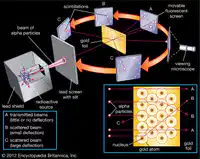
Rutherford considered the results of experiments carried out by Geiger and Marsden and suggested a different model. In these experiments, positively charged particles (alpha α particles) were incident on a gold foil. A fluorescent screen was used to detect the α – particles as a faint flash of light is seen when such a particle hits the screen. The whole apparatus was enclosed in a vacuum.
2

3
3


The results of the Geiger – Marsden experiment were that though
nearly all the α – particles went straight through the foil, a few were deflected and only a very small number reflected. The fact that nearly all went through with no change in path suggests that much of an atom is empty space.
As the α – particles possess a positive charge, the deflection and reflection can be understood as resulting from repulsion by some other positive charge. The fact that very few were reflected suggests that this other positive charge is concentrated in a very small volume.
4

The behaviour of the α – particles used by Geiger and Marsden can be understood better with the aid of an analogy using some marbles and a small heavy ball. If the marbles are rolled towards a ball, it can be observed that most of the marbles will pass the heavy ball (this will represent the α – particles that passed straight through the gold foil). Some of the marbles would also be deflected and some reflected, representing the α – particles that would have done so in the Geiger – Marsden experiment.
Rutherford concluded that
1. an atom has a dense central core, or nucleus, which
is very small compared with the size of the atom,
2. this nucleus has a positive charge,
3. most of the volume occupied by the atom is empty
space,
4. negative electrons move in orbit around the nucleus.
5
This is the nuclear model of the atom which is now generally accepted. Rutherford also suggested that a neutral particle (the neutron) was also in the nucleus and this was supported by the results of Chadwick’s experiments in 1932.
6
Neils Bohr was concerned with the behaviour of electrons in an atom.
He proposed that
1. electrons move in circular orbits around the nucleus;
2. when an electron moves from a higher to a lower energy level (from one orbit to another),
electromagnetic radiation is emitted.
The following analogy with the solar system is useful in describing Bohr’s theory of structure of the atom.

7
Particles in the Atom
The atom is made up of a nucleus and orbits (shells) around the nucleus. The neutral subatomic particles (neutrons) and the positively charged subatomic particles (protons) are found in the nucleus. The negatively charged subatomic particles (electrons) are found in the shells.

8
Standard notation for representing a nuclide:

Calculating the number of subatomic particles in an atom
Number of protons = atomic number = 3
Number of electrons = number of protons = 3
Number of neutrons = Mass number (Nucleon number) – Atomic number (Proton number)
= A - Z
=7 – 3 = 4


Number of protons = ?
Number of electrons = ?
Number of neutrons = ?
9
Isotope
The different isotopes of a given element have the same atomic number but different mass numbers since they have different numbers of neutrons. The chemical properties of the different isotopes of an element are identical, but they will often have great differences in nuclear stability. For stable isotopes of light elements, the number of neutrons will be almost equal to the number of protons, but a growing neutron excess is characteristic of stable heavy elements.

Example of isotopes of carbon
10


11


12


Model and structure of the atom
R Henderson
Scientists such as Thomson, Rutherford, Geiger, Marsden, Bohr and Chadwick helped to establish the modern view of the atom.
At the end of the nineteenth century JJ Thomson showed that negative charges (electrons) existed as part of the structure of matter. Thomson suggested that the arrangement of the electrons in an atom resembled that of the seeds in a water melon. In his model, the main body of the water would represent the positive charge of the atom.
Rutherford considered the results of experiments carried out by Geiger and Marsden and suggested a different model. In these experiments, positively charged particles (alpha α particles) were incident on a gold foil. A fluorescent screen was used to detect the α – particles as a faint flash of light is seen when such a particle hits the screen. The whole apparatus was enclosed in a vacuum.
Show answer
Auto Play
Slide 1 / 12
SLIDE
Similar Resources on Wayground

9 questions
Reported Speech
Presentation
•
10th - 11th Grade
9 questions
Limiting Reactant and Percent Yield
Presentation
•
10th Grade
10 questions
Analyzing Influences
Presentation
•
10th Grade
10 questions
Radioatividade - Emissões alfa, beta e gama
Presentation
•
10th Grade
8 questions
PEMANASAN GLOBAL
Presentation
•
10th Grade
10 questions
Point of View
Presentation
•
9th - 10th Grade
7 questions
Friction
Presentation
•
10th Grade
10 questions
Rational Exponents & Radicals
Presentation
•
10th Grade
Popular Resources on Wayground
6 questions
PRIDE Always and Everywhere
Presentation
•
12th Grade
20 questions
Lab Safety Quiz

Quiz
•
6th Grade
26 questions
KOR Review Kahoot Questions
Quiz
•
8th Grade
21 questions
Continents and Oceans
Quiz
•
6th Grade
12 questions
Unit Zero lesson 2 cafeteria
Presentation
•
9th - 12th Grade
20 questions
Parts of Speech
Quiz
•
5th Grade
10 questions
Riddles Riddles fun Riddles
Quiz
•
6th - 12th Grade
16 questions
Subject & Predicate
Quiz
•
5th Grade