

ERP TEMPLATE

Presentation
•
Other
•
University
•
Practice Problem
•
Hard

Jahaziel Vargas-Herrera
Used 1+ times
FREE Resource
85 Slides • 0 Questions
1
2

3

4
5
6
is a comprehensive process designed to prepare for and manage emergencies to ensure the safety of passengers, crew, and the general public. It encompasses a wide range of scenarios, from in-flight medical emergencies to major disasters such as crashes or terrorist attacks.
Effective emergency response planning involves coordination between airlines, airports, emergency services, and regulatory bodies.
7
1. Regulatory Framework
International Civil Aviation Organization (ICAO): Provides standards and recommended practices (SARPs) for emergency response, including Annex 14 (Aerodromes) and Annex 19 (Safety Management).
National Aviation Authorities (NAAs): Each country has its own regulatory body (e.g., FAA in the U.S., EASA in Europe) that enforces aviation safety standards.
8
2. Emergency Response Plan (ERP)
Development and Implementation: Airlines and airports are required to develop ERPs that outline procedures for various emergency scenarios.
Components:
Emergency Operations Center (EOC): A centralized command and control facility responsible for managing the response.
9
Components:
Emergency Response Team (ERT): A group of trained individuals who execute the ERP.
Communication Plan: Ensures clear and effective communication among all stakeholders, including internal teams, emergency services, and the public.
Training and Drills: Regular training sessions and simulation exercises to ensure readiness.
10
3. Types of Emergencies
Aircraft Accidents: Crashes or serious incidents requiring immediate and large-scale response.
Medical Emergencies: Health issues occurring during flight, requiring coordination with ground medical services.
Security Threats: Hijackings, bomb threats, or other acts of unlawful interference.
11
Natural Disasters: Situations like earthquakes or severe weather impacting flight operations and airport functionality.
Technical Failures: Major malfunctions of aircraft systems necessitating emergency landings or other urgent actions.
12
4. Coordination and Communication
Stakeholder Involvement: Involves coordination between airlines, airports, air traffic control, emergency services (fire, medical, police), and regulatory bodies.
Information Dissemination: Timely and accurate information distribution to passengers, crew, and families of those involved.
Media Management: Handling press and public relations to manage the flow of information and prevent misinformation.
13
5. Recovery and Post-Incident Analysis
Passenger Care: Providing support and assistance to affected passengers and families, including medical care, counseling, and logistical support.
Investigation: Conducting thorough investigations to determine the cause of the emergency and prevent future occurrences.
Improvement Plans: Updating the ERP based on lessons learned from incidents and drills.
14
6. Technological Support
Emergency Locator Transmitters (ELTs): Devices that send distress signals to help locate aircraft in the event of a crash.
Flight Data Monitoring (FDM): Systems that analyze flight data to identify potential safety issues before they become emergencies.
Communication Systems: Advanced communication tools to ensure rapid and reliable information exchange during emergencies.
15
An emergency response plan is a manual that companies use to address many different types of emergencies.
The manuals include:
Who to contact;
How to act; and
Resources to use.
16
Protection;
Safe conduct;
Mitigation/stabilization of the dangerous condition;
Cleanup of the incident, whether this be physical cleanup or conceptual; and
Return to normal operations.
17
ERPs should address only the highest-risk situations. They are critical for high-quality responsive risk management. You might call an “emergency response plan” a “catastrophic situation plan.”
18
Assess Identified Risks in Your Organization
The first thing you need to do to create an ERP is identify what your emergencies are. In this case, an emergency is simply a high-risk situation. You can ascertain which situations are high risk by:
Reviewing all identified (documented) risks in your organization; and
Performing a risk assessment on each risk.
19
Performing a risk assessment is an important step because it’s how you will distinguish emergencies from non-emergencies. Being able to perform the above two steps requires that you have:
Created a list of identified hazards/risks; and
Defined the criteria for your risk matrix.
If you have not already completed these tasks, you will need to do so before creating your ERP.
20
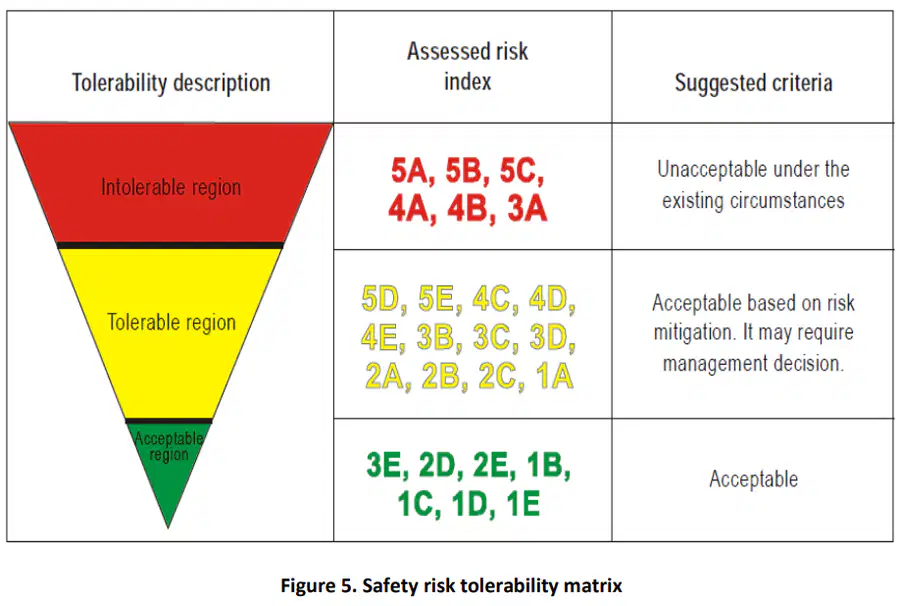
Risk Assessment
It is an evaluation of the potential for injury, equipment damage, or loss due to a hazard and the management of that probability.
21

22


23
24

25
is short for "as low as reasonably practicable".
The concept involves reducing risk to a level that is as low as reasonably possible, taking into account the costs, time, and effort required to further reduce it compared to the benefit gained.
The ALARP principle is often applied in regulatory and industrial settings to ensure that the level of risk mitigation is balanced and justified. It is NOT about eliminating risk entirely but about achieving a balance between the risk and the measures needed to control it, ensuring that any further risk reduction would be grossly disproportionate to the effort involved.
26
Based on your risk assessments, you will need to separate all high-severity risks. High severity risks are based on assessments that have a severity score that is equivalent to “catastrophic,” such as:
Level 4/5 severity; or
Level 5/5 severity.
These risks will be considered emergencies and should be incorporated into your Emergency Response Plan.
27
As such, they should be noted in a separate list. Some examples could be:
Crashed aircraft;
Accidents;
Fires;
Water leaks;
Threats (i.e., terrorism, bomb, etc.); or
Critical system failures.
This list could be quite extensive and will most likely include a diverse set of risks.
28
Document Chain of Command, Contact Info, and Responsibilities
Once you have your list of emergencies organized, it’s time to start actually creating your ERP. This involves the following:
Analyze each emergency;
For each emergency, decide who the chain of command will be;
For each emergency, list the contact information of the chain of command, including the preferred order of contact; and
For company roles that are critical to that emergency, list the responsibilities of each of those roles.
29
Document Steps to Follow in Response to Emergency
In tandem with each role knowing their responsibilities in a given emergency, you should also document a list of steps each role should follow in order to respond to a given emergency. These steps should help mitigate the emergency. These steps should include:
An order of how to respond;
Relevant resources, such as procedures, checklists, maps, tools, etc. at each step; and
Goals of each step.
Each role should have no question about how they should respond to an emergency after you list these steps.
30
Document Steps to Follow in Recovery from Emergency
As in the case of listing steps for how to respond to an emergency, you should also list a set of steps for how to recover from an emergency once the emergency has passed. These steps should help each role understand:
The order of tasks they should accomplish in order to fully recover from an emergency;
Relevant resources that they will use to recover; and
The goals of each step in the recovery process.
31
Document Additional Resources to Use in Emergency
Complete ERPs will include a list of resources for each emergency that will help respond and recover from the emergency. For example, in the case of a fire, helpful resources would be:
A map locating each location of fire retardant equipment;
Relevant checklists;
Relevant procedures used to reduce the severity of the issue; and
Information about fires, such as different types of fires (i.e., a gasoline fire is different from a building fire).
32
Obviously, your list of resources should be much more extensive than this, but it gives you an idea. The goal here is to provide enough resources to be very helpful, but not so many resources that employees are “overwhelmed” during an emergency.
33
What an ERP Should Include
Emergency response plans should be organized into chapters and sub-chapters. Each chapter will categorize a type of emergency. Within each chapter will be numerous sub-chapters, each of which cover a specific emergency OR a separate task.
In more detail, this means that each chapter should:
Have a list of people to contact, in order, with contact numbers;
The list of contact people might be organized by their response category, such as Hangar Fire Contacts, Aircraft Fire Contacts, etc.
34
The safety duties and responsibilities of each role in the company for a given emergency, such as CEO responsibilities, safety manager responsibilities, etc.;
Actions required to maintain safety;
Actions required to mitigate the danger;
Actions required cleanup incident, if applicable; and
What resources are best used to mitigate the emergency.
This “manual” can be an actual physical copy of your ERP, one documented in aviation safety software, or one documented on a server.
35
Plan
(PUBLIC HEALTH EMERGENCIES)

36
IATA recommends that all air carriers have emergency response plans to deal with public health emergencies. While a number of air carriers already have such a plan in place, many do not. The following constitutes a sample template for an emergency response plan applicable to public health emergencies.
37
This document has two primary objectives:
Identify in broad terms how to prepare for a public health emergency.
Provide checklists of actions that should be built into a public health emergency plan.
38
For air carriers that already have an emergency response plan, most of the same resources will be used in cases of public health emergency. For those air carriers without a plan, IATA strongly recommends one is established as soon as possible and resources identified.
39
Before writing an emergency response plan, it is imperative that air carriers consult with their national health authorities in the development and implementation of their response plans for public health emergencies. Air carrier response plans should be aligned with the national plan
40
An emergency response plan is of no use without a team to implement it. Air carriers are encouraged to establish an Emergency Response Team (ERT) as soon as possible. Such a team should consist of executive, core and support members.
41
The ERT executive members should have primary responsibility for advising senior management of developments relating to a public health emergency and actions to be taken in response. ERT executive members might typically be:
Director Emergency Response
Medical Advisor (or designated medical representative)
Communications Director (or equivalent)
42
The ERT core members might typically be from those externally-focused departments that would have direct and immediate operational contact with the consequences of a public health emergency. These include:
Flight Operations
In-Flight Services
Maintenance
Airports
Cargo
Security & Facilitation
Station & Passenger Handling
Operations Control
Government Affairs
43
The ERT support members should be from those internally-focused departments required to support the activities undertaken by an air carrier to address a public health emergency. These include:
Legal
Risk Management
Human resources
Finance/Purchasing
44
2.3 Establishment of an Emergency Response Centre (ERC)
Some air carriers already have designated office space equipped with all of the communications and planning tools required to manage a response to a public health emergency. Air carriers that do not have such a facility are encouraged to establish one.
45
3. Triggers of Public Health Emergency response
The information triggering an emergency response could come from any number of different areas. The most likely scenario would probably be a notification from the World Health Organization (WHO) that there has been a progression into a more critical phase of the emergency in question.
46
However, the information could also come from National Public Health Authorities, as it did for some countries during the SARS crisis and the Fukushima accident. Lastly, a response could also be triggered at the air carrier level if, for instance, many passengers and/or crewmembers on a particular flight display symptoms compatible with communicable diseases.
Depending on the origin and the nature of the information received, the level of response will vary; it could be limited to action required by medical and communications staff or could extend to a full response including all affected parties.
47
4. Activation of the Emergency Response Team and Centre
The department or individual within the air carrier that receives the information that could potentially necessitate an emergency response should immediately contact the Operations Control Director (or its equivalent) who should in turn contact the executive members of the Emergency Response Team, as outlined above.
48
The executive members should determine whether the Emergency Response Plan and Centre should be activated.
If the decision is to open the ERC, all employees involved in the Emergency Response Team should be notified.
If the ERC is activated, the ERT core and support members should be represented.
49
5. Roles and Responsibilities
Attached below are documents specific to each member of the Emergency Response Team. They outline the roles and responsibilities of each team member and contain a checklist of actions to be taken by each team member in the event of a public health emergency.
50
5.1 Director Emergency Response (DER)
Overall responsibility for emergency response and for directing the activities of the Emergency Response Team (ERT).
Advise designated superior of the impact of the emergency on the company’s operations and make relevant recommendations.
Notify the Reservations Department of the need to lock in passenger information or for notifying the operating air carrier to do so when required (only for air carriers not using Departure Control System).
51

52
5.2 Medical Representative (MR)
Initiate and maintain contact with all appropriate health authorities.
Established point of contact for the IATA Medical Advisor.
Make appropriate recommendations applicable to specific departments of the company, based on information received from the health authorities.
53


54
5.3 Communications
5.3.1 External Communications
Initiate and maintain liaison with counterparts at the appropriate health authorities, as well as any other agencies that may be involved.
Act as established point of contact for IATA Corporate Communications representatives.
Manage all communications to the media including the distribution of press releases as required.
Keep the DER informed of significant developments in the media.
55


56
Ensure the establishment of a communication channel that could be used by the general public to contact the air carrier. For example, publish a toll free number or establish a Call Centre that could manage enquiries from the families of passengers caught up in a public health emergency.
Post appropriate communications on the company website.
57
5.4 Flight Operations
Communicate relevant details (i.e. as they affect Flight Operations) of the emergency to pilots and any applicable unions.
Review procedures relating to onboard medical emergencies and advise operational flight crew accordingly.
Ensure that flight crews laying over in affected areas (if applicable) have been provided with necessary guidance and have access to any assistance required.
Closely monitor crew scheduling to try and avoid last minute crew manning problems.
58


59
5.5 In-Flight Services
Communicate relevant details (i.e. as they affect In-Flight Services) of the emergency to cabin crew and any applicable cabin crew union.
Review procedures relating to onboard medical emergencies and advise cabin crewmembers accordingly.
Ensure that enough Passenger Locator Form (PLF) are available
60
Ensure that cabin crews laying over in affected areas (if applicable) have been provided with necessary guidance and any assistance required.
Ensure that the catering function is not interrupted.
Closely monitor crew scheduling to try and avoid last minute crew manning problems (if the appropriate department to do so).
61


62
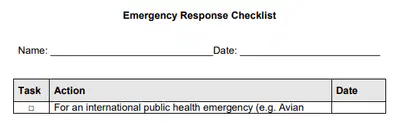
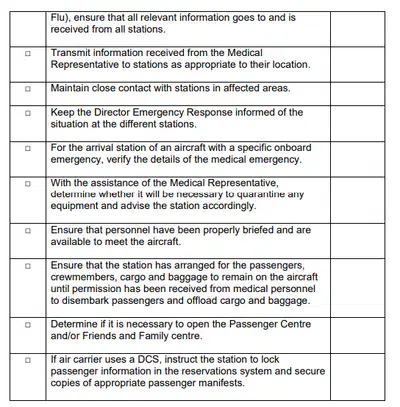
5.6 Airports
Ensure the clear flow of relevant information to and from all stations.
Advise the stations according to their location and according to the information received from the Medical Representative.
Keep the Director Emergency Response informed of the situation in the different stations.
Instruct the stations directly involved in the emergency to lock passenger information in the reservations systems of both the operating and marketing carriers and, in the case of code sharing, to secure copies of appropriate passenger manifests (only air carriers using a Departure Control System).
63
64
5.7 Maintenance
Continue regular activities and adapt any special procedures that are recommended by the Medical Representative as a result of information received from the public health authorities.
If responsible for cleaning aircraft, ensure that aircraft have been properly disinfected when required and should employ the methods and disinfectants recommended by the Medical Representative and the aircraft manufacturers.
Ensure that personnel are properly protected and briefed.
If another department is responsible for aircraft cleaning, that department should assume the latter responsibilities.
65

66
5.8 Cargo
Implement any recommendations made by the Medical Representative and the Public Health Authorities.
When required, ensure safe and rapid transport of diagnostic specimens.
Keep in mind that refusal to carry diagnostic specimens, may result in strong possibility that such specimens will be carried anyway but not declared. This may represent a much more serious hazard than a properly packaged and labeled specimen.
67


68
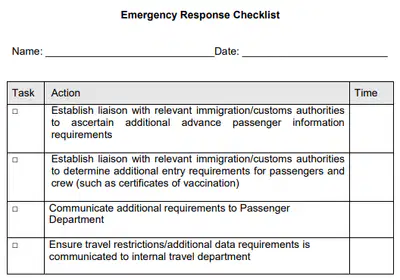
5.9 Security & Facilitation
Support changes to the electronic transmission of Advance Passenger Information or manual data collection required by governments in the event of a public health emergency.
Liaise with governments’ border control agencies to facilitate a two-way flow of information between the air carrier and governments on emerging entry requirements.
Ensure any changes to passenger data collection requirements are communicated to the relevant internal department in order to facilitate the timely collection and transmission of such data
69
70
5.10 Station Management
Implement directives provided by the Emergency Response Centre.
Liaise with local airport authorities and ensure that the company’s head office airport representative is briefed on how the emergency is developing and on any relevant rules at the local airport.
Ensure that copies of all passenger manifests are kept for the minimum period recommended by the public health authorities for that particular emergency (if using a Departure Control System).
71
Ensure that enough Passenger Locator Form (PLF) are available
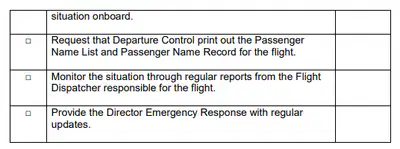
Follow the below checklist when advised of a flight with a suspected communicable disease onboard.
72


73
5.11 Operations Control
Liaise with Flight Dispatch to identify nature of any on-board medical emergency.
Maintain open channel of communication to the Director of Emergency Response and advise if Emergency Response Centre needs to be activated.
Maintain open channel of communication to arrival station involved in onboard medical emergency. Advise and be advised of developments.
74

75
5.12 Legal
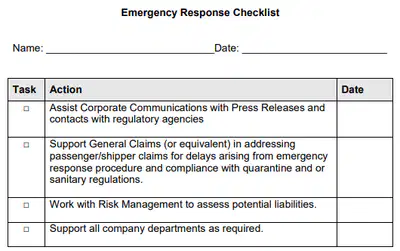
Provide input on any legal aspects of contact with the media and regulatory agencies.
Support internal departments relating to liability issues resulting from a public health emergency.
Provide general support to all company departments as required.
76
77
5.13 Risk Management
Analyse how employees, agents and customers might be affected by a public health emergency.
Ensure that insurance coverage is available.
Ensure that Senior Management is aware of potential liabilities.
78

79
5.14 Human Resources
Provide support to all company departments as required, particularly with regards to Policies and Personnel Services.
Put a system in place to ensure that all employees may be located in the event of an emergency.
80


81
5.15 Finance/Purchasing
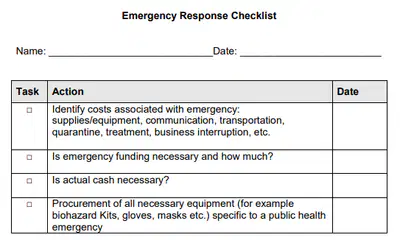
Make special provisions for budget, accounting and purchasing purposes if required.
Ensure rapid procurement of all necessary equipment (for example biohazard Kits, gloves, masks etc.) as required by the different company departments.
82
Purchasing
83
5.16 Government Affairs
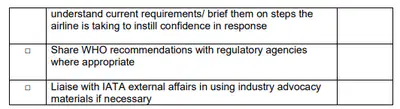
Liaise with regulatory agencies to understand directives and identify compliance actions required
Advocate with regulatory agencies on the need to follow WHO recommendations, and avoid instituting bespoke measures contrary to WHO policy
Liaise with IATA External Affairs as appropriate
84

85
AIRLINES
Show answer
Auto Play
Slide 1 / 85
SLIDE
Similar Resources on Wayground

77 questions
ความปลอดภัยเครือข่ายคอมพิวเตอร์และข้อมูลสารสนเทศระดับองค์กร
Presentation
•
University - Professi...
79 questions
Molecular genetics
Presentation
•
KG
81 questions
AVTC1 - LESSON 16 - WRITING A COMPLETE PARAGRAPH
Presentation
•
University
81 questions
chapter nine security +
Presentation
•
University
80 questions
Solving one step equations
Presentation
•
University
80 questions
Preposition
Presentation
•
KG - University
79 questions
Logos
Presentation
•
University
81 questions
ASEAN External Linkages
Presentation
•
University
Popular Resources on Wayground
10 questions
Safety Day 2026 – Student Review

Quiz
•
9th Grade
21 questions
Continents and Oceans
Quiz
•
6th Grade
20 questions
Parts of Speech
Quiz
•
5th Grade
16 questions
Subject & Predicate
Quiz
•
5th Grade
25 questions
Multiplication Facts
Quiz
•
5th Grade
12 questions
Map Skills
Quiz
•
3rd Grade
22 questions
Continents and Oceans
Quiz
•
5th Grade
15 questions
Rounding Decimals
Quiz
•
5th Grade
Discover more resources for Other
20 questions
Disney Trivia
Quiz
•
University
10 questions
Spanish Greetings and Goodbyes!
Presentation
•
6th Grade - University
20 questions
Physical or Chemical Change/Phases
Quiz
•
8th Grade - University
39 questions
Unit 7 Key Terms
Quiz
•
11th Grade - University
25 questions
SER and Subject Pronouns
Quiz
•
8th Grade - University
38 questions
Unit 6 Key Terms
Quiz
•
11th Grade - University
19 questions
Key Concepts in Buddhism
Quiz
•
University
0 questions
Cell Domain Basic Review (Biology)
Quiz
•
University