
Unit 1: Regions

Presentation
•
Social Studies
•
7th Grade
•
Easy

Tyler Thomason
Used 26+ times
FREE Resource
31 Slides • 1 Question
1


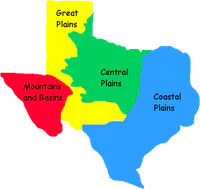
The Regions of Texas
◆Coastal Plains
◆North Central Plains
◆Great Plains
◆Mountains & Basins
2

The Coastal Plains
3


◆ Coastal Plains
➢
Information
•Most populated region
•Largest region
•Covers 1/3 of TX
•Divided into 5 subregions

4


• Wettest part of Texas receives the most rainfall. 20-58
inches annual average
• Supports forests areas
• Mild weather (close to the Gulf of Mexico)
• Intracoastal Waterway (helps economy)
◆ Coastal Plains
➢
Climate

5

•Dense forests (National Forests)
•Grassy Prairies
•Rich soil
•Low & marshy (Bayous) in some areas near the coastlines
◆ Coastal Plains
➢
Soil/Vegetation
6


Nacogdoches
Caddo Lake near
Marshall,TX
◆ Coastal Plains


7


•Banking (Federal Reserve Bank in Dallas), trade,
tourism, sports
•Ranching: cattle, poultry, & hogs
•Lumber
•Farming: rice, cotton, corn, grain, sugarcane
•Fruits & vegetables: grapefruit & oranges
(especially in Rio Grande Valley with fertile soil, warm, freezing rare)
•Fishing, shrimping & shipping (many ports for international
shipping)
•Petrochemical: Oil & oil refining (Spindletop and E. TX Oilfield)
•Minerals: coal, lignite, natural gas, granite, sand
◆ Coastal Plains
➢
Economy/Resources
8


Shrimp boats near Galveston
◆ Coastal Plains
➢
Economy/Resources

9


Oil rig near Galveston
◆ Coastal Plains
➢
Economy/Resources


10


•Houston (largest city in TX)
•San Antonio
(2nd largest city)
•Beaumont
•Galveston
•Corpus Christi
Houston
◆ Coastal Plains
Cities


San Antonio
11

The North Central Plains
12


•Divided from Coastal Plains
by Balcones Escarpment
•“Where the West Begins”
Slogan relates back to a treaty signed when the Republic of Texas and
nine Native American groups signed Bird’s Fort Treaty. Under this
treaty, the Native Americans agreed to stay west of what is now Fort
Worth. At the time, the location marked the western frontier of
settlement and explains, in part, why some people think of Fort Worth
as being in West Texas.
◆ North Central Plains
➢
Information

13

•Light rainfall
•Hot summers
•Cold winters
•Not affected by the Gulf of Mexico (too far away)
◆ North Central Plains
➢
Climate
14

•Rolling Prairies, shrubs, small trees
•Soil
✓stony soil in some areas (not good for farmers)
◆ North Central Plains
➢
Soil/Vegatation
15

•Ranching: cattle (beef/dairy), hogs, sheep,
poultry, goats
•Fort Worth Stockyards
•Farming: cotton, wheat, grains, & peanuts
•Manufacturing: airplanes, helicopters, &
electronics
◆ North Central Plains
➢
Economy/Resources

16

Mineral Resources:
• sand
• gravel
• coal
• limestone
◆ North Central Plains
➢
Economy/Resources
17


•Fort Worth (est. in 1849 as an army fort on the Texas frontier)
•Abilene
•Wichita Falls
Fort Worth
◆ North Central Plains
➢
Cities

18
Draw
circle the ONLY region that doesn't border the Rio Grande
19

The Great Plains
20


•Separated from the North
Central Plains by the
Caprock Escarpment
•Covers the Panhandle of TX
•Divided into 2 subregions
◆ Great Plains
➢
Information

21

•Part of TX w/ the coldest and longest winter
(further from Gulf & higher in elevation)
•Mild sun
•Dry region – drought often a problem
◆ Great Plains
➢
Climate
22


•Varied landscape:
•Flat and treeless (called a “Sea of Grass”)
•Hilly & rugged
•Palo Duro Canyon
•Escarpment
•Rocky soil (hard layers of limestone)
◆ Great Plains
➢
Soil/Vegetation

23

•Farming w/ irrigation from Ogallala Aquifer:
cotton & grain (wheat)
•Ranching: sheep, goats, cattle
•Oil & Natural Gas
◆ Great Plains
➢
Economy/Resources
24


25


•Amarillo
•Lubbock
•Odessa
•Midland
Red Butte near Amarillo
Near Lubbock
◆ Great Plains
➢
Cities


26

Mountains and Basins
27


Close cultural and economic ties to Mexico
Presidio Chapel in San Elizario
◆ Mountains & Basins
➢
Information

28


•Driest part of TX
•Desert
•Hot Summers
•Cold Winters
•Average rainfall: 9” per year
❖ Rain comes as air moves up in elevation, it cools,
and rains
Red Sands (near El Paso)
◆ Mountains & Basins
➢
Climate

29


•Dry, rocky soil
•Desert plants (cactus) & mesquite trees
•Farmers irrigate crops with water from the Rio
Grande River
•Dramatic landscape:
•Canyons
•Mountains
•Plateaus
•Basins
Franklin Mountains
◆ Mountains & Basins
➢
Soil/Vegetation

30
Google Earth
You can open this webpage in a new tab.
31

•Ranching: cattle, sheep, goats
•Minerals: oil, sulfur, & silver
•Farming: cotton, pecan trees, alfalfa, &
vegetables
•Tourism: Big Bend & Guadalupe Mountains
National Parks
◆ Mountains & Basins
➢
Economy/Resources
32


•El Paso
•Marfa
•Alpine
El Paso
◆ Mountains & Basins
➢
Cities

The Regions of Texas
◆Coastal Plains
◆North Central Plains
◆Great Plains
◆Mountains & Basins
Show answer
Auto Play
Slide 1 / 32
SLIDE
Similar Resources on Wayground

26 questions
The Great Wall of China
Presentation
•
6th Grade
28 questions
Ancient Greece Review
Presentation
•
7th Grade
25 questions
Introduction to Mayans + Olmecs
Presentation
•
7th Grade
23 questions
China 7.2, Tang & Song Inventions
Presentation
•
6th - 8th Grade
26 questions
The Geography of the Americas
Presentation
•
7th Grade
26 questions
Vocabulary in Context
Presentation
•
6th - 7th Grade
26 questions
Physical Geography of Mexico
Presentation
•
6th - 8th Grade
26 questions
Photosynthesis and cellular respiration
Presentation
•
7th Grade
Popular Resources on Wayground
10 questions
How much do you know about our Portrait of an Eagle?

Quiz
•
10th Grade
10 questions
Fast Food Slogans
Quiz
•
6th - 8th Grade
21 questions
Continents and Oceans
Quiz
•
6th Grade
20 questions
Parts of Speech
Quiz
•
5th Grade
16 questions
Subject & Predicate
Quiz
•
5th Grade
25 questions
Multiplication Facts
Quiz
•
5th Grade
12 questions
Map Skills
Quiz
•
3rd Grade
22 questions
Continents and Oceans
Quiz
•
5th Grade
Discover more resources for Social Studies
10 questions
Exploring the Age of Exploration: Key Events and Figures

Interactive video
•
6th - 10th Grade
13 questions
13 Colonies Map Quiz
Quiz
•
6th - 8th Grade
19 questions
Unit 3 Spanish Colonial Era
Quiz
•
7th Grade
10 questions
Pillars of Free Enterprise
Quiz
•
6th - 8th Grade
26 questions
QA 1 Review
Quiz
•
6th - 8th Grade
10 questions
Exploring the 13 Colonies Regions
Interactive video
•
6th - 10th Grade
21 questions
ss.7.cg.1.1- Ancient Influences
Quiz
•
7th Grade
21 questions
Unit 2 Age of Contact 7th gr
Quiz
•
7th Grade