Algebra 2 Study Guide
Presentation
•
Mathematics
•
9th - 12th Grade
•
Hard
+1
Standards-aligned
Hana Specht
FREE Resource
58 Slides • 45 Questions
1
Synthetic Division
2
What is synthetic division?
Shortcut way to divide polynomials
Uses the roots (not factor form) as the divisor
Uses the coefficients of the terms, and not the variables, as the dividend
3
4
5
6
Steps to dividing by synthetic division
1. Change the factor form of the divisor to the root. (factor form is (x - 3), root is 3)
2. Write out the polynomial to be divided in descending form, writing in zeros for the terms that are missing. For example: x4 + 2x2 + 4 would be written as: x4 + 0x3 + 2x2 + 0x + 4
7
Steps to dividing by synthetic division (cont)
3. Write out the coefficients only of the polynomial, including signs and including the 0's
4. Write the root to the left of the coefficients with a vertical bar between it and the coefficients and a horizontal line underneath the coefficients (like an upside-down division symbol)
8
Steps to dividing by synthetic division (cont)
5. Bring the first coefficient down below the line, without doing anything to it
6. Multiply the coefficient by the root, and add the number to the next term.
7. Multiply the sum by the coefficient and add to the next term.
9
Steps to dividing by synthetic division (cont)
Repeat this process until there are no more terms.
If the remainder is 0, then the factor is a true root
If the remainder is not 0, then the value of the remainder is the value of the polynomial evaluated at the x-value of the divisor (what you would get if you substituted the divisor into the polynomial)
10
Steps to dividing by synthetic division (cont)
Note: You can only use this form if your divisor is a binomial
Always remember to put in the missing terms with a zero coefficient
The remaining number will start with a variable exponent of one less than the original. In the example to the right, the polynomial was 3rd degree, the quotient is 2nd degree.
11
12
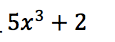
In this lesson we are going to divide this polynomial by this binomial.
13
Multiple Choice
What are the coefficients we use?
5, 6, 28, 2
5, -6, -28, -2
-5, 6, 28, 2
-5, -6, -28, -2
14
Multiple Choice
What number do we put on the outside?
-2
2
-5
5
15
Multiple Choice
Is this the way to start?
No, it should be a positive 2 on the outside.
No, the coefficients are in the wrong order.
yes
16
Multiple Choice
What is the first thing we do?
Bring down the 5 below the line.
Add all the coefficients
Divide 5 by -2
Multiply the 5 and 2
17
Multiple Choice
What goes next to the 5 below the line?
4
-16
16
-4
18
Multiple Choice
What goes under the -28?
32
-32
-20
20
19
Multiple Choice
What goes next to the 32?
-4
4
8
-8
20
Multiple Choice
What is the final answer?
5x4 −16x3+4x2−10x
5x3−16x2+4x−10
5x2−16x+4+x+210
5x2−16x+4−x+210
21
Multiple Choice
Simplify using synthetic division.
v−77v3−59v2+71v−11
7v2−10v+2−v−74
7v2−10v+1−v−75
7v2−10v+1−v−74
7v2−10v−v−72
22
Multiple Choice
Simplify using synthetic division.
p+8p3−2p2−88p−64
p2−10p−8
p2−10p−10
p2−10p−7−p+83
p2−10p−11−p+83
23
Multiple Choice
Rewrite the rational expression.
x−2−4x3+7x2−2x+1
−4x2−x−5−x−28
−4x2−x−4−x−27
−4x2−x−3−x−28
−4x2−x−7−x−212
24
Multiple Choice
Divide using synthetic division:
(2x2+6x−20)÷(2x−4)
x+5+2x−42
x−8
x−5+2x−43
x+5
25
Multiple Choice
Divide using synthetic division
(the optional video clip will help with this problem)
(4x4−3x3−4x2−x+3) ÷ (4x−3)
x3+x2+x−1
x3−x−1
x3−2x−1
x3−x2+x−3
26
27
28
Here are the steps for polynomial long division:
Step 1: Set up the problem, Are polynomials in standard form? is a placeholder needed?
Step 2: Divide, and write something on top
Step 3: Multiply by what is outside
Step 4: Subtract
Repeat until you cannot divide any longer.
Write final answer in proper format (if there is a remainder).
***If there is no remainder, that means the divisor is a factor of the dividend BUT IF THERE IS a remainder, the divisor IS NOT A FACTOR of the dividend.
29
30
31
32
33
Multiple Choice
4x−58x2+6x−20
2x+4−4x−540
2x+4
2x−1−4x−516
2x−4
34
Multiple Choice
3x−227x3+9x2−3x−10
9x4+5
9x2−9x+5
9x2+9x+5
9x2−9x
35
36
37
Multiple Choice
Dividing polynomials requires that your dividend be written both in standard form and such that no variable is missing between the largest and smallest exponent (in descending order). You must insert placeholders (zeroes) if a term(s) is missing in your dividend. Does the polynomial 4x2+23x−16 require any placeholders?
No
Yes
There is not enough information.
38
Now that you have confirmed that your dividend is written correctly, consider what your next step should be and answer the following question.
39
Multiple Choice
What step should you take to begin this problem.
Divide 23x by x and write "23" above 23x.
Divide 4x2 by x and write 4x above 23x.
Divide 4x2 and 23x by x and then write your answer in order above the dividend.
Multiply -16 by x and 5 and subtract your answer from the dividend.
40
41
Multiple Choice
After dividing 4x2 by x and writing 4x above 23x, what is the next step that you should take in solving this problem?
Divide 23x by x and write 23 above -16.
Multiply 4x by x and write 4x2 beneath 4x2 .
Multiply 4x by x and 5, then write 4x2+20 beneath 4x2+23x .
Multiply 4x by x and 5, then write 4x2+20 beneath 4x2+23 .
42
43
Multiple Choice
The next step you should take is to "subtract." What difference will you find?
0x2+3x
8x2+43x
8x2+3x
0x2−3x
44
45
Multiple Choice
Which selection is the final answer?
4x+3−31
4x−28
4x+3−4x+331
4x+3−x+531
46
47
This is a separate example for you to view. Notice that the remainder is written a bit differently in this problem.
48
49
50
Multiple Choice
Consider the given polynomial x2+3 . Does the polynomial require placeholders before long division can be performed? If yes, pick the correct placeholder.
No
Yes, 0x should be included.
Yes, 0x3 should be included.
Yes, 0x2 should be included.
51
Multiple Choice
Perform the given division problem. What is your final answer? Take your time, and show your work. This will be graded.
x+1+x−14
x−1−x−14
x+1−x+14
x+1+x−13
52
Let's analyze some remainders!
Let's start by using synthetic division together.
53
Think to yourself. What is the polynomial represented by this synthetic division? (You will answer on the next slide)
54
Multiple Choice
What is the remainder if P(x)=x4−3x2−2x+5 is divided by x+2 ?
13
23
-13
-23
55
56
Multiple Choice
Try it now using the remainder theorem:
What is the remainder of (2x3 - x2 - 13x + 9) divided by (x - 2)
-7
-5
7
5
57
Multiple Choice
If (9x4−45x3+37x2+x+2) is divided by (x−2) then the remainder is...
-64
64
656
-652
58
Multiple Choice
59
Multiple Choice
60
Example 1: Use Polynomial Long Division to find the remainder of the problem below. Verify using the Remainder Theorem.
61
Example 2: Using the Remainder Theorem, find the remainder of when
Therefore, the remainder is -13
62
63
Let’s check it out:
f(-1) = 3(-1)3+(-1)2+2(-1)+5
f(-1) = -3 + 1 -2 + 5
f(-1) = 1
If there is a
remainder then (-1) is
not a zero of the
polynomial.
64
Multiple Choice
Try it now using the remainder theorem:
What is the remainder of (2x3 - x2 - 13x + 9) divided by (x - 2)
-7
-5
7
5
65
FACTOR THEOREM
66
Example Question: Is x+1 a factor of p(x) = x11 - 4x - 3?
Answer:
If p(-1) = 0, then the remainder must be zero when p(x) is divided by (x+1), which would mean (x+1) is a factor. So first evaluate p(-1).
p(-1) = (-1)11 - 4(-1) - 3
p(-1) = -1 + 4 - 3
p(-1) = 0
x+1 is a factor of p(x)!
FACTOR THEOREM
67
Multiple Choice
You Try!
Is x−3 a factor of x5+16x−200 ?
Yes, because when we evaluate the polynomial for x = 3, we get 0.
Yes, because when we evaluate the polynomial for x = 3, we get 3.
No, because when we evaluate the polynomial for x = 3, we get 91.
No, because when we evaluate the polynomial for x = 3, we get -491.
68
Multiple Choice
Is x−3 a factor of 3−7x+5x2−x3 ?
Yes
No
69
Multiple Choice
Is 2x−1 a factor of 2x3+3x2−8x+3 ?
Yes
No
70
Polynomials
Vocabulary, Classifications, and Operations
71
Polynomials Vocabulary
● Variable (a letter) - represents a quantity that can
vary or change
● Constant (not changing fixed) - a number or symbol
for a non-changing value (6, 234, 𝜋 ) that is NOT
next to a letter (not being multiplied by a variable)
● Coefficient - a number or value NEXT TO A
LETTER or variable that acts as a multiplier
(including the invisible 1)
72
Polynomials Vocabulary
● Monomial - a number, a variable, or the product
of a number and one or more variables (1 term)
● Binomial - polynomial with 2 terms
● Trinomial - polynomial with 3 terms
● Polynomial - a monomial or the sum of
monomials (4 terms or more)
73
In your notebook, write the expression below and label it
(like in the examples above) with these vocabulary words:
Constant, Variable, Coefficient, Exponent, Base, Term.
74
75
76
77
78
79
Multiple Choice
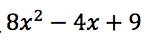
quartic polynomial
quadratic polynomial
quartic trinomial
quadratic trinomial
80
Multiple Choice
81
Multiple Choice
3x2 – 8x + 1
quadratic trinomial
cubic trinomial
quadratic binomial
cubic binomial
82
TERM
- a number, a variable, or the product of a number and variable(s)
EXAMPLES
poly- "many" -nomial "term" Term(s) whose exponents are whole numbers, and are separated by a "+" or a "-"
POLYNOMIAL
x + 3
x2 - 4x - 9
9x3 + 5x2 - 3x + 12
How many terms does each polynomial have?
83
Math Response
How many terms does the polynomial have?
2ab2−4c+6d3−12ef + 101
84
STANDARD FORM of a POLYNOMIAL
all of the terms are in order from the highest exponent (degree) to the lowest exponent (degree).
EXAMPLE
Write in STANDARD FORM
5y2 + w4 + w7 - q3 + 2y - 10
85
Reorder
Rewrite 2x2+9−5x3+3x4−8x in standard form.
+3x4
−5x3
+2x2
−8x
9
86
DEGREE OF A POLYNOMIAL
EXAMPLES
3x2 + 9x - 4
x2 - 8x5 + 7
y5z4 + w2x3 + 2xy - 10
the degree is ___
the degree is ___
the degree is ___
the highest degree of its monomials with non-zero coefficients.
87
Math Response
What is the degree of the polynomial?
a3b3+c4d−x3y2
88
LEAD COEFFICIENT
the coefficient of the first term when the polynomial is written in standard form.
EXAMPLE
What is the lead coefficient?
-9x3 + 3x - 6x4 + 22
89
Math Response
What is the lead coefficient of the polynomial?
−4a3+19a4−a+12a6+103
90
NAMING A POLYNOMIAL
by the number its degree
DEGREE | NAME | EXAMPLE |
|---|---|---|
0 | CONSTANT | 12 |
1 | LINEAR | 3x - 12 |
2 | QUADRATIC | |
3 | CUBIC | |
4 | 4th DEGREE POLYNOMIAL | |
x2 + 4x - 8
4x3 - 5x2 + 4x
9x4 - 2x2 - 6
91
Multiple Choice
Name the polynomial by its degree.
3x2+7x−8
constant
linear
quadratic
cubic
92
NAMING A POLYNOMIAL
by the number of terms it has
Number of Terms | Name | Example |
|---|---|---|
1 | MONOMIAL | 4x |
2 | BINOMIAL | 7x - 8 |
3 | TRINOMIAL | 2x - 7y + 12 |
93
Multiple Select
Chose all the descriptions that describe the polynomial.
−2x2−7
trinomial
linear
quadratic
binomial
monomial
94
Lesson Vocabulary
3
Polynomial
7x2+ 3x + 1
Monomial
Ex: 5x, 8 , 3x2
Binomial
Ex: 4x4 + 9
Trinomial
Ex: 9x2 + 7x − 13
Constant
Ex: 23, 6, −13
1 term
2 terms
3 terms
Contains no variables
Coefficient
Constant
Term
1 min
95
Multiple Choice
What is the degree of the polynomial?
f(x) = 2x4−3x2−2x −4?
4
3
2
1
96
Multiple Choice
What is the leading term of the polynomial?
f(x) = 3x3−6x5−2x2−5 ?
3x3
−6x5
−2x2
-5
97
98
99
100
101
Multiple Choice
Is the function positive or negative from a to b?
Positive
Negative
102
Multiple Choice
Is the function positive or negative from c to d?
Positive
Negative
103
Multiple Choice
Is the function positive or negative from d to e?
Positive
Negative
Synthetic Division
Show answer
Auto Play
Slide 1 / 103
SLIDE

Similar Resources on Wayground
99 questions
GOALS World History I Lesson 5
Presentation
•
9th - 12th Grade
100 questions
Unit 2: DNA & Heredity Review
Presentation
•
9th - 12th Grade
100 questions
Staar Biology Ecology
Presentation
•
9th - 12th Grade
97 questions
PERÍODE D'ENTREGUERRES
Presentation
•
10th - 12th Grade
97 questions
Geometric Sequences
Presentation
•
8th - 11th Grade
97 questions
Photosynthesis and Cellular Respiration Lesson
Presentation
•
9th - 12th Grade
98 questions
食物和饮料
Presentation
•
9th - 12th Grade
99 questions
Continuity and Unity of Life
Presentation
•
10th - 12th Grade
Popular Resources on Wayground
6 questions
Secondary Safety Quiz
Presentation
•
9th - 12th Grade
10 questions
Afterschool Activities & Sports
Quiz
•
6th - 8th Grade
19 questions
ROAR Week 2026
Quiz
•
9th - 12th Grade
20 questions
Lab Safety Quiz
Quiz
•
6th Grade
15 questions
Cool Tool:Chromebook
Quiz
•
6th - 8th Grade
22 questions
would you rather
Quiz
•
3rd - 11th Grade
21 questions
Continents and Oceans
Quiz
•
6th Grade
20 questions
Parts of Speech
Quiz
•
5th Grade
Discover more resources for Mathematics
20 questions
1.1 (a) Classifying Polynomials
Quiz
•
9th Grade
20 questions
Tues(Aug 11) BB: M1, T1, Lesson 1 Assign.
Quiz
•
9th Grade
23 questions
Six Parent Functions
Quiz
•
9th - 12th Grade
20 questions
Solving Multi-Step Equations
Quiz
•
10th Grade
20 questions
Basic Constructions
Quiz
•
10th Grade
19 questions
Classify Types of Real Numbers
Quiz
•
9th - 12th Grade
22 questions
CHS Safety Day Review Quiz
Quiz
•
9th - 12th Grade
13 questions
Rational and Irrational Numbers
Quiz
•
9th Grade