

The Middle of Nowhere - 2nd contextual information lesson

Presentation
•
English
•
7th Grade
•
Practice Problem
•
Easy

Angelina Browning
Used 4+ times
FREE Resource
18 Slides • 13 Questions
1
Contextual information - Lesson 2
The Middle of Nowhere

2
Last lesson we learnt about the setting of the novel (where and when the events take place).
We also learnt about Australia's political context (who governed Australia and how European settlers identified).
Let's see what you can remember from last lesson!
Recap
3
Multiple Choice
The novel is set in...
1849
1894
1948
1984
4
Multiple Choice
The events of the novel take place in...
Adelaide
Sydney
The outback
Perth
5
Multiple Choice
Back in 1894, Queen Victoria ruled Britain and Australia was...
a collection of six colonies ruled by Britain
a collection of six colonies ruled by independent leaders
six separate countries
a collection of six colonies ruled by Canada
6
Multiple Choice
The European settlers that moved to Austraila (and their descendants) considered themselves...
British
Australian
Both British and Australian
7
Social context
Now we are going to learn a little more about the social context of the time. For example, we are going to hear what it was like to be a First Australian after the European settlers arrived, as well as what it was like to be a lady, gentleman or a child back then. Now that you've started reading The Middle of Nowhere, you may have already picked up on some of this information.
8
Open Ended

What do you imagine it might have been like to be an Aboriginal person in the 1800s (when European settlers came in greater numbers and began to take claim of Australia)?
9
Aboriginal people in the 1800s were dispossessed (of their land) and physically harmed or killed.
Their population declined and they were exploited economically (paid very little for work).
First Australians

10
In the 1800s, Aboriginal people were unable to own a house or land, or vote in elections, this unfair treatment reinforced the popular and unjust belief amongst white-Australians that they were superior.
11
In the novel that we are studying, the protagonist's name is Comity. Comity is a term that refers to mutual respect between different people and the equality of all. It is clear that Comity's parents do not believe they are superior those of different backgrounds.
12
Devastating drought
It is clear that the European settlers should have respected the First Australians and sought their advice. During the late 1880s and early 1890s, the outback areas of New South Wales, Queensland, Victoria and South Australia were heavily overstocked. Large numbers of settlers had arrived in the previous 30 years. Their methods of farming led to a loss of vegetative cover and erosion, and many native edible plant species vanished with devastating consequences. This led to a nine year drought called the ‘Federation Drought’.

13
For Aboriginal people, the European way of life would have seemed strange and out of touch with the land.
In an animistic world everything is interconnected; people, plants and animals, landforms and celestial bodies are part of a larger reality.
In this world, everything is alive; animals, plants, and natural forces, all are energised by a spirit. As such, humans are on an equal footing with nature, are part of nature and are morally obligated to treat animals, plants and landforms with respect.
Animistic spirituality

Artwork © Nathan Patterson
14
Open Ended

What might it have been like to have been a lady back in the 1890s? What social customs or rules might people have imposed upon women?
15
The main role of a lady was to serve others. She had to beautiful and clean at all times, hold dinner parties and, in everything she did, aim to please her husband and society.
The ideal Victorian woman was always busy and very able. According to many etiquette books, she could always draw strength from her "moral superiority".

16
When a lady wanted to cross the street there were strict rules. She must hold her dress slightly above the ankle, holding the folds with her right hand and drawing them towards the right.
It was 'vulgar' to lift the dress with both hands as far too much ankle would be shown. However, a woman could show her ankles for a brief moment if there was a lot of mud and needed to ensure her dress was clear of the ground.

17
Open Ended

What might it have been like to have been a gentleman back in the 1890s? What social customs or rules might people have imposed upon men?
18
There were rules for gentlemen too. It was considered bad manners and vulgar to ask a direct question. A Victorian gentleman could never ask for example, "How is your Mother?" They had to put the question in another form such as, "I hope your Mother is doing well?"
In one etiquette rule book it was firmly stated that ‘Showing affection in public was brazen vulgarity.’

19
A very bad breach of etiquette was for a man to sit while a lady was left standing. He must immediately offer her the use of his own chair even if 'the gentleman has the best seat in the room, he must offer it to a lady’. However, if his seat was warm from where he had been sitting, he must go and get another seat for the lady and not offer her the one that was still warm.

20
Open Ended

What might it have been like to have been a child back in the 1890s? What social customs or rules might people have imposed upon children?
21
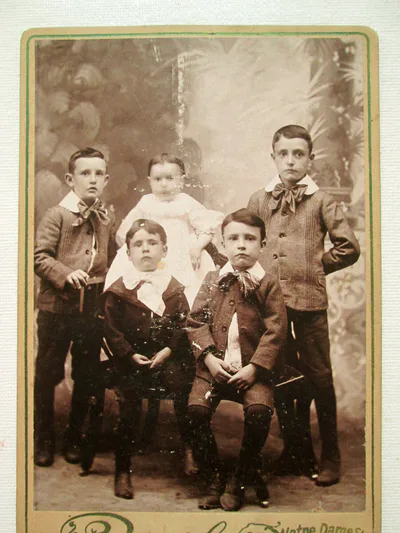
There were many rules for children in the Victorian era:
Never talk back to older people especially your father and mother.
Never whine or frown when spoken to by your elders.
Never argue with your elders - they know best.
Never do anything that is forbidden by your elders.
Do as you are told in a pleasant and willing way.
Never contradict anyone in any way - it is very impolite.
Always rise into a standing position when visitors arrive.
Never start a conversation with a visitor until they have started to speak.
Never interrupt a conversation.
Never allow your parents to bring you a chair and never allow them to get one for themselves. Wait on them, instead of being waited on.
Never run up and down the stairs or across the room.
Keep yourself clean and neat looking at all times.
22
There were many rules for children in the Victorian era:
Never talk back to older people especially your father and mother.
Never whine or frown when spoken to by your elders.
Never argue with your elders - they know best.
Never do anything that is forbidden by your elders.
Do as you are told in a pleasant and willing way.
Never contradict anyone in any way - it is very impolite.
Always rise into a standing position when visitors arrive.
Never start a conversation with a visitor until they have started to speak.
Never interrupt a conversation.
Never allow your parents to bring you a chair and never allow them to get one for themselves. Wait on them, instead of being waited on.
Never run up and down the stairs or across the room.
Keep yourself clean and neat looking at all times.
Which of these rules would you find it the hardest to obey?
23
Fashion
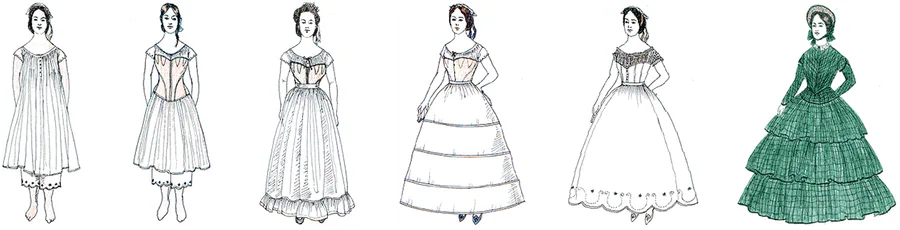
The fashions were also quite strict. Even though the European settlers lived in the harsh environment of the Australian Outback, they would still wear the fashions dictated by England. Look at all the layers that Comity was supposed to wear in one day!
24
Photography
Cameras were not as advanced back in the Victorian era - in fact, they were quite new. You had to stand very still to have your photograph taken, or the image would be blurry. A strange fashion of the time was for mothers to try to hold babies on their lap very still but then have themselves hidden from the photos.


25
Let's check what you can remember!

26
Multiple Choice
During the 1800s, the First Australians...
Were not permitted to own land or houses.
Were not allowed to vote.
Were disrespected, harmed and looked down upon by most European settlers.
All of the above.
27
Multiple Choice
Despite the disrespect that European settlers showed Aboriginal peoples, they would have been wise to get advice from them. The settlers made many mistakes when they first arrived. Just one example of a terrible mistake was their wrong approach to farming. This led to...
floods
bush fires
drought
confusion
28
Multiple Choice
A Victorian lady had many responsibilities, but above all else she needed to focus on...
keeping her ankles hidden.
throwing excellent dinner parties.
wearing beautiful dresses.
pleasing her husband and society.
29
Multiple Choice
While Victorian gentleman had many privileges, they also needed to make sure that they...
wore the trendiest top hat.
always asked people about how their mother was going.
had the most colourful waistcoat in town.
were respectful to women.
30
Multiple Choice
Which of the following was NOT a rule for Victorian children to obey?
Always listen to your elders - they know best.
Never start a conversation with a visitor until they have started to speak.
Always stand when in the presence of adultsand only sit when adults aren't in the room.
Keep yourself clean and neat looking at all times.
31

You have finished.
Well done!
Contextual information - Lesson 2
The Middle of Nowhere
Show answer
Auto Play
Slide 1 / 31
SLIDE
Similar Resources on Wayground

22 questions
Adverbs - Grade 7
Presentation
•
7th Grade
25 questions
Vocabulary List 7 Introduction Lesson
Presentation
•
7th Grade
25 questions
Revision Unit 1 Vol.2: Present Simple vs Present Continuous
Presentation
•
6th - 7th Grade
21 questions
Reading STAAR Prep - Inference
Presentation
•
7th Grade
25 questions
Parts of Speech
Presentation
•
7th Grade
23 questions
Transitions
Presentation
•
7th Grade
23 questions
Clauses and Phrases
Presentation
•
7th Grade
22 questions
Adverb Clauses
Presentation
•
7th Grade
Popular Resources on Wayground
11 questions
Hallway & Bathroom Expectations

Quiz
•
6th - 8th Grade
10 questions
HCS SCI 03 Summer School Assessment 2
Quiz
•
3rd Grade
11 questions
Home Scope
Quiz
•
7th - 8th Grade
12 questions
2026 TAP Technology in the Classroom
Presentation
•
Professional Development
15 questions
HCS SCI 05 Summer School Assessment 2 Review
Quiz
•
5th Grade
15 questions
HCS SCI 04 Summer School Review 2
Quiz
•
4th Grade
59 questions
Geometry Unit 3 Review
Quiz
•
9th - 12th Grade
14 questions
FAST ELA READING SMAPLE TEST MATERIALS

Passage
•
3rd Grade