

Rewards ss unit 9

Presentation
•
English
•
8th Grade
•
Practice Problem
•
Easy
+15
Standards-aligned

Christopher Fish
Used 1+ times
FREE Resource
24 Slides • 4 Questions
1


©2017 Voyager Sopris Learning®. All rights reserved. Permission is granted to reproduce this page for teacher use.
Display 9.1
1. United Nations (noun)
explanation:
The United Nations is an
international organization that is
dedicated to peace.
example:
As of 2016, the United Nations
has 193 members. Flags of all 193
members are displayed in front of
the United Nations Headquarters in
New York City.
2

©2017 Voyager Sopris Learning®. All rights reserved. Permission is granted to reproduce this page for teacher use.
Display 9.2
2. delegate (noun)
explanation:
A delegate is a person who acts for or represents someone
else or a group of people.
example:
In 1945, delegates from 50 nations met in San Francisco to
approve a Charter (governing document) for the new United
Nations (U.N.). The Charter says that the purpose of the U.N.
is to promote peace and cooperation among all the world’s
countries.
3
Multiple Choice
A delegate is
A type of food used by ancient civilizations
a person who acts for or represents someone
else or a group of people.
4

©2017 Voyager Sopris Learning®. All rights reserved. Permission is granted to reproduce this page for teacher use.
Display 9.3
3. ratify (verb)
explanation:
When you ratify a treaty, contract, agreement, or accord, you
give it legal or official approval, usually by signing it.
example:
The first order of business for the original members of the U.N.
was to ratify the official Charter of the United Nations.
5

©2017 Voyager Sopris Learning®. All rights reserved. Permission is granted to reproduce this page for teacher use.
Display 9.4
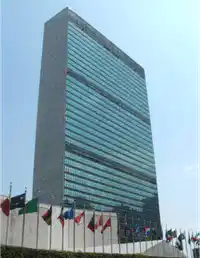
ratify — example
On October 24, 1945, the United
Nations came into existence after
its Charter was ratified by China,
France, Great Britain, the Soviet
Union, the United States, and many
other member nations. Because the
Charter was ratified on October 24,
United Nations Day is celebrated
every year on that date.
The United Nations Headquarters buildings
are in New York City, New York.
6
Multiple Choice
When you ratify a treaty
You ensure it is tested, determined, and understood.
you
give it legal or official approval, usually by signing it.
7


©2017 Voyager Sopris Learning®. All rights reserved. Permission is granted to reproduce this page for teacher use.
Display 9.5
4. centralize (verb)
explanation:
When you centralize services or
activities, you organize them under
one point of control.
example:
A major goal of the United Nations
was to centralize international
services under one organization.
8

©2017 Voyager Sopris Learning®. All rights reserved. Permission is granted to reproduce this page for teacher use.
Display 9.6
5. according to (preposition)
explanation:
We use the phrase according to
when we want to report what a
person said or what was stated in
a document.
example:
According to the United Nations
Charter, the U.N. has four major
purposes.
United Nations Purposes
• to maintain peace and security
throughout the world
• to create friendly relationships
among nations
• to help nations work together to
solve international problems such
as poverty, hunger, and disease
and to protect people’s rights and
freedoms
• to be a center for harmonizing the
actions of nations as they achieve
these common purposes
9


©2017 Voyager Sopris Learning®. All rights reserved. Permission is granted to reproduce this page for teacher use.
Display 9.7
6. relieve (verb)
explanation:
When you relieve things such as
pain, anxiety, distress, or poverty, you
reduce or lighten those things.
example:
After a natural disaster, such as a
hurricane, the United Nations and
other relief organizations relieve
suffering by bringing food and water
to the survivors. This C-17 airplane
is dropping supplies to Haiti after the
earthquake in 2010.
10

©2017 Voyager Sopris Learning®. All rights reserved. Permission is granted to reproduce this page for teacher use.
Display 9.8
relieve — check for understanding
What other things might a relief organization do to help
relieve people’s pain and suffering after a natural disaster?
Begin by saying:
To help relieve people’s pain and suffering after a natural
disaster, a relief organization might . . .
11
Open Ended
What other things might a relief organization do to help
relieve people’s pain and suffering after a natural disaster?
12

©2017 Voyager Sopris Learning®. All rights reserved. Permission is granted to reproduce this page for teacher use.
Display 9.9
7. migrant (noun)
explanation:
A migrant is a person who moves
from place to place to find work,
typically in agriculture.
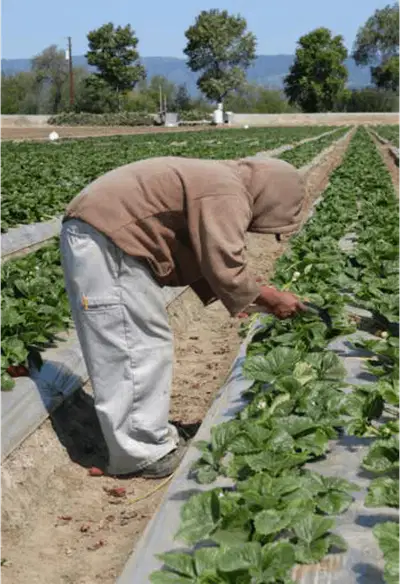
example:
This migrant worker is trimming
strawberry plants on a farm in
Watsonville, California. Since
2003, the United Nations has been
working to monitor the protection
of migrants’ rights throughout
the world.
13

©2017 Voyager Sopris Learning®. All rights reserved. Permission is granted to reproduce this page for teacher use.
Display 9.10
migrant — word family
People are not the only migrants.
A migrant is also an animal that
moves from place to place. Every
year, between one and two million
migratory wildebeests, zebras, and
gazelles travel around a large loop
in East Africa as they migrate from
south to north and then from north
to south. Scientists believe that the
migration is motivated by the search
for rich grazing lands and abundant
surface water.
• migrants – noun
• migrant – noun
• migratory – adjective
• migrate – verb
• migration – noun
14


©2017 Voyager Sopris Learning®. All rights reserved. Permission is granted to reproduce this page for teacher use.
Display 9.11
8. drought (noun)
explanation:
A drought occurs when there is a
long period of dry or hot weather with
a lack of rain or snow.
example:
People are experiencing drought
on every continent. Water shortages
put crops and people at risk for
survival. In 2013, the United Nations
established new policies to help
countries manage drought.
15
Multiple Choice
A drought occurs when
there is a
long period of dry or hot weather with
a lack of rain or snow.
there is a
long period of wet or cold weather with
a lack of sun.
16


©2017 Voyager Sopris Learning®. All rights reserved. Permission is granted to reproduce this page for teacher use.
Display 9.12
9. refugees (noun)
explanation:
Refugees are people who leave their
homes because they are in danger of
being persecuted, and their country
is not protecting them.
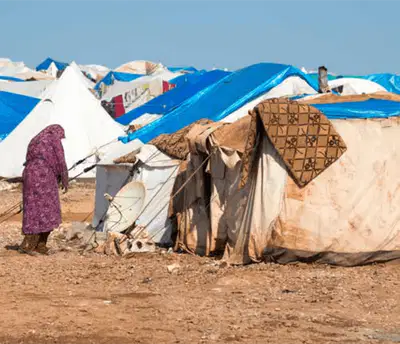
example:
Because of civil war in Somalia,
Africa, these refugees have sought
safety in the neighboring country
of Kenya.
17

©2017 Voyager Sopris Learning®. All rights reserved. Permission is granted to reproduce this page for teacher use.
Display 9.13
10. weary (adjective)
explanation:
When you are weary, you are very
tired and worn out.
example:
Refugees have been fleeing their
homes in Syria because of civil war.
By the time Syrian refugees reach a
refugee camp, they are often weary
due to lack of sleep and food, the
physical challenges of the journey,
and the heartbreak of leaving
their homes.
18

©2017 Voyager Sopris Learning®. All rights reserved. Permission is granted to reproduce this page for teacher use.
Display 9.14
1. dispute (noun)
explanation:
A dispute is a fight, an argument, a
disagreement, or a conflict.
example:
In 2015, the U.N. reported that more
than 50 million people worldwide
were refugees as a result of violent
disputes within or between countries.
The U.N. Refugee Agency oversees
the well-being of all refugees, bringing
them tents, mosquito netting, food,
and other necessary supplies.
19


©2017 Voyager Sopris Learning®. All rights reserved. Permission is granted to reproduce this page for teacher use.
Display 9.15
2. security (noun)
explanation:
To have security means to have
protection from danger, or to be safe
and secure.
example:
The U.N. does not have its own
military. Instead, the U.N. depends
on military troops and police from
member countries to maintain peace
and security in areas of conflict
around the world.
20

©2017 Voyager Sopris Learning®. All rights reserved. Permission is granted to reproduce this page for teacher use.
Display 9.16
3. declaration (noun)
explanation:
If you make a declaration, you make a formal announcement;
you declare something.
example:
In 1948, the United Nations adopted a Universal Declaration
of Human Rights. This document created an international
standard for human rights in all countries.
21

©2017 Voyager Sopris Learning®. All rights reserved. Permission is granted to reproduce this page for teacher use.
Display 9.17
4. inception (noun)
explanation:
Inception means the beginning
of something.
example:
From its inception, the United
Nations has desired to improve the
world’s health. One of its many goals
is to completely eliminate measles.
This child, along with millions of
others, is receiving a measles
vaccination through a U.N. program.
22

©2017 Voyager Sopris Learning®. All rights reserved. Permission is granted to reproduce this page for teacher use.
Display 9.18
5. impoverished (adjective)
explanation:
The word impoverished describes
someone or something that is
very poor.
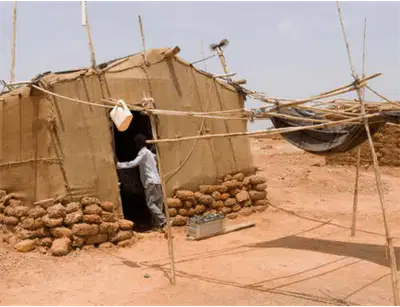
example:
The people of Darfur in Sudan are
impoverished for many reasons,
including a severe drought.
23


©2017 Voyager Sopris Learning®. All rights reserved. Permission is granted to reproduce this page for teacher use.
Display 9.19
6. sustainable (adjective)
explanation:
The word sustainable describes
something that is able to be kept
up or maintained over time; able to
be sustained.
example:
The United Nations has worked to
improve access to sustainable water
supplies in many locations around
the globe.
24

©2017 Voyager Sopris Learning®. All rights reserved. Permission is granted to reproduce this page for teacher use.
Display 9.20
7. destruction (noun)
explanation:
Destruction is the result of an event
that completely ruins or destroys
something.
example:
Some developing countries are also
the site of repeated disasters, such as
hurricanes, earthquakes, and volcanic
eruptions. The U.N. helps disaster-
prone areas design emergency plans
to deal with the destruction from
these natural disasters.
25

©2017 Voyager Sopris Learning®. All rights reserved. Permission is granted to reproduce this page for teacher use.
Display 9.21
8. environmental (adjective)
explanation:
The word environmental describes
something having to do with the
environment.
example:
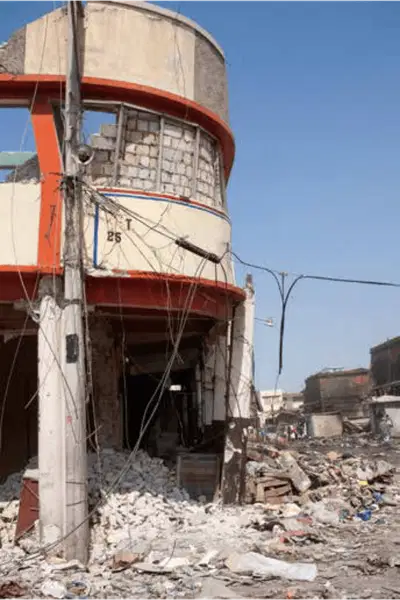
The United Nations responds to many
environmental emergencies such as
the earthquake in Haiti in 2010.
26


©2017 Voyager Sopris Learning®. All rights reserved. Permission is granted to reproduce this page for teacher use.
Display 9.24
9. economic (adjective)
explanation:
The word economic describes
something that has to do with
the economy or with money. An
economy is the system that a
country or region uses to organize its
money, industry, or commerce.
example:
These business people are
discussing the economic
development of their company.
27


©2017 Voyager Sopris Learning®. All rights reserved. Permission is granted to reproduce this page for teacher use.
Display 9.25
economic — example
Many United Nations agencies
are committed to economic
development of the world’s countries
because the agencies believe that
international peace and sustainable
development are possible only with
economic prosperity.
28

©2017 Voyager Sopris Learning®. All rights reserved. Permission is granted to reproduce this page for teacher use.
Display 9.26
10. specialize (verb)
explanation:
If you specialize in a particular activity or area of knowledge,
you become an expert in that activity or area.
example:
The United Nations has a group that specializes in helping
children and mothers in developing countries. This group
is called the United Nations Children’s Emergency Fund
(UNICEF).
©2017 Voyager Sopris Learning®. All rights reserved. Permission is granted to reproduce this page for teacher use.
Display 9.1
1. United Nations (noun)
explanation:
The United Nations is an
international organization that is
dedicated to peace.
example:
As of 2016, the United Nations
has 193 members. Flags of all 193
members are displayed in front of
the United Nations Headquarters in
New York City.
Show answer
Auto Play
Slide 1 / 28
SLIDE
Similar Resources on Wayground

23 questions
Modal verbs
Presentation
•
8th Grade
21 questions
Age of Exploration Review
Presentation
•
7th Grade
21 questions
MEXICAN NATIONAL ERA
Presentation
•
7th Grade
23 questions
Occupations related to digital media careers
Presentation
•
9th Grade
20 questions
Eng9 L2: MODALS TOA
Presentation
•
9th Grade
21 questions
Mending Wall First and Second Read
Presentation
•
9th Grade
22 questions
chapter 2. ability and willingness
Presentation
•
8th Grade
21 questions
GRADE 8 6D LESSON 2
Presentation
•
8th Grade
Popular Resources on Wayground
10 questions
Safety Day 2026 – Student Review

Quiz
•
9th Grade
21 questions
Continents and Oceans
Quiz
•
6th Grade
20 questions
Parts of Speech
Quiz
•
5th Grade
16 questions
Subject & Predicate
Quiz
•
5th Grade
25 questions
Multiplication Facts
Quiz
•
5th Grade
12 questions
Map Skills
Quiz
•
3rd Grade
22 questions
Continents and Oceans
Quiz
•
5th Grade
15 questions
Rounding Decimals
Quiz
•
5th Grade
Discover more resources for English
25 questions
Making Inferences
Quiz
•
6th - 8th Grade
20 questions
Figurative Language Review
Quiz
•
8th Grade
20 questions
Sentences, Fragments, and Run-ons
Quiz
•
8th Grade
30 questions
The Outsiders Day Activity
Quiz
•
8th Grade
27 questions
1st Nine Weeks: ELA Final Exam Study Guide
Quiz
•
6th - 8th Grade
20 questions
Action, Linking, and Helping Verbs
Quiz
•
3rd - 8th Grade
10 questions
Exploring the Role of Setting in Storytelling

Interactive video
•
6th - 10th Grade
10 questions
Differentiating the 3 Types of Irony
Interactive video
•
6th - 10th Grade