

Volcanoes

Presentation
•
Science
•
12th Grade
•
Practice Problem
•
Easy

Miss Nathan
Used 1+ times
FREE Resource
22 Slides • 12 Questions
1


2
Labeling
Label the parts of volcano
Lava
Crater
Dust, ash cloud
Vent
Magma chamber
Volcano cone
3


Volcano formation at divergent boundary- Mid Ocean Ridge formation

4
Thus the mid-ocean ridge is also known as a "spreading center" or a "divergent plate boundary." The plates spread apart at rates of 1 cm to 20 cm per year. As oceanic plates move apart, rock melts and wells up from tens of kilometers deep.

5

Volcano formation at convergent boundaries: At Subduction zone

6
Volcano formation at convergent boundaries:
At Subduction zone
At a convergent plate boundary, one plate dives or “subducts” beneath the other, resulting in a variety of earthquakes and a line of volcanoes on the overriding plate.
7
Found underwater around 1952
Older Crust is deposited into the Earth through a Trench.
Then a New layer of Crust is made here.

8
Multiple Choice
A divergent boundary occurs where plates ....
Pull apart
Come together
Slide past each other
subducting
9
Multiple Choice
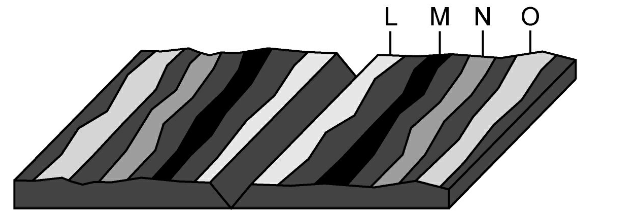
10
Multiple Choice
The OLDEST seafloor is located
closest to the mid-ocean ridge.
farthest from the mid-ocean ridge.
east of Hawaii
west of California
11
Multiple Choice

Seafloor spreading...
creates new oceanic crust
destroys or recycles crust
creates new continental crust
creates old crust
12
Multiple Choice
Mid-ocean ridges can be found in
the Atlantic and Pacific Oceans
the Pacific and the Indian Oceans
all of Earth's oceans
only the Atlantic Ocean
13


14


15


Cinder
16


17


18


19

Composite cones are tall, cone shaped volcanoes that produce explosive eruptions.
Shield volcanoes form very large, gently sloped volcanoes with a wide base.
Cinder cones are the smallest volcanic landform. They are formed from accumulation of many small fragments of ejected material.
20
Match
Match the following type of volcanoes
Composite
Cinder Cone
Shield
Composite
Cinder Cone
Shield
21

22


23

24


25
Multiple Choice
Non explosive eruption is loud
True
False
26
Multiple Choice
Non explosive eruption produces hude amount of lava
True
False
27


28


29
Match
Match the following:
Explosive eruption
Non explosive eruption
Volcanic materials
Explosive eruption
Non explosive eruption
Volcanic materials
30
Multiple Select
Tick all the materials released from a volcano during explosive eruption
Ash
Water
Debris
Gas
31
Fill in the Blanks
Large volcanic blobs : Volcanic
32


33


The Ring of Fire, also referred to as the
Circum-Pacific Belt, is a path along the
Pacific Ocean characterized by active
volcanoes and frequent earthquakes.
The majority of Earth's volcanoes and
earthquakes take place along the Ring of
Fire.
34


A hot spot is an area on Earth over
a mantle plume or an area under
the rocky outer layer of Earth,
called the crust, where magma is
hotter than surrounding magma.
The magma plume causes melting
and thinning of the rocky crust
and widespread volcanic activity.
Hot spots
Show answer
Auto Play
Slide 1 / 34
SLIDE
Similar Resources on Wayground

24 questions
Taxonomy and Classification
Presentation
•
11th Grade
26 questions
AP Unit 8.2: Energy Flow Through Ecosystems
Presentation
•
12th Grade
25 questions
Water Pollution presentation
Presentation
•
11th - 12th Grade
27 questions
Understanding Populations
Presentation
•
11th - 12th Grade
26 questions
Newton's Second Law
Presentation
•
11th Grade
28 questions
Crime Scene Search patterns
Presentation
•
12th Grade
30 questions
Blood Spatter
Presentation
•
12th Grade
25 questions
Compound Interest
Presentation
•
12th Grade
Popular Resources on Wayground
10 questions
How much do you know about our Portrait of an Eagle?

Quiz
•
10th Grade
10 questions
Fast Food Slogans
Quiz
•
6th - 8th Grade
21 questions
Continents and Oceans
Quiz
•
6th Grade
20 questions
Parts of Speech
Quiz
•
5th Grade
16 questions
Subject & Predicate
Quiz
•
5th Grade
25 questions
Multiplication Facts
Quiz
•
5th Grade
12 questions
Map Skills
Quiz
•
3rd Grade
22 questions
Continents and Oceans
Quiz
•
5th Grade
Discover more resources for Science
22 questions
Periodic Table Review
Quiz
•
9th - 12th Grade
7 questions
Newton's Laws Video Quiz

Interactive video
•
9th - 12th Grade
17 questions
Unit 3A: Cells Vocab
Quiz
•
9th - 12th Grade
89 questions
Unit 1 (Ch 2 & 3) Test Review - Water/Ocean Currents
Quiz
•
9th - 12th Grade
58 questions
Biomolecule Test Corrections
Quiz
•
9th - 12th Grade
20 questions
Unit 2: Cell Energy Review
Quiz
•
9th - 12th Grade
17 questions
Explore Newton's Laws of Motion
Quiz
•
8th - 12th Grade
35 questions
Directional Terms, Body Cavities, Body Planes
Quiz
•
11th - 12th Grade