

Introduction to Graphing

Presentation
•
Biology
•
9th - 12th Grade
•
Practice Problem
•
Easy

Jennifer Long
Used 7+ times
FREE Resource
9 Slides • 5 Questions
1
1. Title
2. The independent variable (w/ axis title)
3. The dependent variable (w/ axis title)
4. The scales for each variable
5. A legend or key (if necessary)
A graph contains five major parts: (5 MGP: “5 Major Graph Parts”)
Graphing is an important procedure used by scientists to display the data that is collected during a controlled experiment. Graphs must be constructed correctly to accurately portray the data collected for analysis. Many times the wrong construction of a graph inaccurately portrays data or skews perception about a data set, so being able to accurately create and analyze a graph is an extremely important scientific skill.
Graphing
2
The TITLE: depicts what the graph is about. By reading the title, the reader should get an idea about the graph. It should be a concise statement placed above the graph.
TITLE
3
The INDEPENDENT VARIABLE: is the variable that can be controlled or manipulated by the experimenter. It usually includes time (dates, minutes, hours, etc.), depth (feet, meters), and temperature (Celsius). This variable is placed on the X axis (horizontal axis). [MIX - manipulated, independent, X]
INDEPENDENT VARIABLE
4
The DEPENDENT VARIABLE: is the variable that is directly affected by the independent variable or responds to changes in the independent variable. It is the result of what happens because of the independent variable. Example: How many oxygen bubbles are produced by a plant located five meters below the surface of the water? The oxygen bubbles are dependent on the depth of the water. This variable is placed on the Y or vertical axis. [DRY - dependent, responding, Y]
DEPENDENT VARIABLE
5
The SCALES for each variable: In constructing a graph one needs to know where to plot the points representing the data. In order to do this, a consistent scale must be utilized to include all the data points. The scale should also take up a conservative amount of space. It is not suggested to have a run-on scale making the graph too hard to manage. The scale should start with 0 and climb or decrease based on intervals such as: multiples of 2, 5, 10, 20, 25, 50, or 100. The scale of numbers will be dictated by your data values. Scales must be consistent, with number intervals spaced evenly!
SCALES
6
The LEGEND/KEY: is the meaning of the symbols used in a graph or map. This could include shapes or colors to help the reader determine what the lines or bars on a graph mean. Always use a legend/key if more than one data set is represented on the same graph.
LEGEND/KEY
7


allow us to compare groups or categories
Bar Graphs
allow us to show trends over time or in sequential order
Line Graphs
8
is anything that can be counted or measured; it refers to numerical data
Quantitative Data
is descriptive, referring to things that can be observed but not measured
Qualitative Data
9
Open Ended
What are the 5 major graph parts that should always be included when creating a graph?
10
Open Ended
Write TWO statements to summarize 2 other things you learned about graphs from this page:
11

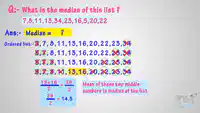
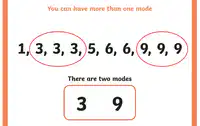
Mean
The MEDIAN for a group of variables: To determine median or “middle” for an even number of values, put the values in ascending order and take the average of the two middle values. e.g. 2, 3, 4, 5, 9, 10 Add 4+5 (2 middle values) and divide by 2 to get 4.5
Median
The MODE for a group of variables: The mode for a group of values is the number that occurs most frequently. e.g. 2, 5, 8, 2, 6, 11 The number 2 is the mode because it occurred most often (twice).
Mode
The MEAN for a group of variables: To determine the mean for a group of variables, divide the sum of the variable by the total number of variables to get an average.
12
Multiple Choice
What does the term independent variable mean?
The term independent variable refers to the factor that is manipulated
13
Multiple Choice
What does the term dependent variable mean?
14
Match
Match the following:
Mean
Median
Mode
The average
The middle value
The most frequent value
The average
The middle value
The most frequent value
1. Title
2. The independent variable (w/ axis title)
3. The dependent variable (w/ axis title)
4. The scales for each variable
5. A legend or key (if necessary)
A graph contains five major parts: (5 MGP: “5 Major Graph Parts”)
Graphing is an important procedure used by scientists to display the data that is collected during a controlled experiment. Graphs must be constructed correctly to accurately portray the data collected for analysis. Many times the wrong construction of a graph inaccurately portrays data or skews perception about a data set, so being able to accurately create and analyze a graph is an extremely important scientific skill.
Graphing
Show answer
Auto Play
Slide 1 / 14
SLIDE
Similar Resources on Wayground

14 questions
3.5.2 Dichotomous Keys, Phylogenetic Trees, & Cladograms
Presentation
•
9th - 12th Grade
11 questions
Must and Mustn't
Presentation
•
9th - 12th Grade
11 questions
Distance & Midpoint Formulas
Presentation
•
9th - 12th Grade
9 questions
Scientific Theory Vs. Law
Presentation
•
9th - 12th Grade
9 questions
Nucleic Acids
Presentation
•
9th Grade - University
11 questions
EOC Review Day 1
Presentation
•
9th - 12th Grade
12 questions
Before Darwin Build Up to Evolution
Presentation
•
9th - 12th Grade
10 questions
9/11
Presentation
•
9th - 12th Grade
Popular Resources on Wayground
10 questions
Safety Day 2026 – Student Review

Quiz
•
9th Grade
21 questions
Continents and Oceans
Quiz
•
6th Grade
20 questions
Parts of Speech
Quiz
•
5th Grade
16 questions
Subject & Predicate
Quiz
•
5th Grade
25 questions
Multiplication Facts
Quiz
•
5th Grade
12 questions
Map Skills
Quiz
•
3rd Grade
22 questions
Continents and Oceans
Quiz
•
5th Grade
15 questions
Rounding Decimals
Quiz
•
5th Grade
Discover more resources for Biology
20 questions
Cell organelles and functions
Quiz
•
10th Grade
20 questions
Cell Transport
Quiz
•
9th - 12th Grade
25 questions
photosynthesis and cellular respiration
Quiz
•
9th Grade
20 questions
Cell Cycle
Quiz
•
9th Grade
8 questions
DNA vs. RNA
Presentation
•
9th - 12th Grade
14 questions
Ecological Succession: Primary and Secondary
Quiz
•
9th Grade
20 questions
Macromolecules
Quiz
•
10th Grade
20 questions
Characteristics of Life
Quiz
•
9th - 10th Grade