

Rhetorical Situation Summary

Presentation
•
Education
•
12th Grade
•
Practice Problem
•
Hard

Ausencio Delgado
Used 2+ times
FREE Resource
21 Slides • 1 Question
1

2

3

4

5

6

7

8

9
10

11

12
13

14

15

16

17

18

19
20
Match
Match the following
The issue or situation that prompts someone to write or speak.
The group of people a message is intended for.
The speaker's intent or goal in delivering a message.
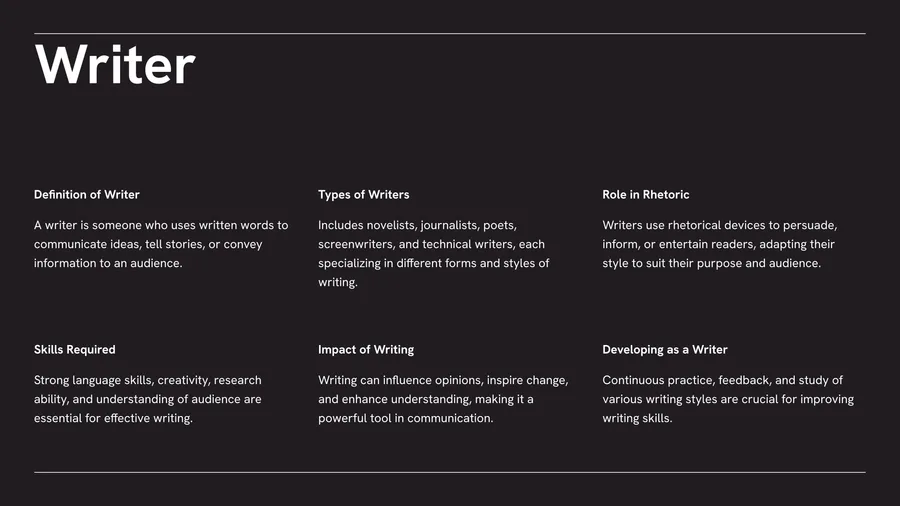
The person who uses written words to communicate ideas.
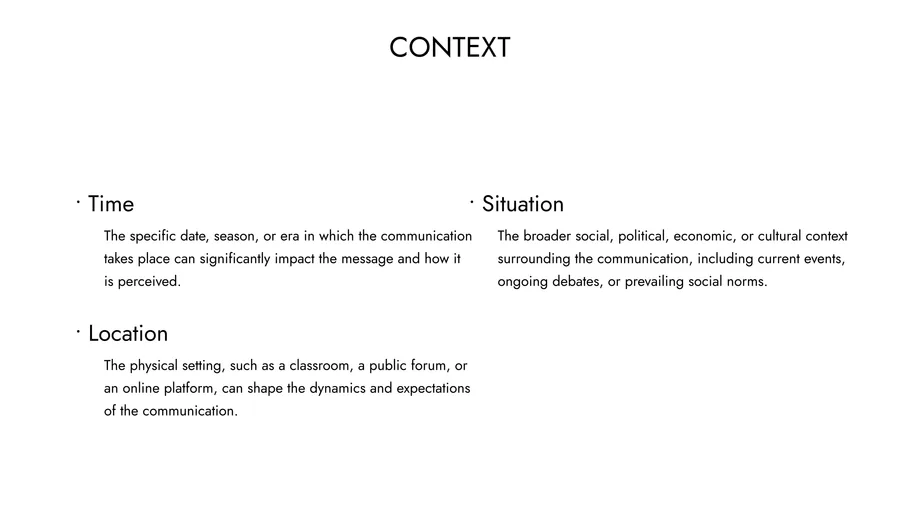
The circumstances or setting surrounding a particular event, statement, or idea.
Exigence
Audience
Purpose
Writer
Context
Exigence
Audience
Purpose
Writer
Context
21
Read, Think, and Annotate
Directions:
Rhetorical Situation Awareness: Exigence and Purpose
What exigence prompted the writing of this article, and how does the author, Alexandria Symonds, address this exigence through her exploration of youth voter turnout? How does the article's purpose align with the needs and concerns of the intended audience?
Claims and Evidence: Identifying Claims
Identify and evaluate the primary claims made by the author regarding the reasons for low youth voter turnout. What types of evidence (e.g., statistics, expert opinions, anecdotes) does the author use to support these claims, and how effectively do they bolster her argument?
Reasoning and Organization: Logical Structure
How does the author organize her argument to guide the reader through her reasoning about the causes of and potential solutions to low youth voter turnout? Assess the coherence and unity of the article's structure.
Stylistic Choices: Tone and Diction
How does the author’s choice of words and tone contribute to the persuasive power of the article? Consider how the language used might resonate differently with young voters versus older audiences.
Engagement with Audience Beliefs and Values: Addressing Audience Concerns
In what ways does the article acknowledge and respond to the concerns or potential objections of its audience regarding youth voter turnout? Does the author effectively engage with the values and beliefs of young voters or those who influence them?
While reading, consider the following questions.
22

Why Don’t Young People Vote Reading - Assignment at TeacherMade
You can open this webpage in a new tab.
Show answer
Auto Play
Slide 1 / 22
SLIDE
Similar Resources on Wayground

19 questions
ECONOMICS TOPIC 1 LESSON 2
Presentation
•
12th Grade
20 questions
Get Smart Plus 3 Topic 8 was/were
Presentation
•
1st - 4th Grade
20 questions
One Step Equations
Presentation
•
KG - University
20 questions
ACT Prep
Presentation
•
12th Grade
18 questions
The Road to the Civil War
Presentation
•
11th - 12th Grade
16 questions
Review Text Bahasa Inggris Peminatan
Presentation
•
12th Grade
17 questions
Food Chain/Food Web Recap
Presentation
•
12th Grade
18 questions
JANJANG
Presentation
•
12th Grade
Popular Resources on Wayground
20 questions
"What is the question asking??" Grades 3-5

Quiz
•
1st - 5th Grade
20 questions
“What is the question asking??” Grades 6-8
Quiz
•
6th - 8th Grade
10 questions
Fire Safety Quiz
Quiz
•
12th Grade
20 questions
Equivalent Fractions
Quiz
•
3rd Grade
34 questions
STAAR Review 6th - 8th grade Reading Part 1
Quiz
•
6th - 8th Grade
20 questions
“What is the question asking??” English I-II
Quiz
•
9th - 12th Grade
20 questions
Main Idea and Details
Quiz
•
5th Grade
47 questions
8th Grade Reading STAAR Ultimate Review!
Quiz
•
8th Grade