

Pronoun Antecedent

Presentation
•
English
•
9th - 12th Grade
•
Practice Problem
•
Medium
+4
Standards-aligned

Elena Gutierrez
Used 40+ times
FREE Resource
4 Slides • 10 Questions
1
2
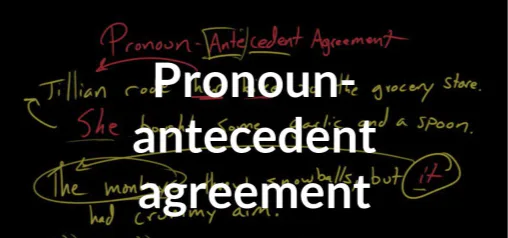
What is an antecedent?
Answer: A pronoun usually refers to a noun or another pronoun called its antecedent. Example: Jen lost her textbook.
Example: The snake shed its skin.
Example: Dreamers make their dreams a reality.
Example: Each one of my friends paid for his or her airfare.
|
3
What is the driving rule behind pronoun-antecedent agreement?
Answer: A pronoun should always agree in number and gender with its antecedent. Let’s explore the examples above.
Context matters: Be mindful that these rules are based on traditional gender norms. You may encounter situations where traditional gender norms do not apply. Thus, standard conventions of writing may not apply. In these cases, it is best to be respectful and adapt your language accordingly. For example, it may be more appropriate to use a singular form of they or their instead of him/her or his/hers. |
4
What are some other important rules to follow?
- Use a singular pronoun to refer to anybody, anyone, anything, each, either, everybody, everyone, everything, neither, nobody, no one, none, nothing, one, somebody, someone, or something. Example: Everybody in the meeting wanted his or her chance to speak. - Use a plural pronoun to refer to both, few, many, or several. Example: Few of the actors and actresses enjoyed their own play. - Indefinite pronouns such as all, any, more, most, none, and some may be singular or plural, depending on how they are used in a sentence. Example: Some of the bread was eaten, and some of the chips were eaten. - Use a singular pronoun to refer to two or more singular antecedents joined by or or nor. Example: Cheryl or Madge will lend her voice to this week’s podcast. - Use a plural pronoun to refer to two or more antecedents joined by and. Example: Cheryl and Madge will lend their voices to this week’s podcast. - When dealing with collective nouns, remember that a collective noun is singular when it refers to the group as a collective unit. Example: The committee held its meeting in Mr. Clarksen’s classroom. |
5
Multiple Choice
The rabbits sunned (itself, themselves) contentedly in the backyard.
Itself
Themselves
6
Multiple Choice
James loaned (their, his) textbook to Josie.
Their
His
7
Multiple Choice
The captain of the girls’ basketball team accepted (her, their) responsibilities with pride.
Her
Their
8
Multiple Choice
After a trip to the park, the family dogs like to relax in (its, their) kennels.
Its
Their
9
Multiple Choice
The dresses in my closet still have (its, their) price tags attached.
Its
Their
10
Multiple Choice
The managers of the restaurant began incorporating (its, their) family recipes into the menu.
Its
Their
11
Multiple Choice
The children will make breakfast in bed for (their, his or her) mom.
Their
His or her
12
Multiple Choice
You may find that mice make (its, their) nests in your basement.
Its
Their
13
Multiple Choice
The kitten familiarized (itself, themselves) with the new litter box.
Itself
Themselves
14
Multiple Choice
The hamster enjoyed running around in (its, their) ball.
Its
Their
Show answer
Auto Play
Slide 1 / 14
SLIDE
Similar Resources on Wayground

10 questions
SONG LYRIC
Presentation
•
9th - 11th Grade
9 questions
Fallacy of the Day: False Cause
Presentation
•
9th - 12th Grade
10 questions
Synonym
Presentation
•
1st - 3rd Grade
10 questions
Grammar and Punctuation Review #1
Presentation
•
9th - 12th Grade
11 questions
Teenager 5 Session 22: Pronunciation & Speaking
Presentation
•
KG
12 questions
Word Choice,: Figurative, Connotative, and Impact
Presentation
•
9th - 12th Grade
11 questions
Number the Stars Chapter 13
Presentation
•
KG - University
11 questions
Third Conditional - Inglês
Presentation
•
9th - 12th Grade
Popular Resources on Wayground
10 questions
How much do you know about our Portrait of an Eagle?

Quiz
•
10th Grade
10 questions
Fast Food Slogans
Quiz
•
6th - 8th Grade
21 questions
Continents and Oceans
Quiz
•
6th Grade
20 questions
Parts of Speech
Quiz
•
5th Grade
16 questions
Subject & Predicate
Quiz
•
5th Grade
25 questions
Multiplication Facts
Quiz
•
5th Grade
12 questions
Map Skills
Quiz
•
3rd Grade
22 questions
Continents and Oceans
Quiz
•
5th Grade
Discover more resources for English
15 questions
Simple, compound, and complex sentences
Quiz
•
9th Grade
16 questions
Ethos, Pathos, Logos Practice
Quiz
•
9th Grade
20 questions
Context clues
Quiz
•
10th Grade
20 questions
Parts of Speech Review
Quiz
•
9th Grade
15 questions
ENG 10 Grammar: 18.1 Prepositions or Adverbs P. 34
Quiz
•
10th Grade
10 questions
Making Inferences and Drawing Conclusions

Interactive video
•
6th - 10th Grade
10 questions
Crafting an Effective Thesis Statement
Interactive video
•
6th - 10th Grade
10 questions
Exploring Coordinating Conjunctions with FANBOYS
Interactive video
•
6th - 10th Grade