Search Header Logo
enzymes 2

enzymes 2

Assessment

Presentation

Biology

11th Grade

Easy

Created by

supper teacher

Used 47+ times

FREE Resource

20 Slides • 31 Questions

1

media

2

media

3

media

4

media

5

media

6

media

7

media

8

Multiple Choice

Enzymes are an example of which type of biological molecule?

1

carbohydrates

2

proteins

3

nucleic acid

4

fat

9

Multiple Choice

What is the function of an enzyme?

1

To catalyse a reaction, so it takes place more quickly.

2

To make a reaction slower, so it can be controlled more easily.

3

To alter the taste of a food.

4

To provide energy during a reaction.

10

Multiple Choice

What does the lock and key model represent?

1

The way an enzyme works is secret.

2

The rate at which a product is created in a catalysed reaction.

3

The action of the substrate on the enzyme.

4

The way that a particular enzyme fits with a specific substrate.

11

Multiple Choice

What is the active site of an enzyme?

1

It is a group of amino acids lined up in a unique sequence.

2

It is the site at which an enzyme attaches to another enzyme.

3

It is the site on an enzyme at which substrates bind.

4

It is the site at which the enzyme increases its catalytic activity.

12

Multiple Choice

Which of these is NOT true?
1
Enzymes can denature (change shape) when the temperature gets too high.
2
Enzymes can only be used once in a chemical reaction. 
3
Extreme pH can denature enzymes.
4
Enzymes speed up chemical reactions. 

13

Multiple Choice

Where do substrates bind to an enzyme?

1

calcium channels

2

active site

3

receptor molecules

4

voltage-gated channels

14

Multiple Choice

The ____________________ mechanism describes how each substrate must fit into the enzyme.

1

lock and key

2

hammer and nail

3

jigsaw puzzle

4

seesaw

15

Multiple Choice

Which of the following best explains why enzymes are necessary for reactions in our cells?

1

The reactions are too slow to meet the needs of the cell if enzymes are missing.

2

Enzymes supply the oxygen necessary for the reactions.

3

Enzymes change reactants from solid to liquid during the reactions.

4

The reactions take up too much space in the cell if enzymes are missing.

16

Multiple Choice

Which of these is most likely an enzyme?  
1
Sucrose
2
Galactose
3
Fructose
4
Amylase

17

Multiple Choice

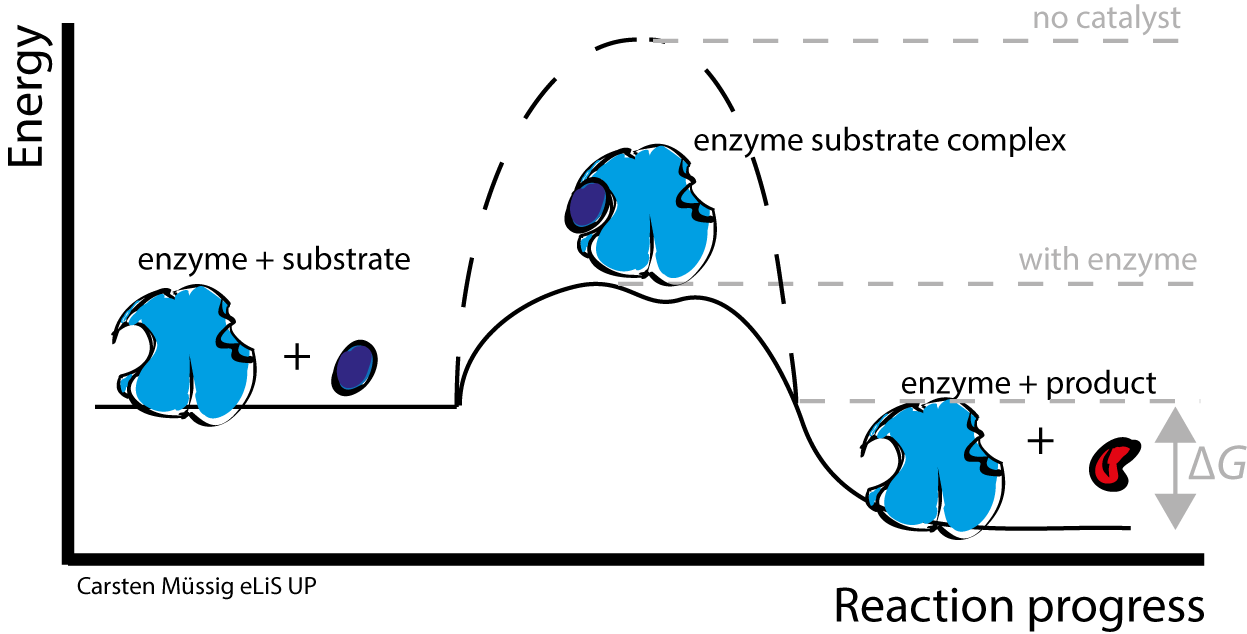
Question image
An enzyme speeds up a reaction by
1
lowering the activation energy.
2
raising the activation energy.
3
releasing energy.
4
absorbing energy.

18

Multiple Choice

Question image
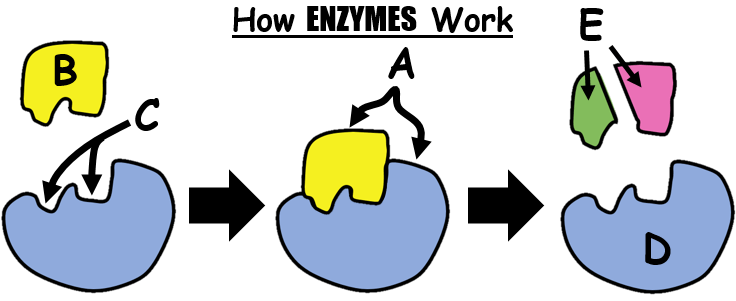
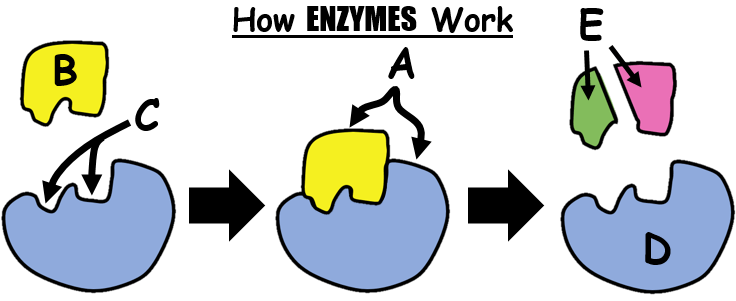
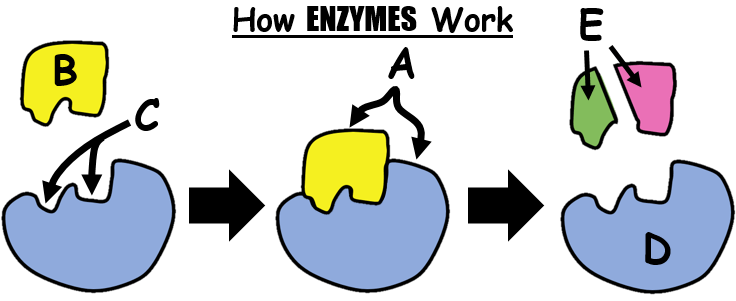
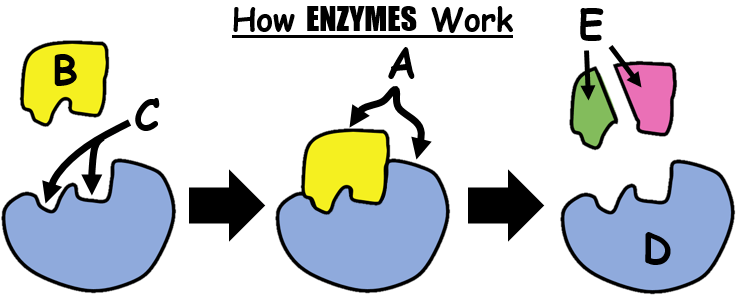
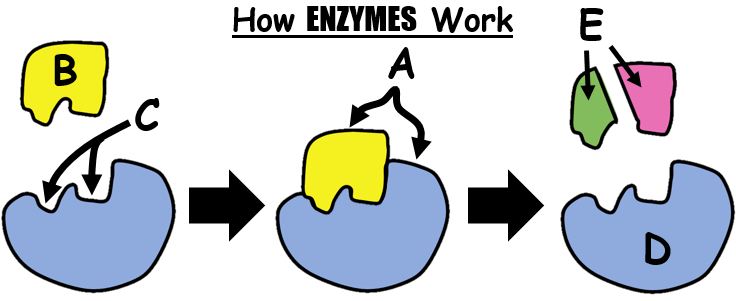
Letter E...
1
active site
2
enzyme
3
substrate
4
products

19

Multiple Choice

Question image
Letter C...
1
active site
2
enzymes
3
substrate
4
products

20

Multiple Choice

Question image
Letter B...
1
active site
2
enzyme
3
substrate
4
products

21

Multiple Choice

Question image
Letter D...
1
active site
2
enzyme
3
substrate
4
products

22

Multiple Choice

Question image
In the diagram, what is letter A? 
1
product
2
substrate
3
enzyme-substrate complex
4
active site

23

Multiple Choice

Each enzyme only has 1 substrate that will fit its active site.  What is this called?
1
reusable
2
catalyst
3
specific
4
fragile

24

Multiple Choice

What is a substance called if it speeds up a chemical reaction?
1
reusable
2
catalyst
3
specific
4
fragile

25

media

26

media

27

media

28

media

29

media

30

media

31

media

32

media

33

media

34

Multiple Choice

What happens when enzymes are heated to a high temperature?

1

The enzymes die.

2

The shape of the enzyme are changed and it denatures

3

The enzymes' amino acid sequence changes.

4

The enzymes remain the same

35

Multiple Choice

Question image
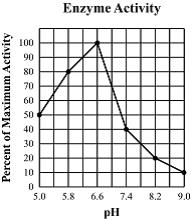
Which of the following conclusions can be drawn from this graph?
1
The optimum pH of the enzyme is 6.6.
2
The optimum pH of the enzyme is 5.8
3
The enzyme’s activity increases as pH increases 5.0 to 9.0
4
The enzyme’s activity is greater around pH of 8.0 .

36

Multiple Choice

Changes in pH and temperature can ___________________ an enzyme which causes it to lose its shape and affects its function.

1

puncture

2

denature

3

double

4

delete

37

Multiple Choice

Question image

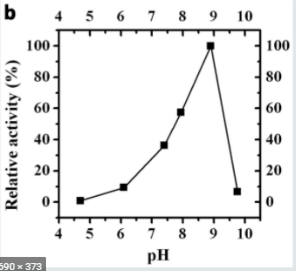
What is the optimal pH for this enzyme?

1

6

2

10

3

9

4

7

38

Multiple Choice

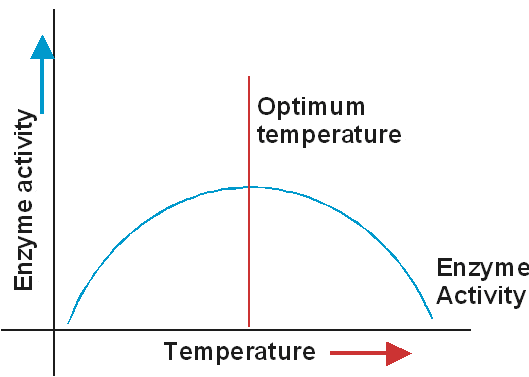
Question image

What is the optimal temperature of this enzyme?

1

60

2

40

3

70

4

30

39

Multiple Choice

What factors affect an enzyme's reaction rate?
1
temperature 
2
pH
3
substrate concentration
4
all of these

40

Multiple Choice

Question image
At high temperatures enzyme activity declines because of:
1
Denaturation
2
Decreased Kinetic Motion
3
Increased H-Bonding
4
Dissociation of Ionic Compounds

41

Multiple Choice

Which organ of the body has enzymes with very low optimun pH

1

Pancreas

2

Small intestine

3

Liver

4

Stomach

42

Multiple Choice

An enzyme and its substrate bind together because they have ...

1

the same shape

2

complementary shapes

3

opposite shapes

4

different shapes

43

Multiple Choice

Which enzyme breaks down protein?

1

Amylase

2

Catalase

3

Lipase

4

Protease

44

Multiple Choice

Which reaction is catalysed by lipase?

1

Lipids => Glycerol

2

Lipids => Amino Acids & Glycerol

3

Lipids => Fatty Acids

4

Lipids => Fatty Acids & Glycerol

45

Multiple Choice

Question image

The diagram shows an experiment. What is in the water after 15 minutes?

1

Amino Acids

2

Fatty Acids

3

Glucose

4

Glycerol

46

Multiple Choice

Question image

Which of these are digested by protease?

1

A

2

B

3

C

4

D

47

Multiple Choice

Which statement is correct?

1

Enzymes only breakdown large molecules into smaller molecules.

2

Enzymes increase the number of collisions between molecules.

3

Enzymes lower the activation energy needed to start a reaction.

4

Enzymes provide the activation energy needed to start a reaction.

48

media

49

media

50

media

51

media
media

Show answer

Auto Play

Slide 1 / 51

SLIDE