
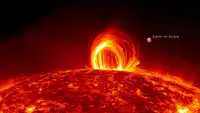
Sun spots and solar flares

Presentation
•
Science
•
6th - 12th Grade
•
Hard
+9
Standards-aligned

Ana Rosario
FREE Resource
14 Slides • 6 Questions
1
2
Engage and Explore
3
4

Describe the properties of the sun
Describe the major features of the Sun's surface, such as flares and sunspots
Learners can:
5
solar flare - A violent explosion on the Sun’s surface.
sun spot - Cool, dark area on the Sun’s surface that have lower temperatures than surrounding areas; sunspots usually occur in pairs and come and go on an 11-year cycle.
6

7

8


Cooler, darker areas on the surface of the Sun with intense magnetic activity
SunSpots
Found where loops of the Sun's magnetic field break through the surface and disrupt heat transfer within the sun
Usually occur in pairs
9
Open Ended
Why do you think sunspots occur in pairs?
10
Multiple Choice

11

11 YEAR CYCLE
12
Multiple Choice

Sunspots appear and disappear in a cycle that lasts approximately _____ years.
11
22
13

Violent explosions that release huge amounts of energy
This happens if a loop of the Sun's magnetic field snaps and breaks.
Strong solar flares can turn into coronal mass ejections (CME)
Releases streams of highly energetic particles that make up Solar Wind
Solar Wind can be dangerous due to the radiation that it releases.
Can knock out power grids, disturb radio, satellite, and cell phone towers.
Can also cause auroras over the poles.
Solar Flares

14
15
Multiple Choice

A strong solar flare can lead to ____
Coronal mass ejections
Space eruptions
16

◦Plasma that flows along a loop of the Sun's magnetic field from sunspot to sunspot
◦A glowing arch thousands of kilometers into the Sun's atmosphere.
◦Can last a day to several months
◦Visible during total solar eclipse
Solar Prominence
17
Multiple Choice

Plasma loops that connect two sunspots are called _____ .
Solar Prminences
Solar Wind
18
19
Multiple Choice
Why is it important to monitor the Sun's activity?
Both A and B
Neither A or B
20
These spots are cooler and darker than the rest of the Sun's surface and they are marked by intense magnetic activity.
Solar prominences are the plasma loops that connect two sunspots.
Solar flares and coronal mass ejections are eruptions of highly energetic particles that can erupt from the Sun's surface and cause problems with power grids and communications on Earth.
The Sun is an ordinary star. It supports nearly all life on Earth.
The Sun is at the center of the solar system.
The Sun makes up almost all of the mass of the solar system.
Sunspots occur in pairs because each is one side of a loop of the Sun's magnetic field that reaches the Sun's surface.
Show answer
Auto Play
Slide 1 / 20
SLIDE
Similar Resources on Wayground

17 questions
Water Cycle Lesson
Presentation
•
7th - 12th Grade
15 questions
Study Skills
Presentation
•
6th - 12th Grade
16 questions
The Verb Ir
Presentation
•
6th - 12th Grade
14 questions
Classifying Triangles
Presentation
•
10th Grade
20 questions
States of Matter Review
Presentation
•
3rd Grade
17 questions
Sentence Types - Complex and Compound-Complex
Presentation
•
6th - 12th Grade
17 questions
Crime Scene Basics
Presentation
•
6th - 12th Grade
14 questions
Ecosystem Goods & Services
Presentation
•
7th - 12th Grade
Popular Resources on Wayground
10 questions
How much do you know about our Portrait of an Eagle?

Quiz
•
10th Grade
10 questions
Fast Food Slogans
Quiz
•
6th - 8th Grade
21 questions
Continents and Oceans
Quiz
•
6th Grade
20 questions
Parts of Speech
Quiz
•
5th Grade
16 questions
Subject & Predicate
Quiz
•
5th Grade
25 questions
Multiplication Facts
Quiz
•
5th Grade
12 questions
Map Skills
Quiz
•
3rd Grade
22 questions
Continents and Oceans
Quiz
•
5th Grade
Discover more resources for Science
17 questions
7.6D Aqueous Solutions
Quiz
•
7th Grade
20 questions
Scientific Method and Variables
Quiz
•
8th Grade
20 questions
Scientific method and variables
Quiz
•
8th Grade
27 questions
Counting Atoms - Subscripts
Quiz
•
8th Grade
10 questions
6.6D - Relative Density Review
Quiz
•
6th Grade
20 questions
Claim, Evidence and Reasoning (CER)
Quiz
•
6th - 8th Grade
18 questions
Counting Atoms
Quiz
•
7th - 8th Grade
20 questions
Density
Quiz
•
6th Grade