
Lesson 13.1

Presentation
•
Science
•
9th Grade
•
Practice Problem
•
Easy
+9
Standards-aligned

Nicole Rolland
Used 1+ times
FREE Resource
7 Slides • 8 Questions
1

2
Open Ended
Why are we learning about cell structure...AGAIN?
3

4

5

6
Match
Match the following
ribosomes
plasma membrane
mitochondria
vacuoles
nucleolus
site of protein synthesis
regulates the materials that enter/exit
food--> usable energy fro the cell
structures that store food, water, waste
site of ribosome synthesis
site of protein synthesis
regulates the materials that enter/exit
food--> usable energy fro the cell
structures that store food, water, waste
site of ribosome synthesis
7
Open Ended
Regarding the plasma membrane, what areas of human anatomy and physiology do you think this would be important to understand?
8

9
Multiple Choice
If you were stranded on an island in the middle of the ocean, would it be a good idea to drink the seawater?
No, your cells would be saltier than the seawater, so water would leave the cells.
No, your cells would be less salty than the seawater, so water would leave the cells.
Yes, your cells would be less salty than the seawater, so water would move into your cells.
Yes, your cells would be saltier than the seawater, so water would move into the cells.
10

11
Multiple Select
Which of the following statements about the nucleus, DNA, and protein synthesis are true?
Genes are segments of DNA that carry instructions to make a protein.
The nucleus of a cell is responsible for packaging proteins made by the ribosomes.
Genes are located in the ribosomes in eukaryotic cells.
Ribosomes synthesize proteins using instructions that come from the DNA stored in the nucleus.
12
Labeling
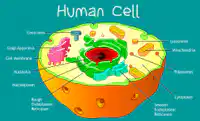
Label the indicated organelles
nucleus
plasma membrane
cytoplasm
13
Draw
Shade the following cell structures found on the microscopic image of human cells found below
Plasma membrane-Red
Nucleus- Green
Cytoplasm- Yellow
14
Multiple Choice
Certain traits, such as eye color, are the result of proteins produced by the body. Which of the structures listed below stores the instructions for making proteins?
DNA
smooth endoplasmic reticulum
mitochondria
vacuoles
15

Today, you learned:
the presence of a nucleus and other membrane-bound organelles defines a cell as eukaryotic;
the organelles perform specific tasks to support the cell;
water will move across the plasma membrane from a less salty environment to a saltier environment; and
DNA plays a role in producing physical traits.
Show answer
Auto Play
Slide 1 / 15
SLIDE
Similar Resources on Wayground

14 questions
The Sun
Presentation
•
8th - 9th Grade
10 questions
Limiting Factors
Presentation
•
8th Grade
12 questions
Nitrogen Cycle
Presentation
•
9th Grade
11 questions
Linear Equation in two variable
Presentation
•
9th Grade
11 questions
Teenager 5 Session 22: Pronunciation & Speaking
Presentation
•
KG
11 questions
Google Sheets Basics lesson
Presentation
•
9th Grade
11 questions
1.3 Day 1 Solving Eq. with Variable on both Sides
Presentation
•
9th Grade
10 questions
1.3 Biotic/Abiotic
Presentation
•
9th Grade
Popular Resources on Wayground
10 questions
How much do you know about our Portrait of an Eagle?

Quiz
•
10th Grade
10 questions
Fast Food Slogans
Quiz
•
6th - 8th Grade
21 questions
Continents and Oceans
Quiz
•
6th Grade
20 questions
Parts of Speech
Quiz
•
5th Grade
16 questions
Subject & Predicate
Quiz
•
5th Grade
25 questions
Multiplication Facts
Quiz
•
5th Grade
12 questions
Map Skills
Quiz
•
3rd Grade
22 questions
Continents and Oceans
Quiz
•
5th Grade
Discover more resources for Science
10 questions
Exploring Chemical and Physical Changes

Interactive video
•
6th - 10th Grade
20 questions
Atomic Structure
Quiz
•
9th Grade
10 questions
Decoding the Periodic Table of Elements
Interactive video
•
6th - 10th Grade
10 questions
Exploring the Periodic Table
Interactive video
•
6th - 10th Grade
22 questions
Periodic Table Review
Quiz
•
9th - 12th Grade
20 questions
Observation vs. Inference
Quiz
•
7th - 9th Grade
10 questions
Exploring the States of Matter
Interactive video
•
6th - 10th Grade
10 questions
Exploring Physical and Chemical Changes
Interactive video
•
6th - 10th Grade