

AS -Valdation

Presentation
•
Computers
•
12th Grade
•
Practice Problem
•
Hard

Sumeera Wajid
Used 1+ times
FREE Resource
19 Slides • 0 Questions
1

Verification
&
Validation
2

Objectives:
Types of Validation
How to calculate check digit
Visual check
Double Entry
Parity Check
Check Sum
Hash total
Control Total
3

STARTER
Why is there need for both
validation and verification?
4

Types of Validation
• Range Check
• Presence Check
• Format Check
• Data type check
• Length Check
• Lookup Check
• Consistency Check
• Check Digit
• Limit check
5

Validation Checks
6

Check digit Calculation:
9
7
8
1
1
0
7
5
7
7
2
4
?
*1
*3
*1
*3
*1
*3
*1
*3
*1
*3
*1
*3
4
Now Calculate:
ISBN 978-1-107-57724-4
9
21
8
3
1
0
7
15
7
21
2
12
Add all of them together
=106
106 mod 10= 6 (remainder)
=10-6 = 4
It is used on numerical data, which
is often stored as a string of
alphanumeric data-type. For
example, the last digit of an ISBN
for a book is a check digit
calculated using simple arithmetic.
7

VERIFICATION
Verification simply ensures that data has either been entered
accurately by a human or that it has been transferred
accurately from one storage medium to another. There are
several methods of verification, some related to manual entry
of data and some related to data transfer.
•
Visual checking: Visual checking is carried out by the
person who enters the data, who visually compares the
data they have entered with that on the source document.
They can see the differences and then correct the mistakes.
•
Double data entry: As the name suggests, involves the entry
of data twice. The first version is stored. The second entry
is compared to the first by a computer, and the person
entering the data is alerted by the computer to any
differences.
8

Parity Check
Most computers use ASCII codes to represent text, which makes
it possible to transfer data from one computer to another. It is a
code which uses numbers to represent 96 English-language
characters, with each character being given a number between
32 and 127.
A way to check that data has been transmitted accurately is
called parity checking. The parity bit is added to every byte
(8bits) that is transmitted.
•
Even Parity:
When data is being transmitted from one device
to another, the sending device counts the number of 1s in
each byte. If the number of 1s is even, it sets the parity bit to 0
and adds this on to the end of the byte.
•
Odd Parity:
if the number of 1s is odd, it sets the parity bit to 1
and adds it on. The result is that every byte of transmitted
data consists of an even number of 1s. When the other device
receives the data, it checks each byte to make sure that it has
an even number of 1s. If there is an odd number of 1s, then
this means there has been an error during the transfer of data.
9

Even Parity – example
Consider the example given above: the word BROWN
• B – 01000010 there are two 1s (even) so we add 0; it now
becomes 010000100 (two 1s [even])
• R – 01010010 there are three 1s (odd) so we add 1; it now
becomes 010100101 (four 1s [even])
• O – 01001111 there are five 1s (odd) so we add 1; it now
becomes 010011111 (six 1s [even])
• W – 01010111 there are five 1s (odd) so we add 1; it now
becomes 010101111 (six 1s [even])
• N – 01001110 there are four 1s (even) so we add 0; it now
becomes 010011100 (four 1s [even])
This is a very effective verification method. It makes sure that all bytes
have an even number of 1s. If a 1 within the byte is transmitted as a 0,
then the error will be trapped by the system
10

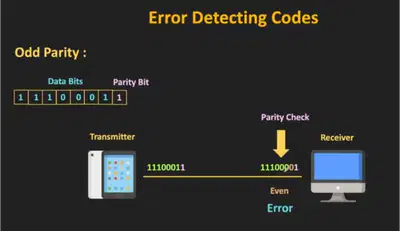
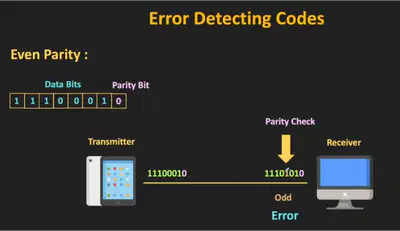
Even/ODD Parity
11

Check Sum
Checksums are a follow-on from the use of parity checks in that they are used to check that
data has been transmitted accurately from one device to another. A checksum is used for whole
files of data, as opposed to a parity check which is performed byte by byte.
A checksum can be calculated in many ways, using different Algorithms e.g. MD5 and SHA-1
The actual checksum is produced in hexadecimal format. This is a counting system that is based
on the number 16, whereas we typically count numbers based on 10.
MD5 checksums consist of 32 hexadecimal characters, such as 591a23eacc5d55a528e22ec7b99705cc.
These are added to the end of the file. After the file is transmitted, the checksum is recalculated by the
receiving device and compared with the original checksum. If the checksum is different, then the file has
probably been corrupted during transmission and must be sent again.
12

Hash Total
This is like the previous two methods in that a calculation is performed
using the data before it is sent, then it is recalculated, and if the data has
transmitted successfully with no errors, the result of the calculation will be the
same. This type of check is normally performed on large files but, for
demonstration Purposes. For example, Sometimes, school examinations
secretaries are asked to do a statistical analysis of exam results. Here we have a
small extract from the data that might have been collected.
The hash check involves adding all the Student IDs together. In
this example it would perform the calculation
4762 + 153 + 2539 + 4651 giving us a hash total of 12105.
The data would be transmitted along with the hash total and then
the hash total would be recalculated and compared with the original
to make sure it was the same and that the data had been
transmitted correctly.
13

Control Total
A control total is calculated in exactly the same way as a hash total, but is only
carried out on numeric fields. There is no need to convert alphanumeric data to
numeric. The value produced is a meaningful one which has a use For example,
If the head teacher to know what is the average pass rate in each year.
In this example, we can see that it would be useful for the
head teacher to know what the average pass rate was each
year. The control total can be used to calculate this average
by dividing it by the number of students. The calculation is
6 + 8 + 7 + 3 giving us a control total of 24.
If that is divided by 4, the number of students, we will find
that the average number of passes per student is6.
The control total is added to the file, the file is transmitted, and the
control total is recalculated, if the values are different, it is an
indication that the data has not been transmitted or entered correctly.
14

TIP
If two numbers were transposed, say student
4762 was entered as having 8 passes and
0153 with 6 passes, this would obviously be
an error but would not be picked up by
either a control or hash total check.
Shortcomings of Hash and Control total
15


Plenary
16


Class-Task
17

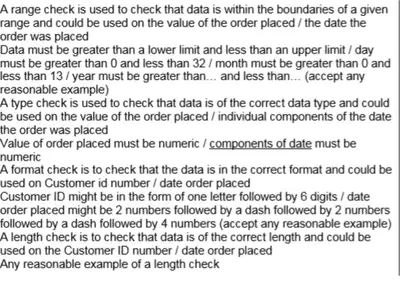
Task
Answer
18

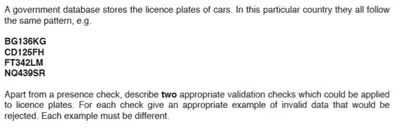
EX-Task
19


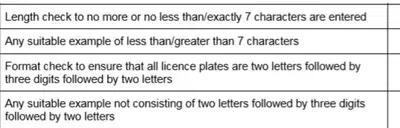
Task
Answer
Verification
&
Validation
Show answer
Auto Play
Slide 1 / 19
SLIDE
Similar Resources on Wayground

14 questions
ANALISIS DATA
Presentation
•
12th Grade
15 questions
Y1 ICT Topic: Inserting Online Pictures in the Spreadsheet
Presentation
•
KG
15 questions
Misplaced Modifiers
Presentation
•
12th Grade
12 questions
Prepositions
Presentation
•
3rd Grade
11 questions
Robotics
Presentation
•
University
15 questions
CHAT BOT
Presentation
•
12th Grade
15 questions
Personal & Public Communication Revision
Presentation
•
12th Grade
14 questions
Subscriber Internet
Presentation
•
12th Grade
Popular Resources on Wayground
10 questions
Safety Day 2026 – Student Review

Quiz
•
9th Grade
21 questions
Continents and Oceans
Quiz
•
6th Grade
20 questions
Parts of Speech
Quiz
•
5th Grade
16 questions
Subject & Predicate
Quiz
•
5th Grade
25 questions
Multiplication Facts
Quiz
•
5th Grade
12 questions
Map Skills
Quiz
•
3rd Grade
22 questions
Continents and Oceans
Quiz
•
5th Grade
15 questions
Rounding Decimals
Quiz
•
5th Grade