
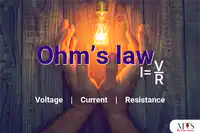
APPLYING OHM'S LAW

Presentation
•
Physics
•
10th Grade
•
Practice Problem
•
Hard

Jocelyn Q. Tejoso
Used 2+ times
FREE Resource
24 Slides • 0 Questions
1

TYPES OF ELECTRIC CIRCUITS
APPLYING OHM’S LAW
2

ELECTRICITY
is the set of physical
phenomena associated
with the presence and
motion of matter that
has a property of
electric charge.
It was discovered about
600 BC, THALES, a
Greek philosopher and
scientist.
Came from the Greek
word “Electron”
meaning “AMBER”
is the flow of electrical
power or charge.
Charges are:
• Positive (proton)
• Negative (electron)
• Neutral (neutron)
3

OHM’S LAW
•
The current flowing
through a circuit is directly proportional to the
potential difference and inversely proportional to the resistance of the
circuit. The first part of the law may be represented as
I
(current)
∝
V
(potential difference). The second part may be expressed as
I
∝
1/R.
Algebraically, Ohm’s law is
I = V/R
•
Where
I
, the rate of flow of electric charge referred to as
current
, is
measured in amperes (A).The
ammeter
is the instrument used to measure
current. The potential difference
V
is in
volts
(V) and the instrument that
directly measures this is the
voltmeter
. R, the
resistance
to the flow of
electrons by the conductor, is given in ohms (Ω). one way of directly
measuring electrical resistance is using
ohmmeter
.
4

RESISTANCE
•
Resistance
is a measure of the opposition to
current flow in an electrical circuit.
•
Resistance is measured in ohms, symbolized
by the Greek letter omega (Ω). Ohms are
named after
Georg Simon Ohm
(1784
-
1854), a
German physicist who studied the relationship
between voltage, current and resistance. He is
credited for formulating Ohm's Law.
5

VOLTAGE
is
the
pressure from
an
electrical
circuit's
power source
that
pushes
charged
electrons
(current)
through
a
conducting
loop,
enabling
them
todo
work such as
illuminating a
light.
The
man
to
first
discover
voltage
was
Italian
Physicist
Alessandro
Volta
was
also
credited
with
creating
the
first
electric
battery,
called
the
Voltaic
Pile,
which allowed
scientists
of
the
time
to
create
a
steady flow of
electrons.
In
the
Philippines the
supply
voltage
is 220V. If the
appliance is a
single voltage
rated
appliance,
it
will
need
to
operate at the
same voltage
as the supply
voltage of the
country
i.e.
220V.
6

CURRENT
➢
Rate of flow of charge
➢
Amount of charge per unit time that crosses one
point
➢The ampere is named for French physicist and
mathematician André-Marie Ampère (1775–1836),
who studied electromagnetism and laid the
foundation of electrodynamics. In recognition of
Ampère's contributions to the creation of modern
electrical science, an international convention,
signed at the 1881 International Exposition of
Electricity, established the ampere as a standard
unit of electrical measurement for electric current.
7

PROBLEM SOLVING
•
What is the potential difference in an electric circuit with a current of 58 amperes
and a resistance of 9.0 ohms?
• Find the current I through a resistor of resistance R = 22 Ω if the voltage across the
resistor is 180 V.
• How much current would flow through a circuit that has 1000 Ohms of resistance
if powered by 1.5 volts?
• What is the amount of current flows in a 220 V wire with a resistance of 60 ohms?
8

ELECTRIC CIRCUIT
is an interconnection of electrical
components or a model of such
an interconnection, consisting of
electrical elements. An electrical
circuit is a network consisting of a
closed loop, giving a return path
for the current.
includes a device that gives
energy to the charged particles
constituting the current, such as a
battery or a generator; devices
that use current, such as lamps,
electric motors, or computers; and
the connecting wires or
transmission lines.
9

5 MAIN TYPES OF ELECTRIC CIRCUIT
• Closed circuits
• Open circuits
• Short circuits
• Series circuits
• Parallel circuits
10

CLOSED CIRCUIT & OPEN CIRCUIT
• An open circuit is one where the
continuity has been broken by an
interruption in the path for current to
flow.
• A closed circuit is one that is
complete, with good continuity
throughout.
• A device designed to open or close a
circuit under controlled conditions is
called a switch.
11

SHORT CIRCUIT
• is an electrical circuit that allows a
current to travel along an unintended
path with no or very low electrical
impedance.
• This results in an excessive current
flowing through the circuit.
• The opposite of a short circuit is an
"open circuit", which is an infinite
resistance between two nodes.
12

SERIES AND
PARALLEL CIRCUIT
• In a series circuit, the same
amount of current flows
through all the components
placed in it.
• Parallel circuits, the
components are placed in
parallel with each other due
to which the circuit splits the
current flow.
13

RULES FOR RESISTANCE IN SERIES ARE AS
FOLLOWS:
14

GIVEN:
R
1 = 20
R4 = 75
R2 =10
R 5 = 55
R3 = 5
VT= 220
•
Example: Let us assume that you have five
appliances connected in series as in the figure.
The refrigerator has a resistance of 20 Ω; the
TV set, 10 Ω; the radio, 5 Ω; the flat iron, 75 Ω;
and the electric stove, 55 Ω. If the circuit is
connected to a direct current of 220 volts,
what is
•
a. the total resistance in the circuit?
•
b. the total current?
•
c. the voltage across each appliance?
15

16

1. For the following circuit:
Find the total resistance
Find the current i
Find the voltage accross the 10Ω
resistor
A refrigerator, TV set, radio, flat iron, and electric stove have a
resistance of 25 Ω, 15 Ω, 50 Ω, 70 Ω, 50 Ω, respectively. If it is
connected in series circuit and the
circuit is connected to a direct current of 220 volts, what is the:
A.Total resistance in the circuit?
B. Voltage drop in each appliance?
C.Current used by each appliance, in respective order?
D.Total current?
17

RULES FOR RESISTANCE IN PARALLEL ARE AS
FOLLOWS:
18

•
In
the
figure,
the
refrigerator,
TV
set,
radio,
flat
iron,
and
electric
stove
have
a
resistance
of
20
Ω,
10
Ω,
5
Ω,
75
Ω,
55
Ω,
respectively
.
If
the
circuit
is
connected
to
a
direct
current
of
220
volts,
what
is
the
•
a
.
total
resistance
in
the
circuit?
•
b
.
voltage
drop
in
each
appliance?
•
c
.
current
used
by
each
appliance?
•
d
.
total
current?
19

20

•
A refrigerator, TV set, radio, flat iron, and electric stove
have a resistance of 2
Ω
, 10
Ω
, 15
Ω
, 25
Ω
, 5
Ω
,
respectively. If it is connected in
parallel
circuit and the
circuit is connected to a direct current of 220 volts, what is
the:
A.
Total resistance in the circuit?
B.
Voltage drop in each appliance?
C.
Current used by each appliance, in respective order?
D.
Total current?
21

• For one, the total resistance
of a Parallel Circuit is NOT
equal to the sum of the
resistors (like in a series
circuit). The total resistance
in a parallel circuit is always
less than any of the branch
resistances. Adding more
parallel resistances to the
paths causes the total
resistance in the circuit to
decrease.
22

A.
Total resistance in the circuit?
B.
Voltage drop in each
appliance?
C.
Current used by each
appliance, in respective
order?
D.
Total current?
23

ACTIVITY
•
1. What is the voltage if a resistance of 25 Ω produces a current of 250 amperes?
•
2. What is the current produced by a voltage of 240 V through a resistance of 0.2
Ω?
•
3. What voltage is necessary to produce a current of 200 amperes through a
resistance of 100 Ω?
•
4. What resistance would produce a current of 120 amps from a 6
-
V battery?
•
5. What is the current produced by a 9
-
V battery flowing through a resistance of
200 Ω?
24

TYPES OF ELECTRIC CIRCUITS
APPLYING OHM’S LAW
Show answer
Auto Play
Slide 1 / 24
SLIDE
Similar Resources on Wayground

18 questions
La Ropa
Presentation
•
10th Grade
19 questions
Calculating Speed, Acceleration and Force Review
Presentation
•
9th - 10th Grade
18 questions
Free Body Diagrams
Presentation
•
9th Grade
19 questions
INDUS RIVER VALLEY CIVILIZATION
Presentation
•
10th Grade
19 questions
CORRELATIVE CONJUNCTION
Presentation
•
10th Grade
19 questions
Le futur simple - intro
Presentation
•
10th Grade
21 questions
Hakikat Fisika Bagian 3
Presentation
•
10th Grade
18 questions
Now and the future
Presentation
•
10th Grade
Popular Resources on Wayground
10 questions
Safety Day 2026 – Student Review

Quiz
•
9th Grade
21 questions
Continents and Oceans
Quiz
•
6th Grade
20 questions
Parts of Speech
Quiz
•
5th Grade
16 questions
Subject & Predicate
Quiz
•
5th Grade
25 questions
Multiplication Facts
Quiz
•
5th Grade
12 questions
Map Skills
Quiz
•
3rd Grade
22 questions
Continents and Oceans
Quiz
•
5th Grade
15 questions
Rounding Decimals
Quiz
•
5th Grade
