

Resistance in Series and Parallel

Presentation
•
Physics
•
11th - 12th Grade
•
Medium

T Southerden
Used 3+ times
FREE Resource
24 Slides • 12 Questions
1


Core B1.47
Calculating Resistance
Starter questions
1
State Ohms Law
2
What is the unit of resistance
3
Calculate 1/10 + 1/15 + 1/5
4
What is the mean average of this set of data: 2,1,3,3,2,2,2,1
5
What is the mode average of the data above?
KO 1
Prerequisite
knowledge
Memory in
science
2

Starter questions
1
V=IR
2
Ohms
3
0.36….
4
2.2 (2.18)
5
2
Prerequisite
knowledge
Memory in
science
Green pen your answers
3


Resistors in Series
In this presentation you will:
■ determine current, voltage and resistance for circuits with series
connected resistors
Next >
R1
R2
R3
V2
V3
V1
V
I
4



Introduction
Next >
In a series circuit, the
same current from the
battery flows through
each resistor.
Resistors are often
connected together in
series. It is possible to
predict these things:
■ voltage across resistors
■ total current flowing
■ total resistance of the circuit
V
R1
1 kΩ
R2
1 kΩ
I
5


Next >
Resistance of Resistors in Series
RT = R1 + R2 + R3
To calculate the total
resistance of resistors
connected in series, add
their values.
I
R1
R2
R3
6


I
Next >
Resistance of Resistors in Series
RT = R1 + R2 + R3
Here is an example
calculation of resistors
connected in series:
RT = 25 Ω + 75 Ω + 100 Ω
RT = 200 Ω
R1
25 Ω
R2
75 Ω
R3
100 Ω
7


Question 1
Next >
A) 15 kΩ
B) 22 kΩ
C) 47 kΩ
D) 69 kΩ
What single resistor could replace these two resistors connected in series?
22 kΩ
I
47 kΩ
8


What single resistor could replace these two resistors connected in series?
Question 1
Next >
RT = 69 kΩ
RT= R1+ R2
RT= 22 kΩ+ 47 kΩ
A) 15 kΩ
B) 22 kΩ
C) 47 kΩ
D) 69 kΩ
22 kΩ
I
47 kΩ
9


Core B1.47
Calculating Resistance
10


Core B1.47
Calculating Resistance
11
Multiple Choice

The circuit shown contains a battery, a 6.0 Ω resistor and two meters X and Y.
One meter records current and one meter records potential difference.
meter X : 2.0 A
meter Y : 12.0 V
meter X : 2.0 V
meter Y : 1.0 A
meter X : 12.0 A
meter Y : 2.0 V
meter X : 12.0 V
meter Y : 2.0 A
12
Multiple Choice
Which equation can be used to calculate the resistance R of a resistor?
V = I / R
I = V x R
R = V x I
V = I x R
13
Multiple Choice
A student uses a length of wire as a resistor. He makes a second resistor from the same material.
To be certain of making a second resistor of higher resistance, he should use a piece of wire that is:
longer and thicker.
longer and thinner.
shorter and thicker.
shorter and thinner.
14
Multiple Choice
How to you calculate the total resistance in a series circuit?
R1 + R2+ R3
R1 - R2 - R3
1/R1 + 1/R2 + 1/R3
R1 = R2 = R3
15
Multiple Choice
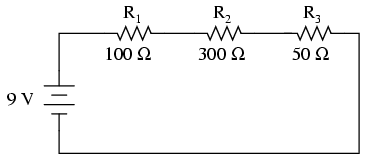
The total resistance in this circuit is
100 ohms
450 ohms
400 ohms
30 ohms
16
Multiple Choice
Calculate the effective resistance of three resistors in series if they have the following values: 1.2 kΩ, 5.6 kΩ and 7.1 kΩ.
6800 Ω
12700 Ω
13900 Ω
17


Next >
Three resistors are
connected in series
with a battery.
The supply voltage is
given by this equation:
In a series circuit, the
same current (I ) flows
through all components.
V = V1 + V2 + V3
V1 = I×R1
V2 = I×R2
V3 = I×R3
Voltage in a Series Circuit
I =V
RT
R1
R2
R3
V2
V3
V1
V
I
18


V2
V3
V1
V
Next >
Total resistance:
Voltage in a Series Circuit
RT = 200 Ω
I =V
RT
I =
10 V
200 Ω
I = 50 mA
R1
25 Ω
10 V
R2
75 Ω
R3
100 Ω
50 mA
Current:
Using equations,
calculate total resistance,
current and voltages.
RT = R1 + R2 + R3
19


Next >
V1 = I× R1
Voltage in a Series Circuit
I = 50 mA
V1 = 50 mA× 25 Ω
V1 = 1.25 V
V2 = I×R2
V2 = 50 mA× 75 Ω
V2 = 3.75 V
V3 = I× R3
V3 = 50 mA× 100 Ω
V3 = 5 V
RT = 200 Ω
Use the total resistance
and current to
calculate voltages.
R1
25 Ω
V
R2
75 Ω
R3
100 Ω
V2
V3
V1
50 mA
10 V
20


R1
25 Ω
V
R2
75 Ω
R3
100 Ω
Next >
Summary of values:
V = V1 + V2 + V3
Voltage in a Series Circuit
V1 = 1.25 V
V2 = 3.75 V
V3 = 5 V
I = 50 mA
RT = 200 Ω
V = 1.25 V + 3.75 V + 5 V
V = 10 V
Confirmation of total voltage:
V2
V3
V1
50 mA
10 V
21


Next >
What is the voltage across the 40 Ω resistor in this circuit?
Question 2
A)
4 V
B)
8 V
C) 12 V
D)
24 V
R1
20 Ω
V2
V3
V1
V
I
24 V
R2
40 Ω
R3
60 Ω
22


Next >
Question 2
RT= 20 Ω+ 40 Ω + 60 Ω
RT= 120 Ω
I =
24 V
120 Ω
I = 200 mA
V2 = I× R2
V2 = 200 mA× 40 Ω
V2 = 8 V
What is the voltage across the 40 Ω resistor in this circuit?
A)
4 V
B)
8 V
C) 12 V
D)
24 V
R1
20 Ω
V2
V3
V1
V
I
24 V
R2
40 Ω
R3
60 Ω
23
Multiple Choice

If V1 = 12V, V2 = 6V and V3 = 3V, what is V4?
4
3
12
6
24
Multiple Choice

If V1 = 9V and the resistance of each bulb is the same, what is V2, V3 and V4?
12
48
3
27
25
Multiple Choice

What is the missing voltage?
3
13
36
5
26


Next >
Equal value resistors
connected in series share
the supply voltage equally.
The voltage across each resistor
(VR) is given by the following
equation:
VR =
V
Number of resistors
Equal Value Resistors in Series
R1
V
R2
R3
27


R1
1.5 V
R2
R3
In this circuit the battery
has a voltage of 1.5 V.
Here is how to work out
the voltage across
each resistor.
The voltage across each resistor is 0.5 V.
Next >
VR =
V
Number of resistors
VR =
1.5 V
3
VR = 0.5 V
VR = VR1 = VR2=VR3
Equal Value Resistors in Series
0.5 V V
0.5 V V
0.5 V V
28


What is the voltage across each resistor in the circuit?
A)
R1 = 30 V, R2 = 15 V
B)
R1 = 15 V, R2 = 30 V
C)
R1 = 15 V, R2 = 15 V
D)
R1 = 30 V, R2 = 30 V
Question 3
Next >
R1
47 kΩ
R2
47 kΩ
30 V
29


Question 3
Next >
For equal value resistors, the supply voltage is shared equally.
What is the voltage across each resistor in the circuit?
R1
47 kΩ
R2
47 kΩ
30 V
A)
R1 = 30 V, R2 = 15 V
B)
R1 = 15 V, R2 = 30 V
C)
R1 = 15 V, R2 = 15 V
D)
R1 = 30 V, R2 = 30 V
30


Core B1.47
Calculating Resistance
31


Core B1.47
Calculating Resistance
32
33
Multiple Choice

How would the equivalent resistance be determined?
1 / Req = (1/5) + (1/8) + (1/3) Ω
120 Ω
1.5189873 Ω
1 / Req = (1/5) * (1/8) * (1/3) Ω
34
Multiple Choice
A 9.0 Ω resistor and another 9.0 Ω resistor are connected in parallel. What is their combined resistance?
0.5 Ω
2.0 Ω
4.5 Ω
9.0 Ω
35
Multiple Choice
Which one of the following resistors connected in parallel with a 24 Ω would give a total resistance of 8 Ω
16 Ω
12 Ω
8 Ω
6 Ω
36



You have 20 minutes to complete SLOP
1.
No questions for the first 5 minutes
2.
Golden silence 10 minutes
3.
Answer all teacher feedback with a green pen
4.
KO 1
Core B1.47
Calculating Resistance
Core B1.47
Calculating Resistance
Starter questions
1
State Ohms Law
2
What is the unit of resistance
3
Calculate 1/10 + 1/15 + 1/5
4
What is the mean average of this set of data: 2,1,3,3,2,2,2,1
5
What is the mode average of the data above?
KO 1
Prerequisite
knowledge
Memory in
science
Show answer
Auto Play
Slide 1 / 36
SLIDE
Similar Resources on Wayground

29 questions
Spojování rezistorů
Presentation
•
12th Grade
28 questions
Average Velocity
Presentation
•
11th Grade - University
30 questions
Properties of Waves Calculation
Presentation
•
12th Grade
30 questions
Second Law Calculation Lesson
Presentation
•
10th - 12th Grade
26 questions
RELATIVITAS
Presentation
•
12th Grade
30 questions
Constitution Review
Presentation
•
11th - 12th Grade
25 questions
Producing Electric Current (Phys. Sci. 7.3)
Presentation
•
11th - 12th Grade
30 questions
Wave properties
Presentation
•
12th Grade
Popular Resources on Wayground
10 questions
How much do you know about our Portrait of an Eagle?

Quiz
•
10th Grade
10 questions
Fast Food Slogans
Quiz
•
6th - 8th Grade
21 questions
Continents and Oceans
Quiz
•
6th Grade
20 questions
Parts of Speech
Quiz
•
5th Grade
16 questions
Subject & Predicate
Quiz
•
5th Grade
25 questions
Multiplication Facts
Quiz
•
5th Grade
12 questions
Map Skills
Quiz
•
3rd Grade
22 questions
Continents and Oceans
Quiz
•
5th Grade
Discover more resources for Physics
18 questions
Interpreting Motion Graphs
Presentation
•
9th - 12th Grade
20 questions
Unit 2 - Waves Test - 2026
Quiz
•
9th - 12th Grade
21 questions
Newton's Laws of Motion and Forces
Quiz
•
11th - 12th Grade
17 questions
Newton's 2nd Law
Presentation
•
8th - 12th Grade
10 questions
Significant Figures
Quiz
•
10th - 12th Grade