

Oct 7 Lesson Authors Purpose

Presentation
•
English
•
4th Grade
•
Practice Problem
•
Hard
+16
Standards-aligned

Nicolas Garcia
Used 20+ times
FREE Resource
10 Slides • 8 Questions
1

1
Oct 7 Lesson
Author’s Purpose and Author's Message.
Ⓡ ELA 4.10A explain the author’s purpose and message within a text
Ⓡ ELA 4.7C use text evidence to support an appropriate response
Unit 2: Contemporary Fiction
2
Multiple Choice
While the berries boiled, Mother spun threads made from milkweed stems. Then she twisted the threads together to make wicks for the candles
Read the dictionary entry for the word spun.
spun /spun/ verb
1. to make using thread that comes from an insect’s body
2. to cause to turn quickly on an axis
3. to form or develop from the imagination
4. to draw out, twist, and wind
Which definition most closely fits the way the word spun is used in the text?
definition 1
definition 2
definition 3
definition 4
3
Multiple Choice
Mother boiled the bayberries in water. Their waxy coating floated to the surface. Mother skimmed it off and put the
wax in a “starter pot.” Every day more wax was added to the starter pot.
Read the dictionary entry for the word skim.
skim /skim/ verb
1. to remove from the surface of a liquid
2. to fly or glide over
3. to glance through in a hurry
4. to throw so that a liquid surface is only touched in a brief way
Which definition most closely fits the way the word skimmed is used in the text?
definition 1
definition 2
definition 3
definition 4
4

3
LO: SWBAT explain the author’s purpose within a text using text evidence.
DOL: Given a fiction text, students will correctly
explain the author’s purpose and message within a
text using text evidence in at least 4 of 5 questions.
Ⓡ ELA 4.10A explain the author’s purpose and message within a text
Ⓡ ELA 4.7C use text evidence to support an appropriate response
Unit 2: Contemporary Fiction
5

4
Academic Vocabulary
text evidence
(noun)
paraphrased or directly
quoted information from
a source that supports
understanding
author's purpose
(noun)
the reason an author
writes about a particular
topic
6

6
Excerpt 1:
Cafe Con
Leche
Excerpt 2:
Cangrejitos de
guayaba y
queso
Excerpt 3:
Synchronized
Eating
Excerpt 4:
Congri
Excerpt 5:
Mariquitas
Excerpt 6 :
Ropa vieja,
parte 1
Excerpt 7 :
Ropa vieja,
parte 2
Excerpt 8:
Ropa vieja,
parte 3
Excerpt 9:
Misunderstandings
Knowledge Objective:
SWBAT analyze narrative
literature by focusing on literary
elements such as detailed
descriptions, theme development,
and contrasting perceptions.
Excerpt 10:
Asking for
Help, Part 1
Excerpt 11:
Asking for
Help, Part 2
Excerpt 12:
Flan
7

7
Author’s Purpose
Refers to the
main goal in a
piece of writing
-
to Persuade
-
to Inform
-
to Entertain
-
to share an
experience
8

8
Why is it important for
readers to understand the
author’s purpose?
It is important for readers
to understand the
author’s purpose
because…
9
Multiple Choice
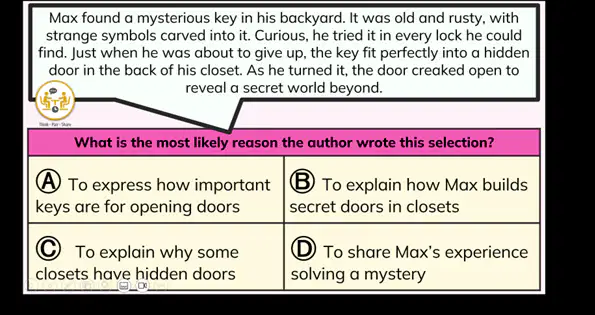
What is the most likely reason the author wrote this selection?
In other words, what is the author's purpose?
Ⓐ To express how important keys are for opening doors
Ⓑ To explain how Max builds secret doors in closets
Ⓒ To explain why some closets have hidden doors
Ⓓ To share Max’s experience solving a mystery
10
Multiple Choice
Marly was a little angry with her friend Susy. Every time Marly would get a new shirt, notebook, bag or anything Susy would go and get the same thing. This really bothered Marly. One day Marly decided that she was going to talk about Susy to another friend just because she was just fed up with her. Susy found out that Marly was talking about her and their friendship got worse.
What is the most likely reason the author wrote this selection.
A. To share with the reader what goes on at school.
B. To explain to the reader what Marly's school day is like.
C. To share with the reader how Marly feels towards Susy.
D. To persuade the reader not to talk about people behind their backs.
11
Multiple Choice
(4) Noah put the little creatures in a small fish tank in his backyard. (5) The tank was filled with water that he had lugged up from the creek to make sure that the tadpoles felt at home. (6) Noah’s new little pets seemed to be on this first day mostly eyes and tails. (7) Their big heads bobbled in a funny way as they swam.
What is the most likely reason the author wrote this selection?
12
Multiple Choice
(8) The bluebonnet is a wildflower with bright blue petals. (9) Its color is somewhere between navy and royal blue. (10) When bluebonnets are grouped together, their blue coloring appears especially brilliant and bright.
What is the most likely reason the author wrote this text?
A. To share the climate that bluebonnets grow in.
B. To explain what the bluebonnet looks like and how they look grouped together.
C. To describe what navy and royal blue looks like.
D. To explain the life cycle of the bluebonnet.
13
Multiple Choice
What is author's purpose?
The reason you should read.
The reason an author writes about a particular topic.
The reason an author writes the summary of a story.
The reason we explore and express our ideas.
14
Multiple Choice
Text evidence is important because it -
supports the reason an author wrote a text.
helps you understand the text better.
supports your ideas and answers.
15
Turn and Talk
Why is text evidence important?
Text evidence is important because it ...
16

13
aroma
(noun)
an often pleasant smell
that one notices
flan
(noun)
a sweet dessert
made out of custard
with caramel glaze
drenched
(verb)
filled or covered by liquid
Content Vocabulary
17
HOMEWORK
You have vocabulary homework starting this week.
18

14
Letters From
Heaven
Excerpt 12:
Flan
Independent work worksheet
1
Oct 7 Lesson
Author’s Purpose and Author's Message.
Ⓡ ELA 4.10A explain the author’s purpose and message within a text
Ⓡ ELA 4.7C use text evidence to support an appropriate response
Unit 2: Contemporary Fiction
Show answer
Auto Play
Slide 1 / 18
SLIDE
Similar Resources on Wayground

12 questions
Cause and Effect
Presentation
•
4th Grade
12 questions
Prepositions
Presentation
•
3rd Grade
14 questions
IDIOMS
Presentation
•
4th Grade
13 questions
Personification
Presentation
•
4th Grade
12 questions
Modal Auxiliaries
Presentation
•
4th Grade
14 questions
Main Verbs and Helping Verbs
Presentation
•
4th Grade
12 questions
Root/Base Words
Presentation
•
4th Grade
14 questions
Characterization
Presentation
•
4th Grade
Popular Resources on Wayground
10 questions
How much do you know about our Portrait of an Eagle?

Quiz
•
10th Grade
10 questions
Fast Food Slogans
Quiz
•
6th - 8th Grade
21 questions
Continents and Oceans
Quiz
•
6th Grade
20 questions
Parts of Speech
Quiz
•
5th Grade
16 questions
Subject & Predicate
Quiz
•
5th Grade
25 questions
Multiplication Facts
Quiz
•
5th Grade
12 questions
Map Skills
Quiz
•
3rd Grade
22 questions
Continents and Oceans
Quiz
•
5th Grade
Discover more resources for English
20 questions
Inferences
Quiz
•
4th Grade
20 questions
Figurative Language Review
Quiz
•
4th Grade
15 questions
Subject/Verb agreement
Quiz
•
4th Grade
15 questions
Singular and Plural Nouns
Quiz
•
4th Grade
20 questions
4 Types of Sentences
Quiz
•
4th - 5th Grade
11 questions
Theme
Quiz
•
4th Grade
15 questions
Character Traits
Quiz
•
4th Grade
20 questions
Prepositions and prepositional phrases
Quiz
•
4th Grade