

3.5 The Factions Make Their Case

Presentation
•
Social Studies
•
12th Grade
•
Practice Problem
•
Medium

Amy Schneider
Used 3+ times
FREE Resource
15 Slides • 8 Questions
1

The
Factions
Make
Their Case
Unit 3-6
2
Multiple Choice

Which parts of the Constitution represent the concept of separation of powers?
Article V, which establishes the procedures for amending the Constitution
Article IV, which establishes the relationship with the states, and Article VI, which establishes the Constitution as the supreme law of the land
the Preamble and Article VII, which established ratification procedures
Articles I, II, and III, which establish the legislative, executive, and judicial branches
3


Lesson Overview
• Students Will Be Able To:
• Identify the reasons the Bill of Rights was
added to the Constitution.
• Analyze primary sources for the authors'
message.
• Evaluate the Constitution ratification process from the viewpoint of a Federalist or Anti-Federalist
• Vocabulary:
• Federalist Paper Number Ten (Federalist No. 10)
• Massachusetts Compromise


4

Essential Question- How
did factions debate the
ratification of the
Constitution?
5


A little review, and a little introduction to what we're talking about today....
6
Multiple Choice
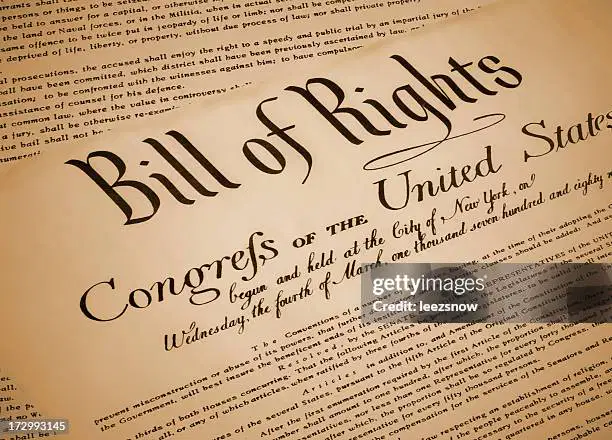
Which answer choice BEST explains why the Bill of Rights was added to the Constitution?
To stop the federal government from violating those rights in the future.
To enable each state to create their own Bill of Rights.
To list the rights of people who commit crimes.
To limit the federal government from raiding peoples' homes.
7


Arguments Over the Bill of Rights
• James Madison and other Federalists did not think a Bill of Rights was needed at all because-
• The Government only had the powers that the
Constitution gave it
• No list of rights could ever be complete
• Anti-Federalists wanted protection for the
rights they believed were fundamental
• Two different Points of View (POV) about
the same issue
• Imagine you are a delegate in the
congress, who would you support and why?

8
Multiple Select

If you were a delegate in congress, would you support adding a Bill of Rights?
YES!
NO WAY!
9
What other documents or evidence would you use to help you understand this event or topic?
What kind of language does the author use, such as words, phrases, and metaphors, and why?
What evidence does the author use to support their claims?
What information or arguments does the author omit, and why?
Who made this source?
When was it created?
Why did the author create it?
Who is the audience the author wanted to reach?
What is the author’s point of view?
What was happening at the time it was created?
What were the opinions or knowledge of the people at the time?
Is the information in the source reliable and trustworthy? Why or why not?
Steps for Analyzing Primary Source Documents
10


Federalist No. 10
• Written by James Madison it defends the
form of republican government as outlined by the Constitution
• Published on Nov. 22, 1787, under the name
Publius it targeted the people of New York City
to encourage them to ratify the Constitution.
• Remember that individual states had to
ratify the Constitution
• The country was still recovering from the
revolution and the process of setting-up a
new government
• Federalist No. 10 explains the reasons for a
democratic republic under the Constitution

11
12
Draw
From this section of Federalist 10, which line or lines stand out to you the most?
13
Multiple Choice
Madison suggests that the best way to handle the problem of factions is to remove the causes of them by either giving everyone the same opinion or by destroying the freedom for them to exist.
True
False
14
Multiple Choice
Madison thought that the best form of government to handle the problem of factions was:
direct democracy
autocracy
dictatorship
republic
15

Federalist No. 10 is considered one of the most significant of the 85 Federalist Papers because it explains the framers' reasoning for the creation of a democratic republic under the Constitution. Madison lays out the ways the Constitution solves the problem of factions and how it protects the rights of the minority against the majority.
16


Thomas Jefferson
(TJ) Letter to Uriah
Forrest
• TJ was serving as Ambassador to France at the time of this letter
• He was responding to Uriah's letter
• TJ was following the news from the
Constitutional Convention and at the
time of his letter only three states
had ratified it
• Jefferson was an Anti-Federalist and was concerned about the lack of a Bill of Rights

17
I will now tell you what I do not like.—First, the Omission of a bill of rights, providing clearly . . . for freedom of religion, freedom of the press, protection against standing armies, . . . the eternal and unremitting force of the habeas corpus laws [rights of accused people], and trials by jury in all matters of fact triable by the laws of the land . . .
It was hard to conclude because there has been a want [lack] of uniformity among the states as to the cases triable by jury, because some have been so incautious as to dispense with this mode of trial in certain cases, therefore the more prudent [cautious] states shall be reduced to the same level of calamity. It would have been much more just and wise to have concluded the other way, that as most of the states had preserved with jealousy this sacred palladium [important element] of liberty, those who had wandered should be brought back to it: and to have established general right rather than general wrong. . .
I have a right to nothing which another has a right to take away, and Congress will have a right to take away trials by jury in all civil cases. Let me add that a bill of rights is what the people are entitled to against every government on earth, general or particular; and what no just government should refuse, or rest on inferences.
18
Open Ended
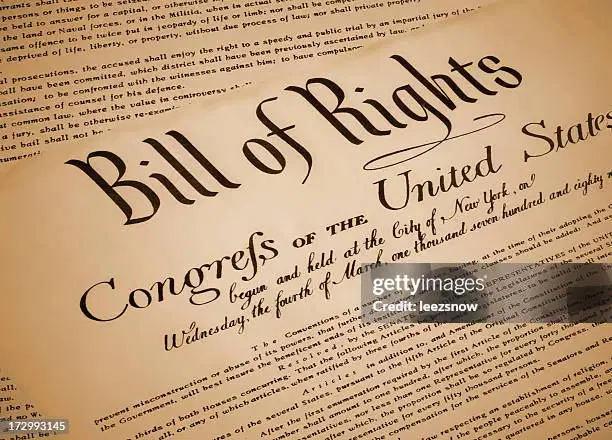
What rights does Jefferson think should be in the Bill of Rights?
19


The End of
Ratification
Approaches...
•By January of 1788 five states had ratified the Constitution
•Delaware, Pennsylvania, New Jersey, Georgia and
Connecticut fight to rat
•The fight to ratify was fought in the newspapers to sway public opinion
•John Hancock led the Anti-Federalist argument in Massachusetts
•He did try to find common ground with the Federalist POV
•Massachusetts Compromise- an Anti-Federalist agreement to
ratify the Constitution with added recommendations that the first federal Congress adopt a Bill of Rights
•James Madison introduced the 12 Amendments to the First
Congress in 1789, 10 of these would become the Bill of Rights
•December 15th, 1791, the Bill of Rights is approved by the states and becomes the first 10 Amendments to the Constitution

20
Multiple Choice

Why did some states follow Massachusetts's example and add conditions to their ratification of the Constitution?
They wanted the first Congress of the new government to add a Bill of Rights.
They wanted greater limits placed on the executive branch.
They wanted the judicial branch to have greater independence from the legislative branch.
21

Essential Question- How did the factions debate the ratification of the Constitution?
• The debate between Federalists and Anti-Federalists continued through the ratification process.
• In Federalist No. 10, Madison argued that factions were unavoidable, but a government formed as a democratic republic could limit the effect of factions. People who wanted to serve in government would be less influenced by factions because they would represent a large number of people, and the state government would address the issues of local concern.


22
Essential Question: Cont...
•Jefferson explained the Anti-Federalist viewpoint that a fair and just government must include a bill of rights protecting the rights of the people so that the government could not take away rights if it so chose.
•The Massachusetts Compromise paved the way for the adoption of the Constitution as additional states ratified the Constitution with the condition that the first Congress add a bill of rights.
•James Madison authored the Bill of Rights, which was added to the Constitution in 1791.
23

Tomorrow: Test Review
Thursday: Live Classroom
Friday: Unit 3 Test
Coming up this week:
The
Factions
Make
Their Case
Unit 3-6
Show answer
Auto Play
Slide 1 / 23
SLIDE
Similar Resources on Wayground

16 questions
Reagan Era & Conservative Politics
Presentation
•
11th - 12th Grade
18 questions
In-Text Citation (Direct Quote, Paraphrasing, Summarizing)
Presentation
•
12th Grade
18 questions
El amor 1. Thich y Eterno resplandor
Presentation
•
KG
19 questions
Causes and effects of the Great Depression
Presentation
•
12th Grade
21 questions
Unit 5 Vocabulary
Presentation
•
12th Grade
20 questions
Mixed Numbers
Presentation
•
4th - 5th Grade
16 questions
The Theory of Evolution
Presentation
•
8th Grade
17 questions
1-Quiz Review in K-Science
Presentation
•
KG
Popular Resources on Wayground
6 questions
Secondary Safety Quiz
Presentation
•
9th - 12th Grade
10 questions
MyPath Diagnostic Overview
Presentation
•
6th - 8th Grade
20 questions
Lab Safety Quiz

Quiz
•
6th Grade
21 questions
Continents and Oceans
Quiz
•
6th Grade
20 questions
Adding and Subtracting Decimals
Quiz
•
5th Grade
20 questions
Parts of Speech
Quiz
•
5th Grade
16 questions
Subject & Predicate
Quiz
•
5th Grade
21 questions
Lab Safety
Quiz
•
10th Grade
Discover more resources for Social Studies
28 questions
Govt. Unit 1 Exam Review
Quiz
•
12th Grade
14 questions
Fundamentals Test Review
Quiz
•
12th Grade
7 questions
Why study government

Interactive video
•
12th Grade
20 questions
WHG CFA 1 Absolutism
Quiz
•
9th - 12th Grade
39 questions
World History Unit 1 Summative Review
Quiz
•
9th - 12th Grade
21 questions
Economics: Unit 1 (23/24)
Quiz
•
12th Grade
53 questions
Economics basic concepts
Quiz
•
12th Grade
14 questions
Manifest Destiny to Texas Annexation 22-23
Quiz
•
9th - 12th Grade