
Daylight Hours and The Phases of the Moon

Presentation
•
Science
•
7th Grade
•
Practice Problem
•
Hard
+3
Standards-aligned

Jayden Campbell
Used 1+ times
FREE Resource
20 Slides • 0 Questions
1
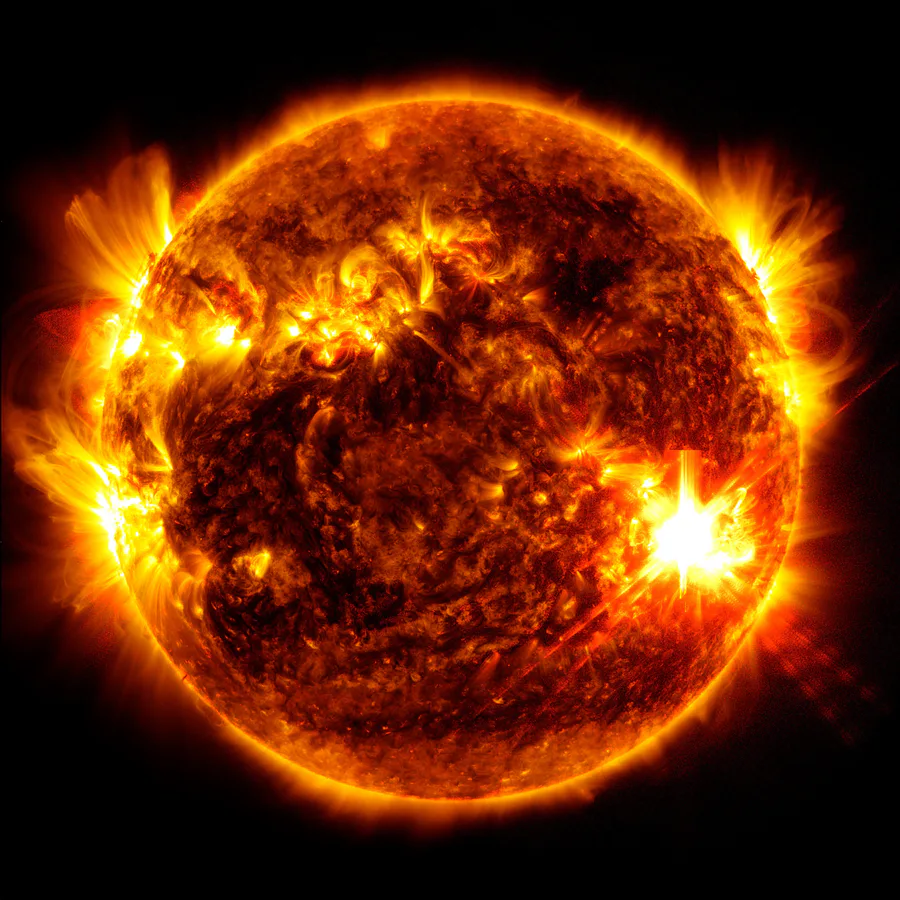
Daylight Hours
2
There are two main ways that the Earth's tilt causes differences in temperature in different seasons.
The Earth's tilt changes:
how directly the Sun's rays hit the Earth, and
how many hours of daylight there are.
3
Daylight Hours
Have you ever noticed that the Sun rises and sets at different times in summer and winter? The number of daylight hours you experience depends on the time of year and how far north or south of the Equator you are.
4

The location marked by a white dot in the diagram is on the Equator. As the Earth rotates on its axis each day, this location spends:
half of its time in sunlight, or daytime (shown in red)
half of its time in darkness, or night-time (shown in blue)
This means that days and nights are both 12 hours long.
On the Equator, days and nights are the same length throughout the year. But if you move further north or south, it's a different story!
5

Now imagine two locations that are equal distances north and south of the Equator. In the diagram, these points are labelled A and C.
When it's summer in the northern hemisphere, more of that hemisphere gets bathed in sunlight. So Location A spends more than half of its time in the sunlight as Earth rotates. This is shown in red. This means that daylight hours are longer in summer.
Location A spends less than half of its time in darkness each day. This is shown in blue. This means that nights are shorter in summer.
6
The Important bits...
Copy these into your Science books.
Effect of Earth's Tilt:
The Earth’s tilt causes changes in the length of day and night throughout the year.
At the Equator, days and nights are always equal (12 hours each).
7
The Important bits...
Copy these into your Science books.
Daylight Changes with Latitude:
As you move away from the Equator, the number of daylight hours changes with the seasons.
In summer, locations in one hemisphere get more daylight, while in winter, they get less.
At the Poles, there can be 24 hours of daylight in summer and 24 hours of darkness in winter.
8
The Important bits...
Copy these into your Science books.
Link to Seasons:
The variation in daylight hours influences seasonal temperatures: more daylight in summer leads to warmer temperatures.
9
Phases of the Moon
10
Getting to know the moon
For thousands of years, humans have gazed at the sky and wondered about the Moon. But have you ever wondered what it would be like to be on its surface?
In 2013, China sent an unmanned rover called Yutu to explore the Moon's surface. The images it captured allow you to imagine visiting the Moon for yourself!
11
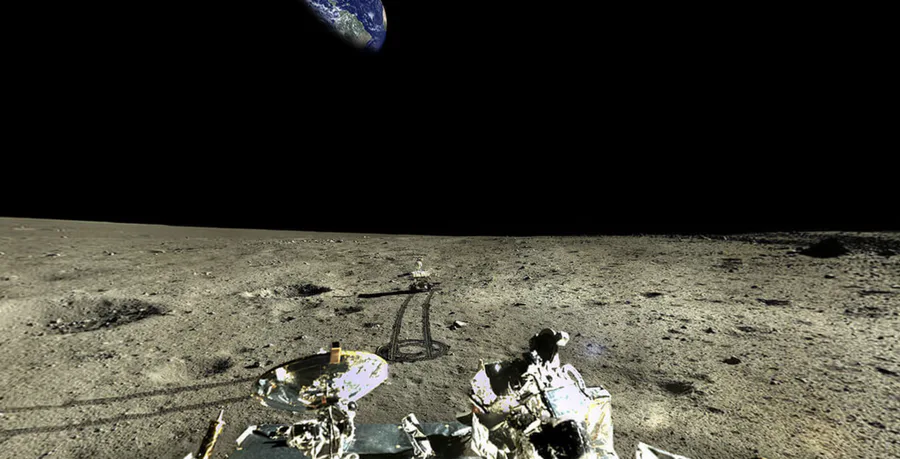
Image taken from the Rover in 2013
12
Observing the moon
Long before humans landed on the Moon, we were observing it from Earth. In 1609, the Italian scientist Galileo Galilei invented one of the first telescopes. At the time, most people thought the Moon was a smooth sphere. But using his telescope, Galileo discovered that the surface had craters, mountains and valleys.
New technologies and more powerful telescopes have continued to expand our knowledge of the Moon. The first photos of the far side of the Moon were taken in 1959 and astronauts landed on its surface in 1969.
13
The Phases of the moon
When you look up at the Moon, night after night, it appears to slowly change shape. Sometimes you'll see a full moon and sometimes only a thin sliver. There are times when you can't see the Moon at all. These different shapes of the Moon are called phases.
14
The Phases of the moon

Record these into your books
15
16
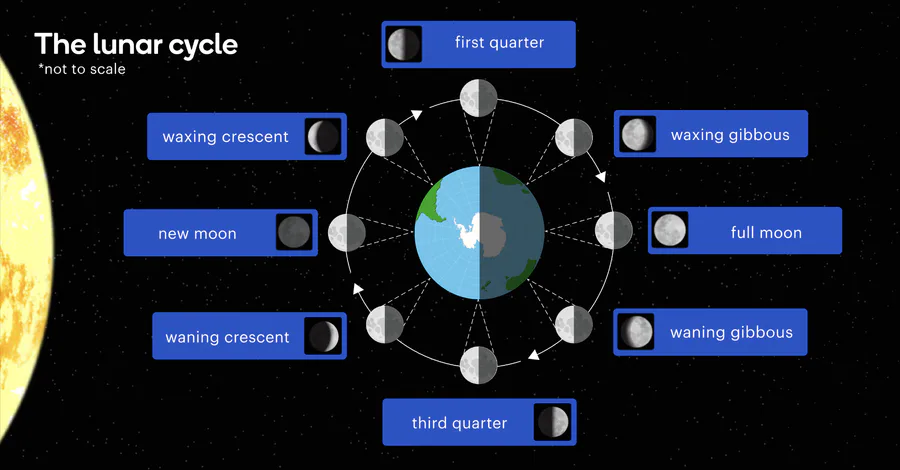
Draw the following diagram into your books
17
the important bits
write these summary notes into your books
Phases of the Moon:
The Moon goes through different phases as it orbits the Earth, taking 29.5 days to complete a cycle.
18
the important bits
write these summary notes into your books
Phases of the Moon:
The main phases are:
New Moon: Moon is between Earth and the Sun, and the side facing Earth is dark.
First Quarter: Half of the Moon is visible from Earth.
Full Moon: Earth is between the Moon and the Sun; the entire face of the Moon is lit.
Third Quarter: Again, half of the Moon is visible, but the opposite half compared to the First Quarter.
19
the important bits
write these summary notes into your books
Why Phases Occur:
The phases happen because as the Moon orbits Earth, we see different amounts of its sunlit side.
We always see the same side of the Moon because it rotates once for every orbit around Earth.
20
Now it is quiz time - check you undrstanding
Go to your dashboard and find the assigned quiz in relation to this lesson on Daylight hours and the Phases of the Moon.
Daylight Hours
Show answer
Auto Play
Slide 1 / 20
SLIDE
Similar Resources on Wayground

14 questions
Endangered Animals
Presentation
•
7th Grade
16 questions
Cell Organelles
Presentation
•
7th Grade
14 questions
Plate Tectonics
Presentation
•
7th Grade
17 questions
Genetics Review Part 2 (Practice)
Presentation
•
6th - 9th Grade
13 questions
evolution and natural selection
Presentation
•
7th Grade
13 questions
Domains and Kingdoms of Life
Presentation
•
7th Grade
13 questions
Mutations & the Environment
Presentation
•
7th Grade
15 questions
Vaccines
Presentation
•
7th Grade
Popular Resources on Wayground
10 questions
Fire Safety Quiz

Quiz
•
12th Grade
20 questions
Equivalent Fractions
Quiz
•
3rd Grade
20 questions
Main Idea and Details
Quiz
•
5th Grade
20 questions
Context Clues
Quiz
•
6th Grade
20 questions
Inferences
Quiz
•
4th Grade
36 questions
6th Grade Math STAAR Review
Quiz
•
6th Grade
19 questions
Classifying Quadrilaterals
Quiz
•
3rd Grade
12 questions
What makes Nebraska's government unique?
Quiz
•
4th - 5th Grade
Discover more resources for Science
19 questions
Introduction to Properties of Waves
Presentation
•
6th - 8th Grade
16 questions
Interactions within Ecosystems
Presentation
•
6th - 8th Grade
20 questions
genetics, punnett squares, heredity
Quiz
•
7th Grade
16 questions
Photosynthesis and Cellular Respiration Review
Quiz
•
7th Grade
20 questions
Abiotic & Biotic Factors
Quiz
•
7th Grade
20 questions
Asexual/Sexual Reproduction
Quiz
•
7th Grade
20 questions
Layers of the atmosphere
Quiz
•
7th Grade
15 questions
Artificial vs Natural Selection
Quiz
•
7th Grade