
- Resource Library
- Physical Education
- Movement And Motor Skills
- 5.3 Gross And Fine Motor Skills Development
5.3 Gross and Fine Motor Skills Development

Presentation
•
Arts
•
9th - 12th Grade
•
Practice Problem
•
Easy

Margeaux Cronce
Used 7+ times
FREE Resource
25 Slides • 13 Questions
1
Do Now:
1) Connect to Wayground
2) Answer in the chat: What was your favorite art material when you were a small child? (Examples: play-dough, clay, pencils, markers)
What we will focus on today:

Objectives:


2

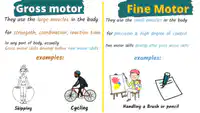
Fine vs. Gross Motor Skills
3
Word Cloud

What's one thing you use your hands for?
4

5

6
Poll

Which did you like to play with when you were a small child?
Puzzles
Legos/Blocks
Artwork/Crafts
7

8

9
Hotspot
Let's practice! Click on the hot spot if the activity is considered gross motor (large muscles).

11
Open Ended
Based on what you just learned about the difference between fine and gross motor skills, what tasks did you see the children in the video doing that were strengthening their fine and gross motor skills?
12
Multiple Choice

Before we go on, what's the difference between gross and fine motor skills again?
Gross has to do with large muscles and fine has to do with small muscles.
Fine has to do with large muscles and gross has to do with small muscles.
13
Fine vs. Gross Motor Developmental Milestones
14


15
16
Open Ended

What do you think is a task a 5-6 year should be expected to do with their hands?
17


18


19


20

21
Multiple Select
Which of the following are milestones a child should reach between the ages of 5 to 6?
play a sport
write paragraphs comfortably
compete in rock climbing
run, hop, skip, and jump
22
Fine vs. Gross Motor Delays
23


24

25
Categorize
Does not like to hold a crayon to color
Does not want to grasp or hold a bottle/sippy cup
Does not try to feed themselves w/little bits of cereal
Cannot catch or throw a ball a short distance
Has difficulty walking and trips often
Cannot physically sit alone with out physical support
Categorize which of the following activities may show a delay in fine motor skills or gross motor skills.
26

27
Treating Gross and Fine Motor Skills Delays
28
Once doctors can identify a developmental delay in a child, treatment will begin. Common treatment options for gross and fine motor delays include:
physical therapy;
occupational therapy; and
sensory-processing therapy

29
Once doctors can identify a developmental delay in a child, treatment will begin. Common treatment options for gross and fine motor delays include:
physical therapy;
occupational therapy; and
sensory-processing therapy

30
Once doctors can identify a developmental delay in a child, treatment will begin. Common treatment options for gross and fine motor delays include:
physical therapy;
occupational therapy; and
sensory-processing therapy

31
Multiple Choice
How are gross and fine motor skill delays treated?
through play and screen time
through physical therapy, occupational therapy, and sensory processing therapy
through trips to different classrooms throughout the school day
32
Word Cloud
What do you think a parent could do at home to help their child with fine motor development?
33
How Parents Can Help a Child Strengthen their Motor Skills
While children with diagnosed gross and fine motor delays will receive extra help from occupational therapists and physical therapists in school and outside of school, the good news is that there are many things that parents can do to help their children strengthen their skills at home as well. These strategies do not have to be formal or planned to make a huge difference in your child's development.

34

35
Multiple Choice
Question 1/3: What is the difference between gross motor skills and fine motor skills?
Gross motor skills focus on fine hand movement while fine motor skills focus on whole body movement.
Gross motor skills focus on whole-body movement while fine motor skills are smaller, controlled movements.
Fine motor skills are easier to develop than gross motor skills.
There is no difference between gross motor skills and fine motor skills.
36
Multiple Choice
Question 2/3: How does physical therapy help children with motor skill delays?
Children can participate in sensory play.
Children can improve balance and walking.
Children can improve their speaking skills.
Children can practice playing their favorite sport.
37
Multiple Select
Question 3/3: Which of the following are examples of activities that can help children with their gross motor skills? (There are two.)
coloring and painting
jumping on a trampoline
puzzles
spending time at a playground
38

See you next time!
If you have questions, you can stick around here or send me a message on Edio. :)
Do Now:
1) Connect to Wayground
2) Answer in the chat: What was your favorite art material when you were a small child? (Examples: play-dough, clay, pencils, markers)
What we will focus on today:
Objectives:
Show answer
Auto Play
Slide 1 / 38
SLIDE
Similar Resources on Wayground

33 questions
The Importance of MS Workforce (3 of 4)
Presentation
•
9th - 12th Grade
31 questions
UNIT 7 - GETTING STARTED
Presentation
•
KG
31 questions
Evolution terms part 1
Presentation
•
9th - 12th Grade
35 questions
Stock Market: Ticker Symbols, Brands and Companies
Presentation
•
9th - 12th Grade
32 questions
CS Principles Unit 1 Review
Presentation
•
9th - 12th Grade
30 questions
Escuchar & Repetir: Memes del futuro
Presentation
•
9th - 12th Grade
32 questions
Alg2 Lesson 3.5: A Field Guide to Polynomial Functions
Presentation
•
9th - 12th Grade
Popular Resources on Wayground
10 questions
How much do you know about our Portrait of an Eagle?

Quiz
•
10th Grade
10 questions
Fast Food Slogans
Quiz
•
6th - 8th Grade
21 questions
Continents and Oceans
Quiz
•
6th Grade
20 questions
Parts of Speech
Quiz
•
5th Grade
16 questions
Subject & Predicate
Quiz
•
5th Grade
25 questions
Multiplication Facts
Quiz
•
5th Grade
12 questions
Map Skills
Quiz
•
3rd Grade
22 questions
Continents and Oceans
Quiz
•
5th Grade
Discover more resources for Arts
10 questions
How much do you know about our Portrait of an Eagle?
Quiz
•
10th Grade
20 questions
Brand Labels
Quiz
•
5th - 12th Grade
20 questions
Characteristics of Life
Quiz
•
9th - 10th Grade
20 questions
REGULAR Present tense verbs
Quiz
•
8th - 9th Grade
20 questions
Graphing Inequalities on a Number Line
Quiz
•
6th - 9th Grade
10 questions
Translating Algebraic Expressions
Quiz
•
9th Grade
10 questions
Exploring the 4 Major Macromolecules and Their Functions

Interactive video
•
9th - 12th Grade
20 questions
Cell organelles and functions
Quiz
•
10th Grade